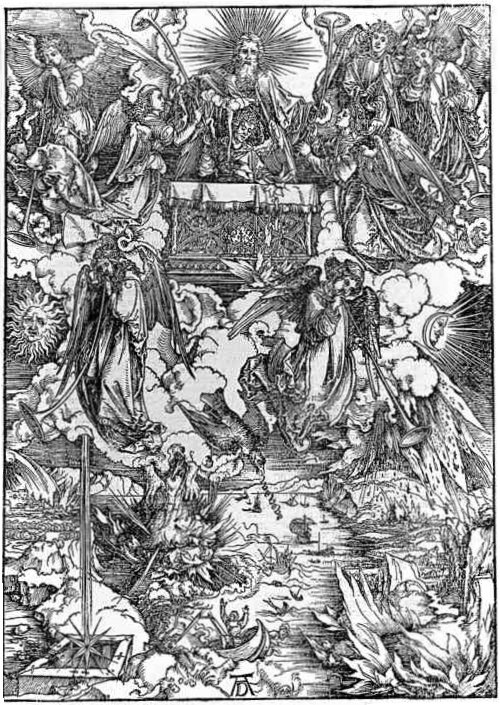
He opened
We must ever bear in mind that it is the Lamb who opens each of the seals initiating the judgments which befall the earth and its citizens. See commentary on Revelation 5:5 and Revelation 6:1.seventh seal
The seventh seal contains the seven trumpet judgments and the seventh trumpet contains the seven bowl judgments.1 The full effects of opening all seven seals include all seven trumpet judgments and the seven bowl judgments: 6 seal judgments + 6 trumpet judgments + 7 bowl judgments = 19 specific judgments in all. At the opening of the seventh seal, 6 judgments (the six seals) have passed and 13 remain (six trumpets and seven bowls within the seventh trumpet). See Literary Structure. “In the Jewish temple, musical instruments and singing resounded during the whole time of the offering of the sacrifices, which formed the first part of the service. But at the offering of incense, solemn silence was kept.”2 Zephaniah revealed that silence would attend the Day of the Lord in response to the solemn occasion where He will prepare a sacrifice and invite His guests (Zep. 1:7).3 The sacrifice will consist of the men who oppose God and the guests are the birds of heaven who will feast upon them (Rev. 19:17-18‣). This silence precedes the Day of the Lord in its narrow sense—the actual day when Christ returns and physically defeats the armies gathered against him. The Day of the Lord, in its broadest sense, is already in progress. See When Does the Day of the Lord Dawn?The implication is that when the judgment about to happen becomes visible as the seventh seal is broken and the scroll unrolled, both the redeemed and the angels are reduced to silence in anticipation of the grim reality of the destruction they see written on the scroll. The half an hour of silence is the calm before the storm. It is the silence of foreboding, of intense expectation, of awe at what God is about to do.4
Scripture reveals a pattern of silence associated with the recognition of God’s holiness and righteous judgment (Ps. 76:8-9; Hab. 2:20; Zep. 1:7; Zec. 2:13).5When Heaven falls silent for half an hour, when all the singing, glorifying, and praising ceases, there will be a deep sense of foreboding. The judgments, every righteous soul knows, must be formidable in the extreme, yet they will shudder in awe at the prospect of having to witness their administration.6
They are of particular rank and distinction, for not all angels are of the same dignity and office. Paul enumerates “dominions, principalities, and powers” [Col. 1:16] among the celestial orders. Daniel speaks of some chief princes [Dan. 10:13‣], Paul and Jude refer to archangels [1Th. 4:16; Jude 1:9]. Angelic beings are not, therefore, of one and the same grade. The sons of God, in general, come before him only at appointed times (Job 1:6) but the Saviour speaks of some angels who “do always behold the face of the Father which is in heaven” (Mat. 18:10).9
Some believe these angels are the seven spirits before God’s throne (Rev. 1:4‣; 3:1‣; 4:5‣; 5:6‣).10 But there is strong evidence for understanding the Seven Spirits as the various manifestations of the Holy Spirit rather than angels. See commentary on Revelation 1:4.who stand before God
When Gabriel visited Zecharias to announce the birth of John the Baptist, he said “I am Gabriel, who stands in the presence of God” (Luke 1:19). Apparently there is a group of especially powerful angels, of which Gabriel is a member, who have close access to God and stand before Him. Here we meet with another piece of evidence which argues that the twenty-four elders are not angels for they sit before God. See commentary on Revelation 4:4.These seven angelic trumpeters are elect and loyal servants of God with a position commensurate with their trust. They stand, permanently, in the presence of God Almighty; these are special angels, they are of Heaven’s elite (Rev. 8:2‣)! In eastern courts the most favored courtiers had the right to enter the king’s presence at all times; these angels are angels of the presence; their high rank is thus confirmed.11
to them were given seven trumpets
The trumpets were given to the angels by divine permission. The judgments which come forth once they are blown are initiated by God. See commentary on Revelation 6:2.These are the next set of seven judgments in the series of seals, trumpets, and bowls. As the judgments progress, they escalate in intensity. The trumpet judgments are more severe than the preceding seal judgments, but less severe than the bowl judgments to follow. For example, at the second trumpet, a third of the seas become blood (Rev. 8:8‣). At the second bowl judgment, the remaining two-thirds of the seas become blood as of a dead man (Rev. 16:3‣). At the sounding of the seventh trumpet, whose effects include the bowl judgments which follow, the announcement is made: “The kingdom of the world has become the kingdom of our Lord and of his Christ, and he will reign for ever and ever.” (Rev. 11:15‣). See Literary Structure.Zephaniah associated trumpets sounding an alarm with the Day of the Lord (Zep. 1:14-18). The seven trumpets, which ultimately lead to the fall of the great city Babylon (Rev. 18‣), are typified by the seven ram’s horns used to overthrow Jericho in the days of Joshua (Jos. 6:4-5). “It should be carefully noted, that the order of these first four trumpet-judgments is the same as that of the bowls of wrath in chapter 16. (1) Earth; (2) Sea; (3) Rivers and fountains of waters; (4) The Sun.”12 The trumpet judgments are divided into two groups: the first four which affect the natural systems (Rev. 8:7-12‣) and the last three which affect men (Rev. 9:1‣, 13‣; 11:15‣).In contradistinction to the last three trumpets, the first four afflict natural objects, i.e., earth, trees, grass, rivers, and the like. The fifth and sixth have men as their special objects, and unlike the first four which are connected and interdependent, are separate and independent. In contrast to these two, the first four have only an indirect effect on mankind. Besides these differences, the voice of the eagle in Rev. 8:13‣ separates the trumpets into two groups (Alford, Swete, Beckwith, Sweet).13
Because of his priestly work, some identify him as the Lord Jesus Christ. That identification is unlikely, however, for several reasons. First, Christ is already identified in the heavenly scene as the Lamb (Rev. 5:6‣; 6:1‣; 7:17‣), distinguishing Him from this angel. Second, while the pre-incarnate Christ appeared as the Angel of the Lord in the Old Testament, Jesus is nowhere identified as an angel in the New Testament. Third, the reference in verse 2‣ [Rev. 8:2‣] to the seven actual angels defines the meaning of the term in this context. The angel in verse 3‣ [Rev. 8:3‣] is described as another (allos; another of the same kind; cf. Rev. 7:2‣) angel like those in verse 2‣ [Rev. 8:2‣]. Finally, everywhere He appears in Revelation, Jesus is clearly identified.15
Here the angel acts merely as a ministering spirit (Heb. 1:4), just as the twenty-four elders have vials full of odors, or incense, which are the prayers of saints (Rev. 5:8‣), and which they present before the Lamb.16
incense . . . offer it with the prayers of the saints
On the day of atonement, Aaron was instructed to take a censer full of burning coals of fire from the altar and put the incense on the fire which would form a cloud which would cover the mercy seat—where the Lord’s presence was. This cloud served as a protective separation from God’s presence “lest he die” (Lev. 16:12-13). The cloud shielded Aaron from the presence of God. Elsewhere, when a plague had broken out among the people, Aaron was instructed to take a censer with fire and incense among the congregation to make atonement for them. Just like the prayers of the saints, this act of Aaron’s was described as intercession (Num. 16:46-48). In the Millennial Kingdom, incense will be offered to God worldwide (Mal. 1:11). Previously, the twenty-four elders (and possibly the living creatures) were said to hold “golden bowls of incense, which are the prayers of the saints” (Rev. 5:8‣). See commentary on Revelation 5:8. The prayers of the saints are intercessory and also include petitions for justice, such as those of the martyrs under the altar at the fifth seal (Rev. 6:10‣).These are undoubtedly the cries of believers in the Great Tribulation against their persecutors and all who blaspheme God and Christ in that time. Their prayers, affirmed by the heavenly incense which God has provided, show that He is in agreement with the cries of the saints as they come into His presence, from which the seven trumpet judgments will be released. There is a sense of anticipation as these prayers rise before God. They will shortly be answered; God’s wrath and His people’s prayers are connected.17
upon the golden altar
The writer of Hebrews informs us that the earthly tabernacle was but a model of a greater reality in heaven (Heb. 9:11, 24). There were two altars in the plan of the tabernacle, a larger altar of burnt offering (sacrifice) outside the holy place and a smaller altar of incense within the holy place (Lev. 4:7). It is upon the altar of incense in the heavenly temple that the prayers are offered (Ex. 30:1; Luke 1:11). smoke of the incense, with the prayers of the saints ascended
The psalm writer recognized that the prayers of the saints served a similar purpose as incense burnt before the Lord (Ps. 141:2)—an aroma pleasing to God. The picture of prayer ascending to God is also seen when Hezekiah reinstated the Passover. Even though they were unable to observe the Passover in strict accordance with God’s instructions, God was pleased with their prayers because of the pure motivation of their hearts. “Then the priests, the Levites, arose and blessed the people, and their voice was heard, and their prayer came up to His holy dwelling place to heaven” (2Chr. 30:27). When Cornelius prayed to God and an angel was sent to instruct him to fetch Peter to hear the gospel, it was said, “Your prayers and your alms have come up for a memorial before God” (Acts 10:4). filled it with fire from the altar
The fire speaks of judgment (Mat. 3:11-12; Luke 12:49), just as when the man in Ezekiel’s vision scattered coals of fire over Jerusalem (Eze. 10:2).The act of the angel with the censer prefigures the angels with the seven bowls of God’s wrath (Rev. 16:1‣, 3‣, 4‣, 8‣, 10‣, 12‣, 17‣). Here, there is an explicit connection between the petitions of the saints and the resulting judgment, whereas the bowls contain God’s own wrath.18“All this occurs in answer to the prayers of the saints. There are those who think meanly of prayer, and are always asking: ‘What profit should we have if we pray unto the Almighty?’ (Job 21:15.) The true answer is, ‘much every way.’
There is an eye that never sleeps
Beneath the wing of night;
There is an ear that never shuts
When sink the beams of light.
There is an arm that never tires
When human strength gives way;
There is a love that never fails
When earthly loves decay.
That eye is fixed on seraph throngs;
That arm upholds the sky;
That ear is filled with angel songs;
That love is throned on high.
But there’s a power which man can wield,
When mortal aid is vain,
That eye, that ear, that love to reach,
That listening ear to gain.
That power is PRAYER, which soars on high,
Through Jesus, to the throne;
And moves the hand which moves the world,
To bring salvation down!”19
there were noises, thunderings, lightnings, and an earthquake
Noises is φωναὶ [phōnai] which can also be translated as “voices” (ASV, KJV, YLT). It is translated as “noises” in Revelation 8:5‣ and by “sound” in Revelation 9:9‣. The noises (or “voices”), thunderings, lightnings and earthquake are all indicators of judgment. There is a direct cause-and-effect relationship between the prayers of the saints which were mingled in the censer before its contents were thrown to the earth and these indicators of impending judgment. See commentary on Revelation 4:5. “These terms compose a FORMULA OF CATASTROPHE; and the fourfold character here denotes universality of the catastrophe in respect to the thing affected.”20 See Four: the Entire World, the Earth. prepared themselves to sound
The sounding of the angels will be in response to the prayers of the saints which were offered with incense before the throne. Since the judgments are now to be of a greater severity than the previous six seals, great solemnity attends the moment.The Old and New Testaments use the trumpet as the symbol of God’s intervention in history (e.g., Ex. 19:16, 19; Isa. 27:13; Joel 2:1; Zep. 1:16; Zec. 9:14; Mat. 24:31; 1Cor. 15:52-53; 1Th. 4:16). A trumpet blast can mean one of three things in Scripture: first, an alarm; second, a fanfare to announce royalty; third, a summons to battle—the latter is appropriate in this context.21
No doubt, these angels had been waiting for this particular ministry for a long time. As “ministering spirits, sent forth to minister for them who shall be heirs of salvation” (Hebrews 1:14), all of Christ’s mighty angels (2 Thessalonians 1:7) are intensely occupied with the progress of His work of salvation on earth, “which things the angels desire to look into” (1 Peter 1:12). The seven “presence angels” were surely the most concerned of all, and they were fully prepared.22
We are aware that a majority of interpreters maintain that the results of this first Trumpet are not literal. They seem as anxious to get rid of the miraculous and the supernatural from Interpretation, as the Rationalists are to eliminate it from Inspiration. But why, unless the plagues of Egypt also were not literal plagues, we cannot understand, Again we ask, Why should not these be literal judgments which are to come upon the earth? What is the difficulty? . . . To explain this away is to manifest a want of faith in the power of God, and in the Word of God. Such things have taken place on earth. Why should they not take place again?23
We note the similarity between the judgments found here and the physical, literal judgments which God poured out upon Egypt. Indeed, Isaiah indicates that literal events future to his day would rival those of the Egyptian Exodus:The LORD will utterly destroy the tongue of the Sea of Egypt; with His mighty wind He will shake His fist over the River, and strike it in the seven streams, and make men cross over dry-shod. There will be a highway for the remnant of His people who will be left from Assyria, as it was for Israel in the day that he came up from the land of Egypt. (Isa. 11:15-16)
In the seventh plague which God sent upon the Egyptians on behalf of Israel, God sent “hail, and fire mingled with the hail, so very heavy that there was none like it in all the land of Egypt since it became a nation.” This judgment was sent “on man, on beast, and on every herb of the field” [emphasis added] (Ex. 9:22-23). Significantly, in the sounding of this angel, the same mix of fire and hail destroys a third of the trees and all the green grass. This includes grain being grown for food (see below).Hail which is sent by God in judgment is often of a great size inflicting severe damage (Jos. 10:11; Eze. 13:11; Hag. 2:17; Rev. 16:21‣). In the seventh bowl judgment, the hail weighs one talent (Rev. 16:21‣)—ranging between 75 to 88 pounds.24 The hail is drawn from God’s “treasury of hail . . . reserved for the day of battle and war” (Job 38:22). Under the Law of Moses, the penalty for blasphemy and idolatry was stoning (Lev. 24:14-16; Deu. 13:6-10; 17:2-5). During the Tribulation period, the earth dwellers continue in blasphemy and idolatry. Perhaps this explains why God stones them with large hailstones (Rev. 16:21‣).The language is evidently drawn from the plagues of Egypt, five or six out of the ten exactly corresponding: the hail, the fire (Ex. 9:24), the water turned to blood (Ex. 7:19), the darkness (Ex. 10:21), the locusts (Ex. 10:12), and perhaps the death (Rev. 9:18‣). Judicial retribution in kind characterizes the inflictions of the first four, those elements which had been abused punishing their abusers.25
Hailstorms are normally isolated, yet this will be a hailstorm that will blanket and devastate an area larger than the entire North and South American continents (together they represent 28% of earth’s land surface). What a fearful storm that will be. This will be the first stroke of God’s scourge, a thunderstorm, or series of thunderstorms, which has no precedent, or anything even mildly approaching it in violence in man’s history since the flood.26
See The Plagues of Egypt and the Tribulation.fire
Fire generally speaks of judgment. When John the Baptist spoke to the Pharisees and Sadducees who came to his baptism, he called them a “Brood of vipers!” and warned them of impending judgment. He spoke of a Coming One who was greater than he who would baptize with the Holy Spirit and fire. Those who repented and turned to God, after the Day of Pentecost, were baptized by Jesus with the Holy Spirit and joined to the Body of Christ (1Cor. 12:13). Those who rejected God would eventually be baptized with fire (Mat. 13:41-42). In the context of this baptism, John presented two alternative categories which encompass all men: wheat and chaff: “His winnowing fan is in His hand, and He will thoroughly clean out His threshing floor, and gather His wheat into the barn; but He will burn up the chaff with unquenchable fire” [emphasis added] (Mat. 3:12). Here, the earth dwellers get their first taste of God’s judging fire which ultimately culminates in the Lake of Fire (Rev. 19:20‣; 20:14-15‣).mingled with blood
Mingled is μεμιγμένα [memigmena], perfect tense: having been mingled. “The perfect tense indicates an inseparable mix.”27 As in the Egyptian judgments, blood is included in the concoction thrown to the earth. Joel predicted this day: “And I will show wonders in the heavens and in the earth: blood and fire and pillars of smoke” (Joel 2:30). All three of these elements are present in this event as the blood is mingled with the hail and the fire causes the green grass and trees to burn generating huge plumes (pillars) of smoke.28thrown to the earth
This is the first judgment specifically targeted at the destruction of life-supporting natural systems on the planet. Even now, those who reject God worship the creature rather than the Creator (Rom. 1:25). At the time of the end, God will set about destroying this idol of the earth dwellers.People today are very concerned about saving the environment. Fears about the depletion of the ozone layer, pollution, the destruction of the rain forests, and global warming are constantly in the news. There is a passionate concern to save endangered species, everything from whales to spotted owls to California condors, and a host of lesser-known species. For many, protecting the environment has become far more than a concern for health and safety; it has become an issue of idolatry, as they worship “Mother Nature” by trying to protect and perpetuate the earth. . . . Fallen mankind has failed to recognize and honor God as Creator, choosing instead to make a god out of the earth. But the environmental, evolutionary pantheism that devalues man, elevates animals and plants, and ignores the Creator will be severely judged. “Earth Day” that year will be a gloomy and dismal affair; in a scorched and ravaged world there will be little of the environment left to celebrate.29
These are the judgments which the 144,000 Israelites were sealed for protection from. See commentary on Revelation 7:1.a third
In each of the trumpet judgments which result in death, a third of the population receiving the judgment perishes. A third of the trees is burned up here, a third of the earth is burned up (Rev. 8:7‣, MT and NU text), a third of the sea becomes blood (Rev. 8:8‣), a third of the sea creatures and ships are destroyed (Rev. 8:9‣), a third of the rivers is polluted (Rev. 8:10-11‣), a third of the sunlight, moonlight, and starlight is affected (Rev. 8:12‣), and a third of mankind is killed (Rev. 9:15‣, 18‣).trees were burned up
This judgment is literal, just as was the similar judgment of Egypt, as recounted by the psalmist: “He turned their rain into hail, with lightning throughout their land; he struck down their vines and fig trees and shattered the trees of their country” (Ps. 105:32-33). This would include fruit-bearing trees contributing to conditions of famine. See The Plagues of Egypt and the Tribulation. “The third seal (Rev. 6:5-6‣) prophesied a severe famine during which food will be horrendously expensive. Compounding this already severe food shortage will be the destruction of one-third of the earth’s foliage, a destruction wreaked by hail and fire mixed with blood (Rev. 8:7‣).”30The natural disasters which attend these judgments are a problem for those whose interpretive system requires a previous “fulfillment” in history. Preterist interpreters attempt to identify this judgment with Roman military tactics during the fall of Jerusalem:Chilton tries to find a literal fulfillment of Revelation 8:7‣ during the siege of Jerusalem in A.D. 70. He says, “Literally, the vegetation of Judea, and especially of Jerusalem, would be destroyed in the Roman scorched-earth methods of warfare.” He then quotes a passage from Wars 6:6-8 describing the desolation of Jerusalem and the surrounding countryside caused by war. What Chilton does not say is why the Romans cut down the trees. . . . The Romans cut down the wood in order to build earthworks for the siege of Jerusalem. They didn’t burn as part of a “scorched earth” policy. The actual cutting of the trees stands in marked contrast with the description of the first trumpet judgment.31
all green grass
Green is χλωρὸς [chlōros], the same word which describes the color (pale) of the horse attending the fourth seal (Rev. 6:8‣). Grass is χόρτος [chortos] which can describe “stalks of grain in their early, grass-like stages Mat. 13:26; Mark 4:28.”32 Thus, this judgment may bring not just environmental destruction, but destroy grain production and contribute to the conditions of famine already initiated by the fourth seal.Joel, in speaking of the locust-induced famine of his day, also speaks of the eschatological Day of the Lord:Alas for the day! For the day of the LORD is at hand; it shall come as destruction from the Almighty. Is not the food cut off before our eyes, joy and gladness from the house of our God? The seed shrivels under the clods, storehouses are in shambles; barns are broken down, for the grain has withered. How the animals groan! The herds of cattle are restless, because they have no pasture; even the flocks of sheep suffer punishment. O LORD, to You I cry out; For fire has devoured the open pastures, and a flame has burned all the trees of the field. The beasts of the field also cry out to You, for the water brooks are dried up, and fire has devoured the open pastures. (Joel 1:15-20) [emphasis added]
Those who take trees and grass here in a symbolic way encounter a logical inconsistency. If trees represent authorities or governmental powers and grass is generally understood as representing the human race (1Pe. 1:24), then we have the situation where all green grass (humanity) is destroyed, but only one-third of the trees (authorities). “Symbolic interpretation leads to a hopeless quagmire of contradictions. For instance, the earth, grass, and trees are symbols of nations and men in the first trumpet (Rev. 8:7‣), but in trumpets 3, 5, and 6 these objects of nature appears side-by-side with men (Rev. 8:11‣; 9:4‣, 15‣).”33 Purely symbolic interpretations render a wide variety of results here which are typically subjected to great elasticity in order to avoid such contradiction. For example, the green grass is taken as Israel rather than mankind.34 It is much simpler to see these as literal, physical catastrophes which are completely in keeping with the predictions of the character of the Day of the Lord in the OT.The variation in interpretation among those who take these items symbolically is strong evidence against such an understanding:Elliott says that this first Trumpet denotes the wars of Alaric the Goth and Rhadagaisus the Vandal against the Western Roman Empire. We should never have guessed this ourselves. There is nothing about this or even like it in this Scripture. . . . One says “trees” mean princes and great men; and “grass” means men’s power and glory (Wordsworth). J. N. Darby says “that which is elevated, eminent, lofty is intended by the trees; the young, feeble and aged are meant by the green grass.” Wetstein says “Trees mean fortified cities; grass unwalled villages.” Others say “by trees are signified apostles and great doctors; by grass, common Christians” (Paralus). Alford holds that “it appears rather to indicate a general character of the judgments, than to require any special interpretation in each particular case.” To all this we have one simple remark to make—We prefer to believe God’s own special interpretation of His own judgments, in the plain literal sense of the words.35
To some, the sea is pure doctrine; the mountain, aspiring prelates; the fire, their ambition; the discoloration of the waters, the introduction of false doctrine; the fishes, the lower orders of ecclesiastics and monks; the ships, the bearers of the Gospel. To others, the mountain is Rome; its burning, the conflagration of that city by Alaric; the destruction of the ships, the plunder of its wealth. Still others see in the record, a symbol of the ravages by Attila. And I only wonder that no one has discovered that it denotes the settlement of the Mormons in Salt Lake Territory! The simple truth is, that if it does not mean what it says, as men ordinarily use language, no man can tell what it does mean; and the opinion of one is just as good, and just as bad, as that of another.36
A short sample of the varied meanings derived by various symbolic interpreters underscores the subjective nature of the entire approach:37| Symbol | Assigned Meaning |
| Satan; a great heresy; Vespasian; prelacy;38 Rome; a system of power; the Messianic Kingdom (Dan. 2‣); the Jewish state; Babylon; Zion; a heathen nation. | |
| The nations; the church’s baptismal waters; sea of Galilee; pure doctrine; confusion and anarchy; the non-Roman world. | |
| Corruption of deadly error; introduction of false doctrine; spiritual death and apostasy. | |
| Destruction of souls; Jews; Ecclesiastics (monks); people. | |
| Congregations; churches; cities of Palestine; bearers of the gospel; sack of Rome; commerce and means of communication; little states at the time of the Roman empire. | |
| Men in the haughtiness of pride and position; the elect remnant. | |
| The people of Israel; the elect remnant. | |
| Mohammed; Simon Magus; Montanus; Arius; Cerinthus; Pelagius; Eleazar; Josephus; Genseric; Attila; Menander; Manes; Novatus; Origen. | |
| Cities of Galilee and the people of the Jews; the Jewish temple, Jerusalem, and its population; the Bible, its doctrine, and the ministers of the Church; the decay of imperial government from Valens to the fall of Augustus, false doctrines and corrupt manners of the patriarchs and bishops; the great prevalence of errors, defections, apostasies, and confusions in Christendom; the subversion of the Western imperial government and its dependencies. |
The first four trumpets all deal directly with the earth. They do not symbolize political, social, or economic judgment; those types of judgment come later in Revelation. Nor do they describe any judgment that has ever happened in history in some locale or region. The trumpet judgments are actual, literal, physical events that will affect the whole earth.39
Some understand the destruction of all the green grass here, but subsequent reference to grass (Rev. 9:4‣) as license to jettison normative interpretation in recognition of the apocalyptic literary genre:To worry about the prohibition in Rev. 9:4‣ against harming the grass, when in Rev. 8:7‣ the green grass was already burned up, or about the question of how a great star could fall from heaven in Rev. 8:10‣ when the stars had already fallen in Rev. 6:12‣, is to misunderstand the literary genre in which the Apocalypse is written. . . . We are dealing here with a montage of divine judgments upon a recalcitrant world.40
These supposed logical inconsistencies are easily explained. During the opening of the sixth seal, stars fall to the earth. As we discuss in our commentary on Revelation 6:13, this does not mean that every stellar “sun” in the universe made its way to the surface of our planet! More likely, it describes a meteor shower or asteroids since human life still remains after the impact (Rev. 6:15-17‣) along with the sun and the moon (Rev. 8:12‣). Thus, there remains plenty of cosmic material to supply the needs of the star which falls here (Rev. 8:10‣). Concerning the grass, one wonders if such authors have ever read anything concerning the beneficial effects of fire upon rangelands? The complete burning of the grass (Rev. 8:7‣) and its reappearance later (Rev. 9:4‣) is easily explained by recognizing that the initial destruction burned the stalks of grass, but left the root system intact underground. Some time later, the grass sprouts up once again. “In most parts of the earth grass is not green the year round, but is seasonal. Burning of all the grass that is green during a particular season would leave the remainder untouched until its season of dormancy is over (Simcox).”41 something like a great mountain burning with fire was thrown into the sea
The text is careful to differentiate between a great mountain and something like a great mountain (ὡς ὄρος μέγα [hōs oros mega]). The object itself is evidently not a mountain, nor is it said to erupt or spew into the ocean—as we might expect from a great volcanic disturbance. Instead, it is thrown into the sea by some agent, possibly an angel, although the text does not say. This could describe the impact of a large meteor burning upon entry to the earth’s atmosphere from outer space,42 or it could be something entirely supernatural.Jeremiah referred to Babylon as a “destroying mountain” which God would make as a “burnt mountain” (Jer. 51:25). Here it seems that God uses a destroying mountain in judgments which will ultimately overthrow Babylon (Rev. 17‣, 18‣).a third of the sea became blood
In the first plague which God brought upon Egypt where Aaron stretched forth his rod, all the waters of Egypt became blood (Ex. 7:19; Ps. 78:44). Here, as in Egypt, a literal judgment is in view because the result affects living creatures and ships ((Ps. 105:29 cf. Rev. 8:9‣). Later, in the pouring of the second bowl, all of the sea will become “blood as of a dead man” (Rev. 16:3‣). Like Moses, God’s two witnesses will also have the power to turn water into blood (Rev. 11:6‣).In the third bowl judgment, the remainder of the rivers and springs of water which were not poisoned in the judgments of the third trumpet also become blood (Rev. 16:4‣). Later, it will be said of the Harlot that she is “drunk with the blood of the saints and with the blood of the martyrs of Jesus” (Rev. 17:6‣). During the Tribulation, God gives her literal blood to drink.The destruction of the sea will cause tremendous upheaval to the food chain which supports all life on the planet. The divine hand is systematically removing every means by which man can continue to imagine himself as independent of the one true God.The price of sin will include the pangs of hunger, for not only will God ensure that the world’s food supply is depleted, but He will also ensure that its meager reserves will not be bolstered, and then ensure that man’s alternate food source, the sea, will be drastically depleted.43
God created the sea to be a blessing to mankind, to provide food, oxygen (much of Earth’s oxygen comes from the phytoplankton and algae in the world’s oceans), and water from the rainstorms on the land that is originally gathered up by evaporation from the oceans. But people have repaid God’s gracious provision with ingratitude and idolatry, revering the sea as the supposed source of their remotest evolutionary ancestors. As He had devastated the land environment, the true God judges the sea.44
In the plague of Egypt, the water turned into literal blood so it would seem a similar miraculous judgment occurs here, although it is also possible that “blood” may simply denote “death” which results from the polluted waters:The word translated “blood” can mean “death” and this provides a ready explanation for this passage. The prophecy may mean that the chemical composition of the waters will be so altered by the meteorite, or whatever it is that God will plunge into the ocean, that the marine life in the effected area will be killed and even metal vessels will be destroyed or ruined. As the text does not say the sea became “like” blood but that it “became” blood, and, as the same word is used in Rev. 16:6‣, this should not be taken as only describing the color of the oceans, but must be understood either literally, or with its secondary meaning of “death.”45
See The Plagues of Egypt and the Tribulation. living creatures in the sea died . . . ships were destroyed
Literally, the creatures in the sea, the ones having life. Life is ψυχὰς [psychas], which has many different shades of meaning, but here describes “life on earth in its external, physical aspects. (breath of) life, life-principle, soul, of animals.”46 The sea is to be taken literally because both living creatures and ships are destroyed—neither of which have biblical precedence if the sea is taken as a symbol representing the Gentile nations. See commentary on Revelation 7:1. When Isaiah prophesied of this time, he mentioned that ships would be among those things which God destroyed as He brought down man’s pride (Isa. 2:16).The impact will also generate unimaginably huge tsunamis (tidal waves). Those giant waves will destroy a third of the ships on the world’s oceans, capsizing huge ocean-going vessels and completely swamping ports. The resulting disruption of commerce and transportation will cause economic chaos.47
This “great star” evidently symbolizes a distinguished ruler responsible as set in the moral firmament to give light in the dark night of the world’s history, but he is an apostate personage—one under the immediate judgment of God, “burning as a torch”; in this respect like the “great mountain burning with fire.” The epithet “great” is attached to the mountain, and also to the star; only in the former a corporate power or system is referred to, whereas in the latter an exalted individual is meant.49
This view finds support by those who understand the star, already fallen, in Revelation 9:1‣ to be this very star. Since the star there is clearly a spiritual being who unlocks the bottomless pit, then perhaps his fall is recorded here. Although there are many parallels between this verse and the fall of Satan (Isa. 14:12; Luke 10:18; Rev. 9:1‣; 12:4‣), the context appears to be describing a cosmological event involving a large physical object. This star is said to be burning and appears to rain down upon a wide area of the globe causing the waters to become polluted. These characteristics speak more readily of natural phenomena than a malevolent spiritual being.As we discussed concerning the interpretation of symbols, once the choice is made to take physical descriptions as being symbolic, there is no end to the conjecture which attends the interpretation of what God is attempting to convey. Again, we ask the question: If God had wanted to describe a time of extreme physical catastrophe, how would He have done so differently than what we have before us? A second question presents itself: How could God tell us about future physical convulsions if we forever insist on taking the text as some form of veiled apocalyptic political intrigue? See The Genre of the book of Revelation.burning like a torch
Torch is λαμπὰς [lampas], which was used in ancient times to describe meteors and comets.50springs of water
Springs is πηγὰς [pēgas] which is elsewhere translated as fountain (Mark 5:29; Jas. 3:11; Rev. 7:17‣; Rev. 21:6‣) and well (John 4:6; 2Pe. 2:17). The emphasis is on water as a life-giving source. When men must exist without food or drink, it is lack of water which first leads to death. There is an intentional contrast between the experience of the earth dwellers who are dependent upon these water supplies and those in the previous chapter coming out of the Great Tribulation who are led by the Lamb to living fountains (πηγὰς [pēgas]) of waters. Though it is God who made these springs of water to maintain physical life (Rev. 14:7‣), He now destroys them to demonstrate the dependence of all life upon Him. God is systematically setting about to remove all the props which allow the earth dwellers to imagine there is no God. [In the Old Testament] it is suggested that it is a poison derived from a root of some kind (Deuteronomy 29:18), that it is very bitter (Proverbs 5:4), and that it produces drunkenness (Lamentations 3:15) and eventual death. It is associated with another poison known as “gall” (Deuteronomy 29:18; Lamentations 3:19). This substance was used to produce a stupefying drink for Christ on the cross (Psalm 69:21; Matthew 27:34) which, however, He refused to drink.54
Significantly, God describes idolatry as “a root bearing bitterness of wormwood” (Deu. 29:18). Idolatry is a prevalent sin of the earth dwellers during this time of judgment (Rev. 9:20‣; Rev. 13:15-16‣). So God judges their bitterness of wormwood by giving them wormwood to drink. This is the same judgment which God gave Israel when she rejected Him and pursued false Gods (Jer. 8:14; 9:14-16; 23:15). Wormwood also describes the fruit of unrighteousness, which will be a prevalent characteristic of the Tribulation period (Amos 5:7; 6:12 cf. 2Ti. 3:2-4).At the bitter waters of Marah, Moses cast a tree into the waters and made them sweet (Ex. 15:25). This pictured Messiah’s work on the cross which provided living water (John 7:38-39). Here, we have wormwood which turns the earth dwellers’ water bitter. Since they would not avail themselves of the cross of Christ—today’s “tree of life”—to obtain the living waters of Jesus (John 4:10), God gives them wormwood instead and poisonous waters which bring death rather than life. Like Moses, one of Elisha’s miracles healed bitter waters and made them sweet (2K. 2:19-22).many men died
The explicit identification of men—separately from the trees, grass, sea, ships, and living creatures in the sea—is another evidence of the need to interpret these judgments literally. If the latter represent various organizations and systems of man, why are men specifically singled out here? Many men die from drinking the poisoned waters, but many more will also die due to lack of water from the loss of one-third of the earth’s aquifer.it was made bitter
It was made bitter is ἐπικράνθησαν [epikranthēsan]. The same word describes the effect upon John’s stomach of the book of prophecy which he is given to eat (Rev. 10:7‣). Here, the bitterness is so severe as to cause death. The wormwood is essentially poisonous. the sun, . . . the moon, . . . the stars
Isaiah prophesied the darkening of all three of these sources of light during the Day of the LORD:Behold, the day of the Lord comes, cruel, with both wrath and fierce anger, to lay the land desolate; and He will destroy its sinners from it. For the stars of heaven and their constellations will not give their light; the sun will be darkened in its going forth, and the moon will not cause its light to shine. (Isa. 13:9-10) [emphasis added]
In Joel’s vision of the Day of the Lord, the darkening of these same heavenly bodies attends the advance of His army (Joel 2:10-11), which are probably the demonic forces unleashed in the next chapter. The darkening of the sun, moon, and stars will be relatively frequent during the various judgments of this terrible period (Joel 3:15).darkened
The sun became “black as sackcloth” as a result of the sixth seal judgment (Rev. 6:12‣). During the plagues of Egypt God brought complete darkness during the day (Ex. 10:21-23), but only a partial darkening is described here. The darkening of the sun, moon, and stars at this juncture is most likely due to cloud cover—either by smoke or other physical disturbances (Isa. 5:30; Eze. 32:6; Zep. 1:14-15; Rev. 9:2‣). As in Genesis, the language may reflect the perspective of the earth dweller so that cloud or dust could obscure these cosmic bodies. Others assume the sun, moon, and stars themselves are directly affected: “Somehow, the visible luminaries in the heavens for a time, maybe a day, maybe several days, slow down their internal reactions in such a way as to reduce their power by a factor of one-third. The day and night, as a result are only two-thirds as bright as normal, even though the skies are completely clear of haze or anything else to obscure the light.”55 Although the text does not say that the skies are completely clear, it is certainly within God’s power to tinker with the internal mechanism of solar power since at a later date the sun’s burning will be intensified (Rev. 16:8-9‣). See also Jeremiah 4:23-28; Matthew 24:29; Mark 13:24; Luke 21:25; Acts 2:20. See commentary on Revelation 6:12. See The Plagues of Egypt and the Tribulation.a third of the day did not shine
The previous description implied the possibility of a continuous reduction in light, possibly due to intervening clouds or dust. Here, the implication is an eclipse or other supernatural phenomena where all light from the sun, moon, and stars is blocked for one-third of the time. It is almost impossible to estimate the means by which God could bring about this phenomena. However it occurs, it will be dramatic and unmistakable in its unnatural origin. “How the fractional darkening of the heavenly bodies can produce a reduced duration of daylight, moonlight, and starlight is a puzzle (Swete). Yet man’s ability to grasp the ‘how’ or the cause and effect is no basis for attributing inconsistency to the author.”56 an angel flying through the midst of heaven
The MT and NU texts have eagle (αετου [aetou]) instead of angel (αγγελου [angelou]). If an eagle rather than an angel, it is interesting to note that one of the living creatures was said to be “like a flying eagle” (Rev. 4:7‣). A few manuscripts have ἀγγέλου ὡς αἐτοῦ [angelou hōs aetou], an angel like an eagle.57 “Since Rev. 4:7‣ relates to the description of one of the four living beings, it may be that John intends the eagle mentioned here to have the same significance.”58 The midst of heaven can describe the atmospheric heavens where birds fly (Rev. 19:17‣). Later, it is an angel (TR, MT, and NU texts) which flies through the midst of heaven (μεσουρανήματι [mesouranēmati]) having the everlasting gospel to preach (Rev. 14:6‣).The angel announces that the judgments associated with the sounding of the final three trumpets are especially severe. “The ability of the eagle to speak . . . is insufficient ground on which to conclude it is symbolic. Animate creation other than mankind receive that ability occasionally in Scripture (cf. Gen. 3:1-5; Num. 22:28-30).”59 The first two of the remaining three trumpets unleash demonic forces upon the world: the fifth trumpet results in the release of a demonic hoard of locusts (Rev. 9:1-12‣); the sixth trumpet releases four fallen angels who lead what appear to be a demonic army against mankind (Rev. 9:13-21‣, 11:14‣). In the sounding of the seventh trumpet (the third woe), after the subsequent bowl judgments have reached their climax, the kingdoms of the world will be Christ’s (Rev. 11:15‣). The two demonic judgments and seven bowl judgments will be especially terrible for those dwelling upon the earth. Woe is also said to the inhabitants of the earth when the devil is cast down to earth (Rev. 12:12‣).If it is an eagle (rather than an angel) which cries, perhaps it cries in anticipation of the feast of carrion which awaits it (Job 39:27-30; Luke 17:37; Rev. 19:17-18‣).60“Vulture” may be more appropriate than “eagle,” for, in a sense, this bird will be calling its fellows to devour the carrion that will result from God’s judgments (Mat. 24:28). This vulture is a seemingly insignificant augury of the gathering of its ilk to the final judgment of Armageddon (Rev. 19:17-18‣), an insignificant omen which will rapidly become a voracious flood of scavengers.61
The threefold repetition of woe corresponds to the three remaining trumpets and emphasizes the completeness of the sorrow to follow. See Three: Life, Resurrection, Completeness, the Trinity. “One reason for using [the word woe] which usually refers to great calamity is that these [judgments] will have people, not objects of nature, as their direct objects.”62inhabitants of the earth
Inhabitants is κατοικοῦντας [katoikountas], the ones presently dwelling upon the earth. These are the earth dwellers who will experience the remaining severe judgments to come. These are the ones who steadfastly refuse God’s mercy throughout the period of severe judgments, but continue to harden their hearts and blaspheme God (Rev. 16:21‣). See Earth Dwellers.Dear reader, today is the day of salvation. If you have not yet left the ranks of the earth dwellers to join those whose citizenship is in heaven, beware! For each day of delay provides further opportunity for your heart to harden:“Do not harden your hearts as in the rebellion, in the day of trial in the wilderness, where your fathers tested Me, tried Me, and saw My works forty years. Therefore I was angry with that generation, and said, ‘They always go astray in their heart, and they have not known My ways.’ So I swore in My wrath, ‘They shall not enter My rest.’ ” Beware, brethren, lest there be in any of you an evil heart of unbelief in departing from the living God; but exhort one another daily, while it is called “Today,” lest any of you be hardened through the deceitfulness of sin. (Heb. 3:8-13)
Notes
1“A study of Revelation 8‣ through 18 indicates that the seventh seal will contain the seven trumpets and the seven bowl judgments.”—Renald E. Showers, The Pre-Wrath Rapture View (Grand Rapids, MI: Kregel Publications, 2001), 54.
2A. R. Fausset, “The Revelation of St. John the Divine,” in Robert Jamieson, A. R. Fausset, and David Brown, A Commentary, Critical and Explanatory, on the Old and New Testaments (Oak Harbor, WA: Logos Research Systems, Inc., 1997, 1877), Rev. 8:1.
3Some understand Zephaniah to be describing silence on the earth, whereas here it is silent in heaven. [Walter Scott, Exposition of The Revelation (London, England: Pickering & Inglis, n.d.), 169n] But Zephaniah says, “Be silent in the presence of the Lord GOD,” which could certainly describe heaven.
4John MacArthur, Revelation 1-11 : The MacArthur New Testament Commentary (Chicago, IL: Moody Press, 1999), Rev. 8:1.
5“This silence, nevertheless, has made a good deal of noise in the world, especially among commentators. It would be difficult to find another point upon which there have been so many different and discordant voices.”—J. A. Seiss, The Apocalypse: Lectures on the Book of Revelation (Grand Rapids, MI: Zondervan Publishing House, 1966), Rev. 8:1.
6Monty S. Mills, Revelations: An Exegetical Study of the Revelation to John (Dallas, TX: 3E Ministries, 1987), Rev. 8:1.
7 “In 1 Enoch 20:2-8, reference is made to seven angels who stand before God and are named Uriel, Raphael, Raguel, Michael, Saraqael, Gabriel (cf. Luke 1:19) and Remiel.”—Alan F. Johnson, Revelation: The Expositor’s Bible Commentary (Grand Rapids, MI: Zondervan Publishing House, 1966), Rev. 8:2. Not all translations of 1 Enoch 20 list seven angels, some list six: “These are the names of the holy angels who watch: Suruel, . . . Raphael, . . . Raguel, . . . Michael, . . . Saraqael, . . . Gabriel.”—James H. Charlesworth, The Old Testament Pseudepigrapha - Vol. 1 (New York, NY: Doubleday, 1983), 1 Enoch 20:1-7. Raphael is also mentioned in Tobit: “I am Raphael, one of the seven holy angels, which present the prayers of the saints, and which go in and out before the glory of the Holy One.”—The Apocrypha: King James Version (Oak Harbor, WA: Logos Research Systems, 1995), Tobit 12:15.
8 Albrecht Durer (1471 - 1528). Image courtesy of the Connecticut College Wetmore Print Collection.
9Seiss, The Apocalypse: Lectures on the Book of Revelation, Rev. 8:2.
10E. W. Bullinger, Commentary On Revelation (Grand Rapids, MI: Kregel Publications, 1984, 1935), Rev. 8:2.
11Mills, Revelations: An Exegetical Study of the Revelation to John, Rev. 8:2.
12William R. Newell, Revelation: Chapter by Chapter (Grand Rapids, MI: Kregel Publications, 1994,c1935), 125.
13Robert L. Thomas, Revelation 8-22 (Chicago, IL: Moody Press, 1995), Rev. 8:4.
14“We are satisfied that the angel-priest is Christ—our great High Priest. The service at the altars proves it—for both the brazen altar and the golden altar are referred to. No mere creature could add efficacy to the prayers of saints. . . . Further, the action recorded at the altars is of mediatorial character—one between suffering and praying saints on earth and God—and as Christianity knows of but ‘one mediator between God and men, the man Christ Jesus’ (1Ti. 2:5), the proof is undeniable that the angel-priest is Christ.”—Scott, Exposition of The Revelation, 171. “This angel casts fire into the earth; and Jesus says of Himself: ‘I came to cast fire into the earth; and what could I wish if it were already kindled?’ . . . This angel offers the prayers of all the saints, and renders them savoury before God. Such an office is nowhere in the Scriptures assigned to angels proper, but is everywhere assigned to the Lord Jesus Christ. There would seem to be strong reason, therefore, for supposing that this Angel is really the Jehovah-Angel, and none other than the Lord Jesus Christ.”—Seiss, The Apocalypse: Lectures on the Book of Revelation, 184-185.
15MacArthur, Revelation 1-11 : The MacArthur New Testament Commentary, Rev. 8:3.
16Fausset, The Revelation of St. John the Divine, Rev. 8:3.
17MacArthur, Revelation 1-11 : The MacArthur New Testament Commentary, Rev. 8:4.
18“Symbolically, this represents the answer to the prayers of the saints through the visitation on earth of God’s righteous judgments.”—Johnson, Revelation: The Expositor’s Bible Commentary, Rev. 8:5.
19Seiss, The Apocalypse: Lectures on the Book of Revelation, 187.
20Scott, Exposition of The Revelation, 173.
21Mills, Revelations: An Exegetical Study of the Revelation to John, Rev. 8:6.
22Henry Morris, The Revelation Record (Wheaton, IL: Tyndale House Publishers, 1983), Rev. 8:6.
23Bullinger, Commentary On Revelation, Rev. 8:7.
24Trent C. Butler, Chad Brand, Charles Draper, and Archie England, eds., Broadman and Holman Illustrated Bible Dictionary (Nashville, TN: Broadman and Holman Publishers, 2003), 1666.
25Fausset, The Revelation of St. John the Divine, Rev. 8:7.
26Mills, Revelations: An Exegetical Study of the Revelation to John, Rev. 8:7.
27Ibid.
28“The specific cause of the hail and fire . . . thrown to the earth is not revealed, but from a scientific standpoint an earthquake of the magnitude and extent of the one in Revelation 8:5‣ would likely trigger worldwide volcanic eruptions. Besides spewing vast quantities of flaming lava (which could be blood red in appearance) into the atmosphere, the atmospheric disturbances caused by those eruptions could trigger violent thunderstorms that would produce large hail.”—MacArthur, Revelation 1-11 : The MacArthur New Testament Commentary, Rev. 8:7.
29Ibid.
30Mills, Revelations: An Exegetical Study of the Revelation to John, Rev. 8:7.
31Gordon Franz, “Was ‘Babylon’ Destroyed when Jerusalem Fell in A.D. 70?,” in Tim LaHaye and Thomas Ice, eds., The End Times Controversy (Eugene, OR: Harvest House Publishers, 2003), 228-229.
32Frederick William Danker and Walter Bauer, A Greek-English Lexicon of the New Testament and Other Early Christian Literature (Chicago, IL: University of Chicago Press, 2000), 884.
33Thomas, Revelation 8-22, Rev. 8:7.
34Scott, Exposition of The Revelation, 178.
35Bullinger, Commentary On Revelation, Rev. 8:8.
36Seiss, The Apocalypse: Lectures on the Book of Revelation, 195.
37 [Bullinger, Commentary On Revelation, Rev. 8:7-11], [Scott, Exposition of The Revelation, Rev. 8:7-11], [Steve Gregg, Revelation Four Views: A Parallel Commentary (Nashville, TN: Thomas Nelson, 1997), Rev. 8:7-11], [Thomas, Revelation 8-22, Rev. 8:7-11], [Seiss, The Apocalypse: Lectures on the Book of Revelation, 194-199].
38Church government administered by prelates.
39MacArthur, Revelation 1-11 : The MacArthur New Testament Commentary, Rev. 8:7.
40Robert H. Mounce, The Book of Revelation (Grand Rapids, MI: William B. Eerdmans Publishing Co., 1977), 184.
41Thomas, Revelation 8-22, Rev. 8:7.
42“This is evidently a giant meteorite or asteroid, surrounded by flaming gases set ablaze by the friction of the earth’s atmosphere, on a collision course with the earth. The current doomsday scenarios about an asteroid hitting the earth will come true with a vengeance.”—MacArthur, Revelation 1-11 : The MacArthur New Testament Commentary, Rev. 8:8.
43Mills, Revelations: An Exegetical Study of the Revelation to John, Rev. 8:8.
44MacArthur, Revelation 1-11 : The MacArthur New Testament Commentary, Rev. 8:8.
45Mills, Revelations: An Exegetical Study of the Revelation to John, Rev. 8:8.
46Danker, A Greek-English Lexicon of the New Testament and Other Early Christian Literature, 893.
47MacArthur, Revelation 1-11 : The MacArthur New Testament Commentary, Rev. 8:9.
48“Whenever the word star is used symbolically, it is a common symbol of an angel, and this is the case here. The angel’s name is Wormwood, showing the angel to be a fallen one.”—Arnold G. Fruchtenbaum, The Footsteps of Messiah, rev ed (Tustin, CA: Ariel Ministries, 2003), 226.
49Scott, Exposition of The Revelation, 181.
50MacArthur, Revelation 1-11 : The MacArthur New Testament Commentary, Rev. 8:10.
51Henry George Liddell, Robert Scott, and Henry Stuart Jones, A Greek-English Lexicon. With a revised supplement, 1996., With a revised supplement, 1996 (Oxford, England: Oxford University Press, 1996), 299.
52Timothy Friberg, Barbara Friberg, and Neva F. Miller, Analytical Lexicon of the Greek New Testament (Grand Rapids, MI: Baker Books, 2000), 85.
53James Swanson, Dictionary of Biblical Languages With Semantic Domains : Hebrew (Old Testament), electronic ed (Oak Harbor, WA: Logos Research Systems, 1997), s.v. “#H3939.”
54Morris, The Revelation Record, Rev. 8:11.
55Ibid., Rev. 8:12.
56Thomas, Revelation 8-22, Rev. 8:12.
57Bruce M. Metzger, A Textual Commentary on the Greek New Testament (Stuttgart, Germany: Deutsche Bibelgesellschaft, 1994), 669.
58Johnson, Revelation: The Expositor’s Bible Commentary, Rev. 8:13.
59Thomas, Revelation 8-22, Rev. 8:13.
60Concerning birds feeding upon carrion as a result of God’s judgment: Deu. 28:26; Job 39:30; Eze. 39:4, 17-20; Jer. 7:33, 12:9, 15:3, 16:4, 19:7; Mat. 24:28; Luke 17:37; Rev. 19:17-18‣.
61Mills, Revelations: An Exegetical Study of the Revelation to John, Rev. 8:13.
62Thomas, Revelation 8-22, Rev. 8:13.