Why do the nations rage, and the people plot a vain thing? The kings of the earth set themselves, and the rulers take counsel together, against the LORD and against His Anointed, saying, “Let us break Their bonds in pieces and cast away Their cords from us.” He who sits in the heavens shall laugh; the Lord shall hold them in derision. Then He shall speak to them in His wrath, and distress them in His deep displeasure: “Yet I have set My King On My holy hill of Zion.” I will declare the decree: The LORD has said to Me, “You are My Son, today I have begotten You. Ask of Me, and I will give You The nations for Your inheritance, and the ends of the earth for Your possession. You shall break them with a rod of iron; You shall dash them to pieces like a potter’s vessel.” (Ps. 2:1-9)
This psalm records the general opposition of man to the rule of God, especially by the leaders of men. The divine response to this rejection includes wrath and a promise that Jesus will ‘break them’ and ‘dash them.’ These are not terms describing gradual Christian conversion and enlightenment which will one day encircle the globe as men continually turn to God. Rather, this psalm describes the radical intervention by God into human history to overthrow the rejection of His King.God’s climactic intervention in the affairs of a rejecting world to establish His kingdom on earth is the theme of numerous other passages. For example:You watched while a stone was cut out without hands, which struck the image on its feet of iron and clay, and broke them in pieces. Then the iron, the clay, the bronze, the silver, and the gold were crushed together, and became like chaff from the summer threshing floors; the wind carried them away so that no trace of them was found. And the stone that struck the image became a great mountain and filled the whole earth. (Dan. 2:34-35‣)
And in the days of these kings the God of heaven will set up a kingdom which shall never be destroyed; and the kingdom shall not be left to other people; it shall break in pieces and consume all these kingdoms, and it shall stand forever. Inasmuch as you saw that the stone was cut out of the mountain without hands, and that it broke in pieces the iron, the bronze, the clay, the silver, and the gold-the great God has made known to the king what will come to pass after this. The dream is certain, and its interpretation is sure. (Dan. 2:44-45‣)
In Nebuchadnezzar’s dream, interpreted by God through Daniel, an image made of various metals representing a series of kingdoms is described. Significantly, the dream includes the vision of a stone “cut without hands” which strikes the image resulting in the various metals being “crushed.” The imagery here is violent, sudden and dramatic—the exact opposite of the gradual worldwide conversion which postmillennialists expect to be the fruit of the gospel spreading across the earth.I was watching; and the same horn was making war against the saints, and prevailing against them, until the Ancient of Days came, and a judgment was made in favor of the saints of the Most High, and the time came for the saints to possess the kingdom. Thus he said: ‘The fourth beast shall be a fourth kingdom on earth, which shall be different from all other kingdoms, and shall devour the whole earth, trample it and break it in pieces. The ten horns are ten kings Who shall arise from this kingdom. And another shall rise after them; He shall be different from the first ones, and shall subdue three kings. He shall speak pompous words against the Most High, shall persecute the saints of the Most High, and shall intend to change times and law. Then the saints shall be given into his hand for a time and times and half a time. ’But the court shall be seated, and they shall take away his dominion, to consume and destroy it forever. Then the kingdom and dominion, and the greatness of the kingdoms under the whole heaven, shall be given to the people, the saints of the Most High. His kingdom is an everlasting kingdom, and all dominions shall serve and obey Him.’ (Dan. 7:21-27‣)
Daniel’s dream and visions record yet another abrupt transition. Prior to the “judgment in favor of the saints,” the “horn was making war against the saints, and prevailing against them” [emphasis added]. This passage describes events immediately prior to the coming of God’s kingdom on earth. This coming of God’s kingdom is something which Jesus instructed His disciples and by extension, all believers throughout the ages to pray for (Mat. 6:10). Did the kingdom come in this sense at the crucifixion and resurrection of Jesus? No. We know this from the conditions which the Lord set forth in the prayer: “Your kingdom come. Your will be done On earth as it is in heaven.” [emphasis added] Until God’s will is being done “on earth as in heaven,” the kingdom of God has not come in the sense Jesus would have us pray for, nor in the way the previous passages describe.Idealists interpret these passages as symbolizing spiritual conflict rather than physical conflict whereas preterists tend to see these passages as hyperbolic descriptions of first-century events. But literal interpretation and the many passages indicating that the earth will reject the knowledge of God (Mat. 24:10-12; 2Th. 2:3; 1Ti. 4:1-3; 2Ti. 3:1-9; 2Pe. 2:3-7) indicate that Christianity will not gradually subsume the social and political institutions of earth resulting in a “Golden Age.” Rather, the world system is predicted to eventually reject and intensely persecute the people of God. It is only by the direct intervention of God and by His own hand that peace and justice will prevail. See Campaign of Armageddon.As in previous dispensational tests of mankind,2 this age will also end in trouble. The Scriptures frequently describe the events attending this period using the term tribulation.The term tribulation is used in several different ways in Scripture. It is used in a non-technical, non-eschatological sense in reference to any time of suffering or testing into which one goes. It is so used in Matthew 13:21; Mark 4:17; John 16:33; Romans 5:3; 12:12; 2 Corinthians 1:4; 2 Thessalonians 1:4; Revelation 1:8-9‣. It is used in its technical or eschatological sense in reference to the whole period of the seven years of tribulation, as in Revelation 2:22‣ or Matthew 24:29. It is also used in reference to the last half of this seven year period, as in Matthew 24:21.3
Several well-known titles are applied by Scripture to this coming time of trouble: the Day of the Lord, the Time of Jacob’s Trouble, and the Great Tribulation.The concept of trouble or tribulation is associated will all three [titles]: the Day of the Lord in Zep. 1:14-17, the Time of Jacob’s Trouble in Jer. 30:7, and the Great Tribulation in Dan. 12:1‣ [Jesus’ Great Tribulation statements in Mat. 24:21, 29 were a reference to Daniel 12:1‣, indicating that Daniel is referring to the Great Tribulation]. All three of these Old Testament passages use the same word for trouble. The Hebrew scholars who produced the Septuagint used the Greek word for tribulation to translate this Hebrew word for trouble in Zephaniah 1:15 and Daniel 12:1‣, showing they understood that both the Day of the Lord and the Great Tribulation will be characterized by tribulation.5
This time of trouble is unavoidably connected with “the problem of man.” This problem is as old as Satan: pride. It is God’s express purpose to turn man’s pride to humility in “the Day of the Lord.”Enter into the rock, and hide in the dust, from the terror of the LORD and the glory of His majesty. The lofty looks of man shall be humbled, the haughtiness of men shall be bowed down, and the LORD alone shall be exalted in that day. For the day of the LORD of hosts Shall come upon everything proud and lofty, upon everything lifted up-And it shall be brought low- upon all the cedars of Lebanon that are high and lifted up, and upon all the oaks of Bashan; upon all the high mountains, and upon all the hills that are lifted up; upon every high tower, and upon every fortified wall; upon all the ships of Tarshish, and upon all the beautiful sloops. The loftiness of man shall be bowed down, and the haughtiness of men shall be brought low; the LORD alone will be exalted in that day. (Isa. 2:10-17) [emphasis added]
The idea became entrenched that the coming of the Messiah will be preceded by greatly increased suffering, . . . the pangs of the Messianic times are imagined as having heavenly as well as earthly sources and expressions. From Above, awesome cosmic cataclysms will be visited upon the earth: . . . These will be paralleled by evils brought by men upon themselves: . . . This will last seven years. And then, unexpectedly, the Messiah will come. [emphasis added]8
The Babylonian Talmud states, “Our Rabbis taught: In the seven-year cycle at the end of which the son of David will come . . . at the conclusion of the septennate, the son of David will come” (Sanhedrin, 97a, p. 654). [The word septennate refers to a period of seven years.]9
Another Jewish source known as the Bereshit Rabbah states: If you shall see the kingdoms rising against each other in turn, then give heed and note the footsteps of the Messiah (XLII:4).10
Where did the rabbis get such ideas? From the Word of God when normally interpreted as the small sample of passages we have given above demonstrates!The Day of the Lord refers to God’s special interventions into the course of world events to judge His enemies, accomplish His purpose for history, and thereby demonstrate who He is—the sovereign God of the universe.11
There is some disagreement concerning whether the phrase “Day of the Lord” refers just to the time of tribulation, or whether it also includes the thousand-year reign of Christ on earth which follows.The most common biblical term for the seven years of Tribulation in both testaments is the Day of Jehovah or Day of the Lord. There are many who use the term, the Day of the Lord, to apply to both the Tribulation and the Messianic Kingdom. This is generally based on the assumption that the phrases, the Day of the Lord and that day, are synonymous. While it is true that the expression, that day, has a wide meaning that includes both the Tribulation and the Messianic Kingdom, in those passages where the actual phrase, the Day of the Lord (Jehovah) is used, they never refer to the Millennium, but always to the Tribulation.12
We believe there are reasons to understand the phrase as including the millennial reign:The future Day of the Lord will have at least a twofold nature. First, it will be characterized by darkness and a tremendous outpouring of divine wrath upon the world (Joel 2:1-2; Amos 5:18-20; Zep. 1:14-15; 1Th. 5:1-11). Amos 5:18-20 emphasizes that this will be the total nature of the Day of the Lord for God’s enemies. It will bring no divine light or blessing to them. This will be the nature of the Day of the Lord during the 70th week of Daniel. Second, the Day of the Lord will also be characterized by light, an outpouring of divine blessing, and the administration of God’s rule. The Prophet Joel, after talking about the darkening of the sun, moon, and stars and God’s Day of the Lord judgment of the armies of the nations gathered in Israel (Joel 3:9-16), foretold great divine blessing “in that day” (Joel 3:17-21). In addition, the Prophet Zechariah, after discussing the future Day of the Lord, when all nations will war against Jerusalem and the Messiah will come to the earth to fight against the nations (Zec. 14:1-5), indicated that although the earlier part of “that day” will be characterized by darkness, the latter part will be characterized by light (Zec. 14:6-7), great blessing (Zec. 14:8), and God’s rule over the earth (Zec. 14:9). This will be the nature of the Day of the Lord in the Millennium. . . . Just as each day of creation and the Jewish day consisted of two phases—a time of darkness (“evening”) followed by a time of light (“day”) [Gen. 1:4-6]—so the future Day of the Lord will consist of two phases, a period of darkness (judgment) followed by a period of light (divine rule and blessing). . . . First, during the 70th week of Daniel it will be characterized by darkness and a tremendous outpouring of divine wrath upon the world. Second, during the Millennium it will be characterized by light, an outpouring of divine blessing, and the administration of God’s rule over the whole world.15
This dual nature results from both a sequential division (judgment bringing in the Kingdom of God on earth followed by the blessings of the millennial reign of Christ) and a spiritual division (the enemies of God will experience only the judgment whereas the people of God will experience the blessings of the millennial reign).Since, . . . the present day of Satan and rebellious mankind involves their rule of the world system, the future Day of the Lord would not truly be His day if it did not involve His rule of the world system during the Millennium. How could the Day of the Lord fully demonstrate who He is—the sovereign God of the universe—without the sovereign exercise of His rule in visible form over the entire world?16
Day of the Lord passages can be difficult to interpret because of the close association of near-term (historic judgments of Israel’s enemies) and far-term aspects (astronomical signs). Interpretation in many of these passages is complicated somewhat by the Law of Double Reference (clearly evidenced in passages such as Zec. 9:9-10; Isa. 61:1-2 cf. Luke 4:18-21; Mic. 5:2-4):This law observes the fact that often a passage or a block of Scripture is speaking of two different persons or two different events which are separated by a long period of time. In the passage itself they are blended into one picture, and the time gap between the two persons or two events is not presented by the text itself. The fact that a gap of time exists is known because of other Scriptures. . .17
This has led to some difference of opinion as to whether the phrase Day of the Lord applies strictly to the future time of God’s direct intervention to bring the rule of Messiah or whether it also includes other “days of the Lord” in past history—significant days when God intervened on behalf of Israel (e.g. Jer. 46:1-10).The Bible indicates that there have been several Days of the Lord in the past in which God demonstrated His sovereign rule by raising up several nations to execute His judgement on other nations. He raised up Assyria to judge the northern kingdom of Israel during the 700s B.C. (Amos 5:18, 20), Babylon to judge the southern kingdom of Judah during the 600s and 500s B.C. (Lam. 1:12; 2:1, 21-22; Eze. 7:19; 13:5; Zep. 2:2-3), Babylon to judge Egypt and its allies during the 500s B.C. (Jer. 46:10; Eze. 30:3), and Medo-Persia to judge Babylon during the 500s B.C. (Isa. 13:6, 9).18
But among literal interpreters, there is no question that the Day of the Lord is yet future because it entails cataclysmic events and astronomical signs which are not to be taken as mere hyperbole (Isa. 2:19-21; Joel 2:2-10, 30-31; Zec. 14:12; Acts 2:20; 2Pe. 3:10).Isaiah 34:1-8 and Obadiah 15 describe a Day of the Lord when God will judge all nations or Gentiles of the world. None of the past Days of the Lord involved divine judgement of all the nations. . . . In light of this, we can conclude that the Day of the Lord of Isaiah 34 and Obadiah must be future. . . . in 1 Thessalonians 5:1-11 the Apostle Paul referred to a Day of the Lord that was future beyond the time when he wrote his epistle and that would bring sudden, inescapable destruction upon the unsaved of the world.19
There appear to be many different titles employed within Scripture to designate this intense time of judgment coming upon the earth.Following the translation found in the American Standard Version of the 1901 edition, these names include [in the Old Testament]: The Time of Jacob’s Trouble (Jer. 30:7); The Seventieth Week (a seven) of Daniel (Dan. 9:27‣); Jehovah’s Strange Work (Isa. 28:21); Jehovah’s Strange Act (Isa. 28:21); The Day of Israel’s Calamity (Deu. 32:35; Ob. 1:12-14); The Tribulation (Deu. 4:30); The Indignation (Isa. 26:20; Dan. 11:36‣); The Overflowing Scourge (Isa. 28:15, 18); The Day of Vengeance (Isa. 34:8; 35:4; 61:2); The Year of Recompense (Isa. 34:8); The Time of Trouble (Dan. 12:1‣; Zep. 1:15); The Day of Wrath (Zep. 1:15); The Day of Distress (Zep. 1:15); The Day of Wasteness (Zep. 1:15); The Day of Desolation (Zep. 1:15); The Day of Darkness (Zep. 1:15; Amos 5:18, 20; Joel 2:2); The Day of Gloominess (Zep. 1:15; Joel 2:2); The Day of Thick Darkness (Zep. 1:15; Joel 2:2); The Day of the Trumpet (Zep. 1:16); The Day of Alarm (Zep. 1:16). The New Testament names and designations include: The Day of the Lord (1Th. 5:2); The Wrath of God (Rev. 15:1‣, 7‣; 14:10‣, 19‣; 16:1‣); The Hour of Trial (Rev. 3:10‣); The Great Day of the Wrath of the Lamb of God (Rev. 6:16-17‣); The Wrath to Come (1Th. 1:10); The Wrath (1Th. 5:9; Rev. 11:18‣); The Great Tribulation (Mat. 24:21; Rev. 2:22‣; 7:14‣); The Tribulation (Mat. 24:29); The Hour of Judgment (Rev. 14:7‣).20
The Day of the Lord includes the judgments described within the book of Revelation which are poured out upon the earth, Israel, Babylon, and the earth dwellers. Passages such as Isaiah 2:10-22 appear to have a direct correlation to the sixth seal (Rev. 6:12-17‣)21whereas Joel 3:1-16 and Zechariah 14:1-3 describe God’s judgment of the armies of the world (Rev. 16:12-16‣; 19:11-21‣).22The biblical expression “the Day of the Lord” has a double sense (broad and narrow) in relationship to the future. The broad sense refers to an extended period of time involving divine interventions related at least to the 70th week of Daniel and the thousand-year Millennium. . . . Concerning this broad sense, A. B. Davidson wrote: “Though the “Day of the Lord,” as the expression implies, was at first conceived as a definite and brief period of time, being an era of judgment and salvation, it many times broadened out to be an extended period. From being a day it became an epoch.” . . .in the narrow sense it refers to one specific day—the day on which Christ will return to the earth from heaven with His angels.24
Thus, the phrase, Day of the Lord, can denote the entire period from when the initial judgments of God are first manifested (at a time of relative peace and safety) through the end of the Millennium (the broad sense) or it can denote the specific day upon which Christ physically returns to earth to destroy the armies gathered against Him (Rev. 19:11-21‣).When Paul refers to the day coming “as a thief . . . when they say peace and safety,” he is referring to the Day of the Lord in its broad sense. There will be no warning—there is no prophetic precondition that warns of the coming of the Day of the Lord in its broad sense—it is imminent. When the earth dwellers react to the cosmic shaking of the sixth seal, they understand the Day of the Lord to already be in progress—the broad definition. Peace and safety are long gone—having been taken by the previous seals—and with these cosmic disturbances, it has become evident that it is God Himself who is behind the global disruption.When Joel indicates that cosmic signs occur “before” the Day of the Lord, he is speaking of the narrow sense—the precise 24-hour period in which Jesus Christ will return to earth physically in judgment (Rev. 19:11-21‣).25 When Zephaniah speaks of silence in heaven indicating that the Day of the Lord is “at hand” (Zep. 1:7 cf. Rev. 8:1‣), he too uses the phrase in its narrow sense:Be silent in the presence of the Lord GOD; for the day of the LORD is at hand, for the LORD has prepared a sacrifice; He has invited His guests. And it shall be, in the day of the LORD’S sacrifice, that I will punish the princes and the king’s children, and all such as are clothed with foreign apparel. (Zep. 1:7-8)
Notice Zephaniah’s emphasis on a sacrifice attending the Day of the Lord. A sacrifice which involves kings and princes. This speaks, in an eschatological sense, of the very day on which Jesus returns physically to earth and defeats the armies gathered against Him (Rev. 19:17-19‣). This can also be seen in the statement made by John concerning the spirits of demons which gather the kings of the earth “to gather them to the battle of that great day of God Almighty” [emphasis added] (Rev. 16:14‣). This is long after the opening of the first seal, the sixth seal, and even the seventh seal.The Day of the Lord begins, in its broad sense, when peace and safety is taken from the earth (possibly during the opening of the first seal, certainly by the opening of the second). By the time of the sixth seal, the world is already in chaos, but the cosmic disturbances make plain even to the earth dwellers that God’s wrath is already in progress. The cosmic signs of the sixth seal and the silence before opening the seventh seal precede the Day of the Lord in its narrow sense—they occur before the final intervention of Jesus in the final destruction of His enemies prior to establishing the Millennial Kingdom.When these uses of the phrase are understood, we see that the day begins in the broadest sense when “peace and safety” are taken away when the day comes as a “thief in the night.” It is our belief that this occurs no later than the opening of the second seal. We disagree with the pre-wrath rapture position which holds that God’s wrath, and the Day of the Lord, does not begin until the opening of the seventh seal. We believe that God’s wrath is associated with all seven seals and that the church will be taken up before this time. See Rapture.“Therefore when you see the ‘abomination of desolation,’ spoken of by Daniel the prophet, standing in the holy place” (whoever reads, let him understand), “then let those who are in Judea flee to the mountains. Let him who is on the housetop not go down to take anything out of his house. And let him who is in the field not go back to get his clothes. But woe to those who are pregnant and to those who are nursing babies in those days! And pray that your flight may not be in winter or on the Sabbath. For then there will be great tribulation, such as has not been since the beginning of the world until this time, no, nor ever shall be. And unless those days were shortened, no flesh would be saved; but for the elect’s sake those days will be shortened.” (Mat. 24:15-22)
Jesus referred to this Daniel 9:27‣ “overspreading of abominations” in Matthew 24:15. Then He said, “then shall be Great Tribulation, such as was not since the beginning of the world to this time, no, nor ever shall be” (Mat. 24:21), thereby indicating that the Great Tribulation will begin when the overspreading of abominations of Daniel 9:27‣ occurs. Since the Great Tribulation will begin when the overspreading of abominations occurs in the middle of the 70th week, we can conclude that the Great Tribulation will begin in the middle of the 70th week of Daniel, or after the first three and one-half years of that seven-year period have transpired.29
Notice Jesus says, “let those who are in Judea flee to the mountains” and “pray that your flight may not be . . . on the Sabbath.” There is an explicit Jewish element to this entire passage. This is because the events are related to the Time of Jacob’s Trouble described by Jeremiah:‘For behold, the days are coming,’ says the LORD, ‘that I will bring back from captivity My people Israel and Judah,’ says the LORD. ‘And I will cause them to return to the land that I gave to their fathers, and they shall possess it.’ Now these are the words that the LORD spoke concerning Israel and Judah. For thus says the LORD: ‘We have heard a voice of trembling, of fear, and not of peace. Ask now, and see, whether a man is ever in labor with child? So why do I see every man with his hands on his loins like a woman in labor, and all faces turned pale? Alas! For that day is great, so that none is like it; and it is the time of Jacob’s trouble, but he shall be saved out of it.’ (Jer. 30:3-7)
Notice several important aspects within this passage:Now gather yourself in troops, O daughter of troops; He has laid siege against us; they will strike the judge of Israel with a rod on the cheek. But you, Bethlehem Ephrathah, Though you are little among the thousands of Judah, yet out of you shall come forth to Me The One to be Ruler in Israel, Whose goings forth are from of old, from everlasting. Therefore He shall give them up, until the time that she who is in labor has given birth; then the remnant of His brethren shall return to the children of Israel. And He shall stand and feed His flock In the strength of the LORD, in the majesty of the name of the LORD His God; and they shall abide, for now He shall be great to the ends of the earth. (Mic. 5:1-4) [emphasis added]
Scripture records two pregnancies in relation to Messiah. The first labor terminates in the First Coming of Messiah (Rev. 12:2-4‣). The second labor terminates in the ushering in of the Millennial Kingdom. It is this second period of labor, subsequent to the going forth of Messiah from Bethlehem, which Micah sets forth. This second labor leads to the millennial age: “For now He shall be great to the ends of the earth.” The time of Jacob’s trouble describes the labor pains associated with the second pregnancy.“She who travaileth” does not refer to Israel bringing forth (giving birth to) Messiah, but to her last-day Tribulation travail (Jer. 30:5-7) in bringing forth a believing remnant, . . . Israel’s greatest and most anguishing sufferings of all her long and checkered history of woe will take place during the coming Great Tribulation (Rev. 8:1‣-20:3‣). Her terrible travail pains that in God’s plan precede the joy of birth (cf. Mic. 4:9; cf. John 16:21), will bring forth a regenerated nation to enter the joy of the Kingdom, which will be as unparalleled as the agony that introduces it.32
This period is mentioned in the book of Revelation and also Daniel which provides additional details as to its duration:33Revelation 12‣ states the length of time this persecution and hiding of the Jews in the wilderness will last . . . it will last 1,260 days (Rev. 12:6‣) . . . Revelation 12:14‣ states that Israel will hide in the wilderness from Satan for “a time, and times, and half a time.” Daniel 7:25‣ uses this identical time designation for the length of time that the Antichrist will persecute the saints of the 70th week. . . . Revelation 13:5-7‣, when referring to this same persecution of 70th-week saints by the Antichrist, declares that it will last for 42 months, which equal three and one-half years. . . . The Jews will be persecuted and will hide in a wilderness area for three and one-half years, exactly one-half of the seven-year 70th week. . . . the Great Tribulation will be finished when God has completely shattered the obstinate rebellion of the nation of Israel against Him [Dan. 9:24‣; 12:7‣]. In other words, the Great Tribulation will end when Israel’s rebellion against God’s rule ends.34
Scofield summarizes the character of this unique period:The elements of the tribulation are: (1) The cruel reign of the “beast out of the sea” (Rev. 13:1‣), who, at the beginning of the three and a half years, will break his covenant with the Jews (by virtue of which they will have re-established the temple worship, Dan. 9:27‣), and show himself in the temple, demanding that he be worshipped as God (Mat. 24:15; 2Th. 2:4). (2) The active interposition of Satan “having great wrath” (Rev. 12:12‣), who gives his power to the Beast (Rev. 13:4‣, 5‣). (3) The unprecedented activity of demons (Rev. 9:2‣, 11‣); and (4) the terrible “bowl” judgments of Rev. 16‣.35
Although the book of Revelation indicates that all those living on the earth immediately prior to the return of Jesus will be involved in troublesome times, this is especially true for the Jews. This is because God applies judgment first and more fully to those who have greater revelation and responsibility (Amos 3:2; Luke 12:48).36While it is true that all will suffer during that time, Israel will suffer more so. The basic reason for this lies in Israel’s relationship to God as God’s first born (Ex. 4:22) and, therefore, Israel receives double, both in blessing and cursing. The principle that Israel receives double for all her sins is stated in Isaiah 40:1-2 . . . It is also found in Jeremiah 16:16-18. The principle of Israel’s receiving double for all her sins is the reason why the Tribulation is uniquely the Time of Jacob’s Trouble.37
Stanton shows the Jewish character of the period by saying: “The tribulation is primarily Jewish. This fact is borne out by Old Testament Scriptures (Deu. 4:30; Jer. 30:7; Eze. 20:37; Dan. 12:1‣; Zec. 13:8-9), by the Olivet Discourse of Christ (Mat. 24:9-26), and by the book of Revelation itself (Rev. 7:4-8‣; 12:1-2‣, 17‣ etc.). It concerns ‘Daniel’s people,’ the coming of ‘false Messiah,’ the preaching of the ‘gospel of the kingdom,’ flight on the ‘sabbath,’ the temple and the ‘holy place,’ the land of Judea, the city of Jerusalem, the twelve ‘tribes of the children of Israel,’ the ‘son of Moses,’ ‘signs’ in the heavens, the ‘covenant’ with the Beast, the ‘sanctuary,’ the ‘sacrifice and the oblation’ of the temple ritual—these all speak of Israel and prove that the tribulation is largely a time when God deals with His ancient people prior to their entrance into the promised kingdom.”38
Our study of the book of Revelation will greatly benefit by keeping in mind the purposes God has for this period of time:The first purpose is to make an end of wickedness and wicked ones (Isa. 13:9; Isa. 24:19-20) . . . The second purpose of the Tribulation is to bring about a worldwide revival (Rev. 7:1-7‣) . . . The Third purpose of the Tribulation is to break the power of the stubborn will of the Jewish nation (Dan. 12:5-7‣; Eze. 20:33-38).39
The Old Testament presents at least five purposes for the Tribulation. 1. The Tribulation will complete the decreed period of national Israel’s judicial hardening as punishment for its rejection of the messianic program, which the partial return from exile did not remove and which culminated in the national rejection of Jesus (Isa. 6:9-13; 24:1-6; cf. John 12:37-41; Rom. 11:7-10). 2. It will produce a messianic revival among Jewish people scattered throughout the world (Deu. 4:27-30; cf. Rev. 7:1-4‣; Mat. 24:14). 3. The Tribulation will convince the Jewish nation of their need for the Messiah in order to produce a national regeneration (Dan. 12:5-7‣; Jer. 31:31-34; Eze. 20:34-38; 36:25-27; 37:1-14; Zec. 12:9-13:2; Isa. 59:20-21). This will result in a massive return of Jews to the land of Israel (Zec. 8:7-8; Eze. 36:24; 37:21). 4. It will end the time of the Gentiles and effect the deliverance of the Jewish people from Gentile dominion (Isa. 24:21-23; 59:16-20; cf. Mat. 24:29-31; Mark 13:24-27; Rom. 11:25). 5. The Tribulation will purge the earth of wicked people in order to establish the Messianic Kingdom in righteousness (Isa. 13:9; 24:19-20; Eze. 37:23; Zec. 13:2; 14:9; Isa. 11:9). This violent reduction of the world’s unbelieving population will result from the divine judgments unleashed throughout the Tribulation (Rev. 6‣-18‣), climaxing with the Battle of Armageddon under King Messiah (Rev. 19‣) and His purge of rebel Jews and oppressive Gentiles at the end of the Tribulation (Eze. 20:33-38; Mat. 25:31-46).40
Seventy weeks are determined for your people and for your holy city, to finish the transgression, to make an end of sins, to make reconciliation for iniquity, to bring in everlasting righteousness, to seal up vision and prophecy, and to anoint the Most Holy. (Dan. 9:24‣)
Notice that the entire period is determined for Daniel’s people and Daniel’s holy city. These are none other than the Jews and Jerusalem. The entire scope of this prophecy pertains to the Jews. While it is beyond our purposes here to deal with the entire prophecy in all its detail, we pause to note that at least two aspects of the introduction infer a fulfillment yet future even to our own day:Each year of [the Babylonian] captivity represented one seven-year cycle in which the seventh or Sabbath year had not been observed. Thus it is clear that the context refers to years, not days.42
The usage of the Hebrew word for “sevens” elsewhere in Daniel also argues that weeks of days are not meant here:The Hebrew word shabua is found only in one other passage of the book (Dan. 10:2-3‣), where the prophet states that he mourned and fasted “three full weeks.” Now here it is perfectly obvious that the context demands “weeks” of days. . . And significantly, the Hebrew here reads literally “three sevens of days.” Now if in the ninth chapter, the writer intended us to understand that the “seventy sevens” are composed of days, why did he not use the same form of expression adopted in chapter ten?43
There are four good reasons for believing that the “seven” intended here is a period of seven years: (1) Daniel has just been concerned about years (Dan. 9:1-2‣). (2) It is impossible to fit the events of verses 24‣–27‣ into 490 days or weeks. (3) In the only other place where Daniel uses the word week, he qualifies it by adding the word days (Dan. 10:2-3‣). (4) Finally, the fact that Dan. 9:27‣ speaks of a covenant being broken at the half-way point of the seventieth seven agrees well with Dan. 7:7‣, 12‣, 25‣; and Rev. 12:14‣, which speak of three-and-one-half years as one-half of a week.44
With modern astronomy one can reckon a year very precisely as being ‘365.24219879 days, or 365 days, 5 hours, 48 minutes, 45.975 seconds.’ However, in ancient times various systems were used. When one investigates the calendars of ancient India, Persia, Babylonia and Assyria, Egypt, Central and South America, and China it is interesting to notice that they uniformly had twelve thirty-day months (a few had eighteen twenty-day months) making a total of 360 days for the year and they had various methods of intercalating days so that the year would come out correctly. Although it may be strange to present-day thinking, it was common in those days to think of a 360-day year.45
The more recent Jewish Calendar utilized a combination of the sun and moon:It is called “lunar-solar” because it allowed the sun’s orbit to mark the years’ beginning but based the beginning of months on observation of the phases of the moon. The first appearance of the new moon would mark the new month. According to the Talmud, the priests would watch for this and proclaim it by sending messengers and blowing trumpets. The first problem is that the moon’s circuit is about 29 1/2 days, forcing a vacillation between a 30-day and a 29-day month; and second, that 12 of these moon/months equal 354 1/4 days, about 11 days short of the solar year. From the Babylonians the Hebrews learned to add an extra month every two or three years. In rabbinical times this “intercalary” month was inserted seven times in 19 years.46
Yet we have evidence from the time of Noah that months did not alternate in length between 30 days and 29 days. The book of Genesis indicates a 5-month period as being exactly 150 days in length, or five 30-day months:The time measurements encountered in Genesis chapters 7 and 8 are the result of a lunar calendar. Gen. 7:11 states the flood began on the seventeenth day of the second month, and it ended on the seventeenth day of the seventh month (Gen. 8:4), exactly five months. Both Gen. 7:24 and 8:3 declare the waters were upon the earth 150 days. Assuming each month is the same length, they would have 30 days apiece. Skeptics say that is a big assumption because the story does not cover an entire year, and thus doesn’t take into account any days the ancients may have added on to their year.47
It appears that the earlier Jewish calendar may have been simpler than the “lunar-solar” system. “Ussher found that the ancient Jews and the Egyptians did not use a year based on the moon. Instead they had a year made up of 12 months, each 30 days long. At the end of the year they tacked on 5 days. Every 4 years they added 6 days.”48 We also have indication in Scripture that a simpler 360-day calendar is found within prophetic passages:And after the sixty-two weeks Messiah shall be cut off, but not for Himself; and the people of the prince who is to come shall destroy the city and the sanctuary. The end of it shall be with a flood, and till the end of the war desolations are determined. (Dan. 9:26‣) [emphasis added]
It is only after these events that the last week begins:Then he shall confirm a covenant with many for one week; but in the middle of the week he shall bring an end to sacrifice and offering. And on the wing of abominations shall be one who makes desolate, even until the consummation, which is determined, is poured out on the desolate. (Dan. 9:27‣) [emphasis added]
It appears that the final week begins when the “prince who is to come” (Dan. 9:26‣) confirms a covenant “with the many for one week.” This final seven years is known as The 70th Week of Daniel. Notice Gabriel mentions that it is in the middle of the week that he shall “bring an end to sacrifice and offering.” This would be after the covenant had been in place three and one-half years.Since the book of Revelation deals with the final stages of Jewish and Gentile history prior to the return of Messiah, it is no surprise to find the same time period set forth in relation to events it records (Rev. 11:2-3‣; 12:6‣, 14‣; 13:5‣).[The] period of totalitarian world rule under the beast is predicted to be just “forty-two months” before he is defeated and the millennium begins (Revelation 13:4‣, 5‣; 19:20‣). Before that period is still another period of “1260 days,” marked by the unrestrained prophesying and miraculous works of “two witnesses” (Revelation 11:3‣), whose influence is finally overcome by the “beast” as he consolidates his world power (Revelation 11:7‣). These two periods—1260 days and forty-two months—are obviously consecutive and each corresponds to a period of three-and-a-half years, . . . a final seven-year period of earth history immediately prior to the millennium. The last half of this period apparently contains the events described in Chapters 12‣-19‣. Correspondingly, the first half of the period is outlined in Chapters 4‣-11‣.49
Chapters 4-19 are believed to synchronize with Daniel’s Seventieth Week (Dan. 9:24‣ . . . ). The great tribulation begins at the middle of the “week,” and continues three and a half years (Rev. 11:3‣-19:21‣). The tribulation is brought to an end by the appearing of the Lord and the battle of Armageddon (Mat. 24:29, 30; Rev. 19:11-21‣).50
The book of Revelation provides further details corresponding to this final seven year period of Gabriel’s prophecy given to Daniel. The final fulfillment of all that Gabriel prophesied to Daniel concerning the Jews and Jerusalem is part and parcel of the revelation given to John and recorded in the book of Revelation.| Event | Scriptures |
| Antichrist establishes covenant with many in Israel. | Dan. 9:27‣ |
| 144,000 Jews sealed for protection. | Rev. 7:1-8‣ |
| Jews sacrifice and worship at the temple in Jerusalem. | Dan. 9:27‣; Rev. 11:1‣ |
| Two witnesses prophesy and torment the earth dwellers. | Rev. 11:3-6‣ |
| Seven seals opened, six of seven trumpets sounded.53 | Rev. 6:1-17‣; Rev. 8:1‣-9:21‣ |
| Event54 | Scriptures |
| Beast given authority.55 | Dan. 7:25‣; Rev. 13:5‣ |
| Two witnesses killed and resurrected.56 | Rev. 11:7-12‣ |
| Antichrist violates covenant. | Dan. 7:25‣; 9:27‣ |
| Sacrifice halted at the temple in Jerusalem. | Dan. 9:27‣ |
| Abomination of Desolation. | Dan. 9:27‣; 11:31‣; 57 12:11; Mat. 24:15; Mark 13:14; 2Th. 2:4; Rev. 13:15‣58 See commentary on Revelation 13:15. |
| Jews flee persecution. | Mat. 24:15-20; Mark 13:14-18 ; Rev. 12:6‣, 14‣ |
| Event | Scriptures |
| Seventh trumpet sounded.59 | Rev. 11:15‣ |
| Beast and his image kill the saints. | Dan. 7:21‣, 25‣; 8:24‣; Rev. 7:9-16‣; 12:11‣; 13:7‣, 15‣; 20:4‣ |
| Seven bowls poured out.60 | Rev. 16:1-21‣ |
| Jews recognize and call for Messiah Jesus. | Lev. 26:40-42; Hos. 5:15-6:3; Zec. 13:9; Mat. 23:39; Luke 13:35 |
| Campaign of Armageddon & Second Coming | Isa. 63:1-6; Joel 3:9-16; Zec. 12:1-9; 14:1-5; Rev. 16:12-16‣; 19:17-21‣ |
| Passage | Description |
| Rev. 1:1-3‣ | Introduction. |
| Rev. 1:4-8‣ | Salutation. |
| Rev. 1:9-20‣ | The Things That John Saw. |
| Rev. 2:1‣-3:22‣ | The Things Which Are. |
| Rev. 4:1‣-5:14‣ | Events in Heaven Preceding the Great Tribulation.62 |
| Rev. 6:1‣-9:21‣ | First Half of the Tribulation. |
| Rev. 10:1‣-14:20‣ | Events of the Middle of the Tribulation. |
| Rev. 15:1‣-16:21‣ | The Second Half of the Tribulation. |
| Rev. 17:1-18‣ | Ecclesiastical Babylon (Recurrence: First Half).63 |
| Rev. 18:1-24‣ | Political Babylon (Recurrence: Second Half). |
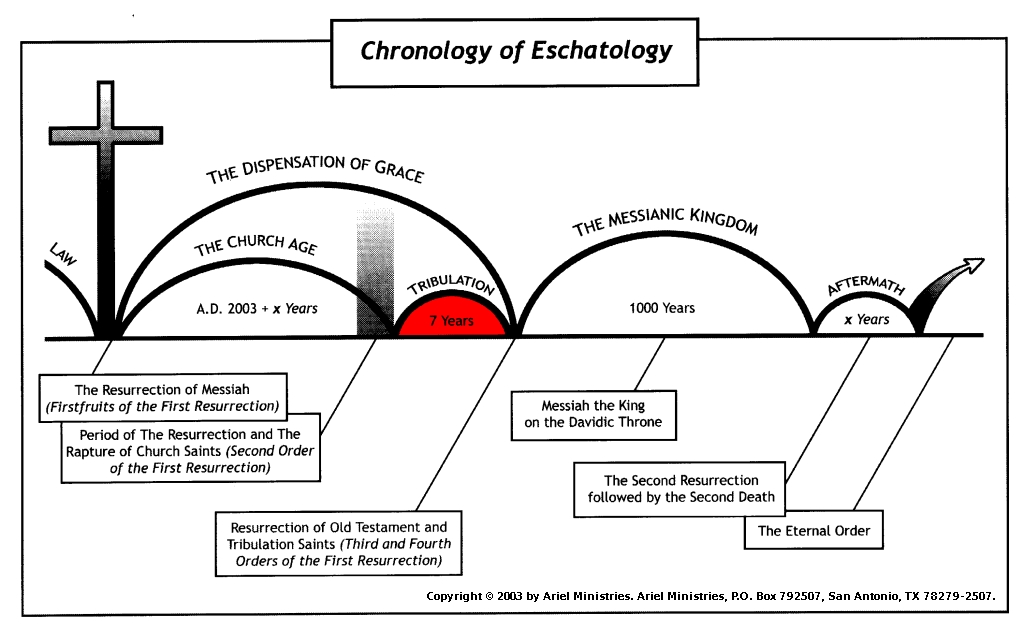
| Rev. 19:1‣-20:3‣ | The Second Coming and Aftermath. |
| Rev. 20:4-6‣ | The Messianic Kingdom. |
| Rev. 20:7-14‣ | The Aftermath of the Messianic Kingdom. |
| Rev. 21:2‣-22:5‣ | The Eternal Order. |
| Rev. 22:6-21‣ | Conclusion. |
| Event | Revelation 6‣ | Matthew 24 | Mark 13 | Luke 21 |
| False messiahs, false prophets. | Rev. 6:2‣ | Mat. 24:5, 11 | Mark 13:6 | Luke 21:8 |
| Wars. | Rev. 6:2-4‣ | Mat. 24:6-7 | Mark 13:7 | Luke 21:9 |
| International discord. | Rev. 6:3-4‣ | Mat. 24:7 | Mark 13:8 | Luke 21:10 |
| Famines. | Rev. 6:5-8‣ | Mat. 24:7 | Mark 13:8 | Luke 21:11 |
| Pestilences. | Rev. 6:8‣ | Luke 21:11 | ||
| Persecution, martyrdom. | Rev. 6:9-11‣ | Mat. 24:9 | Mark 13:9-13 | Luke 21:12-17 |
| Earthquakes. | Rev. 6:12‣ | Mat. 24:7 | Mark 13:8 | Luke 21:11 |
| Cosmic phenomena. | Rev. 6:12-14‣ | [Mat. 24:29]67 | [Mark 13:24-25] | Luke 21:11 |
Christ introduced and discussed the beginning of birth pangs (Mat. 24:4-8) before He introduced the abomination of desolation and the Great Tribulation (Mat. 24:15-21), and it appears that He introduced and discussed events in chronological order in this section of Matthew 24. This implies that the beginning of birth pangs will precede the abomination of desolation (of the middle of the 70th week) and the Great Tribulation (of the second half of the 70th week) and therefore will occur during the first half of that seven-year period.68
There is a definite parallel between the supernatural preparation for the kingdom in history under Moses and the supernatural judgments which shall be poured out upon a rebellious world in preparation for the future Millennial Kingdom of our Lord Jesus Christ at His second advent. There is the same insolent challenge to the true God on the part of the Gentile powers (Ps. 2:1-3). There will be a similar gracious but infinitely greater preliminary miracle [like Ex. 7:12]—the Rapture of the Church—warning men of the supremacy of Jehovah and the ultimate defeat of all who rebel against Him. There will be the same swift progression in the severity of the divine judgments which follow, and even a striking parallel in the nature of the judgments (cf. Rev. 6:1-17‣ through 18). There will be the same victorious outcome, the destruction of the antichrist and his armies in the judgment of Armageddon, and deliverance of the people of Israel (Rev. 19:1-21‣). There will be another song of victory, significantly referred to as ‘the song of Moses. . . and the song of the Lamb’ (Rev. 15:1-3‣).70
| Plague | Egypt | Tribulation |
| #1 - Water becomes blood. | Ex. 7:20; Ps. 105:29 | Rev. 8:8-9‣; 11:6‣; 16:3-6‣ |
| #2 - Frogs | Ex. 8:6; Ps. 105:30 | Rev. 16:13‣71 |
| #3 - Lice | Ex. 8:24; Ps. 105:31 | Rev. 11:6‣?72 |
| #4 - Flies | Ex. 9:6 | Rev. 11:6‣?73 |
| #5 - Food source (livestock) destroyed | Ex. 9:6 | Rev. 8:9‣74 |
| #6 - Boils | Ex. 9:10 | Rev. 16:2‣ |
| #7 - Hail | Ex. 9:23; Ps. 105:32 | Rev. 8:7‣; 16:21‣ |
| #8 - Locusts | Ex. 10:13; Ps. 105:34 | Rev. 9:3‣ |
| #9 - Darkness | Ex. 10:22; Ps. 105:32 | Rev. 8:12‣; 9:2‣; 16:10‣ |
| #10 - Death of Firstborn | Ex. 12:29; Ps. 105:36 | - |
The LORD will utterly destroy the tongue of the Sea of Egypt; with His mighty wind He will shake His fist over the River, and strike it in the seven streams, and make men cross over dry-shod. There will be a highway for the remnant of His people who will be left from Assyria, as it was for Israel in the day that he came up from the land of Egypt. (Isa. 11:15-16)
I will also bring them back from the land of Egypt, and gather them from Assyria. I will bring them into the land of Gilead and Lebanon, until no more room is found for them. He shall pass through the sea with affliction, and strike the waves of the sea: all the depths of the River shall dry up. Then the pride of Assyria shall be brought down, and the scepter of Egypt shall depart. “So I will strengthen them in the LORD, and they shall walk up and down in His name,” says the LORD. (Zec. 10:10-12)
The result will be the establishment of the Millennial Kingdom on earth (Rev. 20:4-6‣). See The Arrival of God’s Kingdom.The Book of Revelation is the sequel to the Book of Genesis, the two books together bounding all history and bounding all of God’s revelations to mankind. They constitute the alpha and omega of God’s written Word, the Book of Beginnings and the Book of Unveilings.76
Given the extensive list of correlations which follow, it is hard to imagine how some in history could have questioned the role of the book of Revelation within the canon. Once these relationships are seen, it becomes clear how important the book of Revelation is to the completion of God’s revelation to man and how inadequate are the views which restrict the events of the book of Revelation to an exclusively first-century fulfillment.77Many questions which are posed when interpreting Genesis can be easily furnished by an understanding of Revelation and vice versa. For example, consider the creation of the sun and moon on day four of creation week (Gen. 1:14-17) whereas light is said to have been created on the first day (Gen. 1:3). The oft-heard question is “how could there be light prior to the creation of the sun?” Many elaborate theories about the sun and moon actually being created earlier than day four and then “unveiled” or made to appear on that day could be instantly disposed of by the study of the light source which John records in the eternal state (Rev. 21:23‣).78Morris offers the following instructive comparisons between the probationary (and subsequently cursed) world described in Genesis and the eternal (and redeemed) world described in Revelation.79| Genesis (probationary world) | Revelation (eternal world) |
| Division of light and darkness (Gen. 1:4). | No night there (Rev. 21:25‣). |
| Division of land and sea (Gen. 1:10). | No more sea (Rev. 21:1‣). |
| Rule of sun and moon (Gen. 1:16). | No need of sun or moon (Rev. 21:23‣). |
| First heavens and earth finished (Gen. 2:1-3). | New heaven and earth forever (Rev. 21:2‣). |
| Man in a prepared garden (Gen. 2:8-9). | Man in a prepared city (Rev. 21:2‣). |
| River flowing out of Eden (Gen. 2:10). | River flowing from God’s throne (Rev. 22:1‣). |
| Tree of life in the midst of the garden (Gen. 2:9). | Tree of life throughout the city (Rev. 22:2‣). |
| Gold in the land (Gen. 2:12). | Gold in the city (Rev. 21:21‣). |
| Bdellium and the onyx stone (Gen. 2:12). | All manner of precious stones (Rev. 21:19‣). |
| God walking in the garden (Gen. 3:8). | God dwelling with His people (Rev. 21:3‣). |
| The Spirit energizing (Gen. 1:2). | The Spirit inviting (Rev. 22:17‣). |
| Bride formed for her husband (Gen. 2:21-23). | Bride adorned for her husband (Rev. 21:2‣). |
| Command to multiply (Gen. 1:28). | Nations of the saved (Rev. 21:24‣). |
| Garden accessible to the Liar (Gen. 3:1-5). | City closed to all liars (Rev. 21:27‣). |
| Man in God’s image (Gen. 1:27). | Man in God’s presence (Rev. 21:3‣). |
| Man the probationer (Gen. 2:17). | Man the heir (Rev. 21:7‣). |
| Genesis (cursed world) | Revelation (redeemed world) |
| Cursed ground (Gen. 3:17). | No more curse (Rev. 22:3‣). |
| Daily sorrow (Gen. 3:17). | No more sorrow (Rev. 21:4‣). |
| Sweat on the face (Gen. 3:19). | No more tears (Rev. 21:4‣). |
| Thorns and thistles (Gen. 3:18). | No more pain (Rev. 21:4‣). |
| Eating herbs of the field (Gen. 3:18). | Twelve manner of fruits (Rev. 22:2‣). |
| Returning to the dust (Gen. 3:19). | No more death (Rev. 21:4‣). |
| Coats of skins (Gen. 3:21). | Fine linen, white and clean (Rev. 19:14‣). |
| Satan opposing (Gen. 3:15). | Satan banished (Rev. 20:10‣). |
| Kept from the tree of life (Gen. 3:24). | Access to the tree of life (Rev. 22:14‣). |
| Banished from the garden (Gen. 3:23). | Free entry to the city (Rev. 22:14‣). |
| Redeemer promised (Gen. 3:15). | Redemption accomplished (Rev. 5:9-10‣). |
| Evil continually (Gen. 6:5). | Nothing that defiles (Rev. 21:27‣). |
| Seed of the woman (Gen. 3:15). | Root and offspring of David (Rev. 22:16‣). |
| Cherubim guarding (Gen. 3:24). | Angels inviting (Rev. 21:9‣). |
| Genesis | Revelation |
| Man in God’s image (Gen. 1:26). | Man headed by one in Satan’s image (Rev. 13‣). |
| Man’s religion, art, and science, resorted to for enjoyment apart from God (Gen. 4). | Man’s religion, luxury, art, and science, in their full glory judged and destroyed by God (Rev. 18‣). |
| Nimrod, a great rebel and King, and hidden anti-God, the founder of Babylon (Gen. 10:8-10). | The Beast, the great Rebel, a King, and manifested anti-God, the reviver of Babylon (Rev. 13‣, 17-18‣). |
| A flood from God to destroy an evil generation (Gen. 6-9). | A flood from Satan to destroy an elect generation (Rev. 12‣). |
| Marriage of first Adam (Gen. 2:18-23). | Marriage of last Adam (Rev. 19‣). |
| A bride sought for Abraham’s son (Isaac) and found (Gen. 24). | A Bride made ready and brought to Abraham’s Son (Rev. 19:9‣). |
| Man’s dominion ceased and Satan’s begun (Gen. 3:24). | Satan’s dominion ended and man’s restored (Rev. 22‣). |
Notes
1Rev. 2:1‣, 8‣, 12‣, 18‣; 3:1‣, 7‣, 14‣.
2e.g., Adam and Eve in the Garden of Eden, mankind prior to the flood of Noah, Israel’s rejection of Messiah at the First Coming of Christ
3J. Dwight Pentecost, Things to Come: A Study in Biblical Eschatology (Grand Rapids, MI: Zondervan Publishing House. 1958), 170.
4Copyright © 2003 Ariel Ministries (www.ariel.org), P.O. Box 792507, San Antonio, TX 78279-2507. This image appears by special permission and may not be duplicated for use in derivative works. [Arnold G. Fruchtenbaum, The Footsteps of Messiah, rev ed (Tustin, CA: Ariel Ministries. 2003), 2].
5Renald E. Showers, Maranatha, Our Lord Come (Bellmawr, NJ: The Friends of Israel Gospel Ministry. 1995), s.v. “Trouble Ahead.”
6Christians recognize that Messiah comes twice and that the cataclysm is associated with His second coming. Judaism “missed” Messiah at His First Coming and so interprets Second Coming passages as preceding His initial arrival.
7Ibid., Shabbath, 118a, cited in Ibid., 21.
8Raphael Patai, The Messiah Texts (Detroit, MI: Wayne Statue University Press. 1979), 95-96.
9Renald E. Showers, The Pre-Wrath Rapture View (Grand Rapids, MI: Kregel Publications. 2001), 14.
10Fruchtenbaum, The Footsteps of Messiah, 634.
11Showers, Maranatha, Our Lord Come, 38.
12Arnold Fruchtenbaum, “The Day of the Lord,” in Mal Couch, ed., Dictionary of Premillennial Theology (Grand Rapids, MI: Kregel Publications. 1996), 87.
13Fruchtenbaum understands Peter (2Pe. 3:10-12) as describing the result of judgments described in the book of Revelation which are poured out prior to the Second Coming. Others see Peter as describing the final destruction of the very elements comprising the heavens and earth to be replaced by the new heavens and earth. Peter’s point seems to be on the total annihilation of all that is material. Understanding this fact is to inoculate believers from the temptation and distraction of materialism. Another possibility is that Peter is referring to the regeneration which precedes the Millennium (Isa. 65:17). This is the view of Peters: “This Kingdom is preceded by the conflagration of 2Pe. 3:10-13. This is self-evident, since the Kingdom is identified with the establishment of ‘the new heavens and new earth’ of Isa. 65:17 and 66:22. Peter expressly alludes to these two passages in Isaiah and appropriates them as descriptive of ‘the new heavens and new earth’ presented by himself, in the specific phraseology, ‘according to promise.’ The Millennial new heavens and new earth thus claimed by the Apostle, and which are associated with the Kingdom itself, are necessarily preceded by the fire, described. . . . some have wrongfully . . . endeavored to locate this fire after the thousand years.”—George H. N. Peters, The Theocratic Kingdom (Grand Rapids, MI: Kregel Publications. 1978, 1884), 2:506.
14“[Some] wish to extend the period of the Day of Jehovah to include the Millennium and the Aftermath, but a study of the term in every passage will show that it is never used in any context except that of the Tribulation. While other expressions, such as that day or in that day, are used for both the Tribulation and the Millennium, the term the Day of Jehovah, is never used for anything outside the Great Tribulation.”—Fruchtenbaum, The Footsteps of Messiah, 183.
15Showers, Maranatha, Our Lord Come, 32-33,39.
16Ibid., 33-34.
17Fruchtenbaum, The Footsteps of Messiah, 4.
18Showers, Maranatha, Our Lord Come, 31.
19Ibid., 31-32.
20Fruchtenbaum, The Footsteps of Messiah, 176.
21“Isaiah 2:10-22 describes a Day of the Lord that will involve the sixth seal described by the Apostle John in Revelation 6:12-17‣.”—Showers, Maranatha, Our Lord Come, 31.
22“Joel 3:1-16 and Zechariah 14:1-3, 12-15 refer to a Day of the Lord that will involve God’s judgment of the armies of all the nations of the world, when those armies gather in Israel to wage war against that Nation and the city of Jerusalem [Rev. 16:12-16‣] and when the Messiah comes to war against them [Rev. 19:11-21‣].”—Ibid., 32.
23Marvin Rosenthal, The Pre-Wrath Rapture of the Church (Nashville, TN: Thomas Nelson Publishers. 1990).
24Showers, Maranatha, Our Lord Come, 35,39.
25The problem of cosmic signs prior to the day can also be resolved by realizing that there are numerous cosmic signs associated with the period of the end and the cosmic signs of the sixth seal, although probably the most dramatic to that point, may not be the first.
26“The Scriptures indicate that the Day of the Lord, the Time of Jacob’s Trouble, and the Great Tribulation have several things in common. First, the concept of trouble or tribulation are associated with all three . . . Second, the concept of an unparalleled time of trouble is identified with all three [Joel 2:1-2; Jer. 30:7; Dan. 12:1‣ cf. Mat. 24:21] . . . Third, the term ‘great’ is used for all three . . . Fourth, the concept of birth pangs is associated with all three . . . Fifth, the expression ‘that day’ is used for all three . . . Sixth, Israel’s future repentance or spiritual restoration to God is associated with all three . . . These comparisons demonstrate that several of the same concepts and terms are associated with the Day of the Lord, the Time of Jacob’s Trouble, and the Great Tribulation . . . they indicate that the Day of the Lord will cover or at least include the same time period as the Time of Jacob’s Trouble and the Great Tribulation.”—Ibid., 41-42.
27“Both the Time of Jacob’s Trouble (Jer. 30:6-7) and the Great Tribulation (Mat. 24:21) are described as the unparalleled time of trouble. Since there can only be one such time, both will cover the same time period. The Great Tribulation will begin in the middle of the seven-year 70th week. We know this because Jesus indicated that the Great Tribulation will begin with the abomination of desolation (Mat. 24:15-21), which will take place in the middle of the 70th week (Dan. 9:27‣). . . . Since the Great Tribulation will begin in the middle and terminate at the end of the 70th week and will cover the same time period as the Time of Jacob’s Trouble, the Time of Jacob’s Trouble will also cover the entire second half of the 70th week.”—Ibid., 23-24.
28They must necessarily eclipse all the world wars and the horrors of the holocaust unless God be accused of exaggeration.
29Ibid., 43.
30James Strong, The Exhaustive Concordance of the Bible (Ontario: Woodside Bible Fellowship. 1996), G5604.
31How different this is from the interpretation which preterists force upon Matthew 24! The destruction of Jerusalem in A.D. 70 involved no intervention by God on behalf of the Jews.
32Merrill F. Unger, Unger’s Commentary on the Old Testament (Chattanooga, TN: AMG Publishers. 2002), Mic. 5:3.
33See Prophetic Year.
34Showers, Maranatha, Our Lord Come, 44-46.
35C. I. Scofield, The Scofield Study Bible (New York, NY: Oxford University Press. 2002, 1909), Rev. 7:14.
36“It has been denied that God’s people were actually worse than the pagans about them, but reckoning must be in proportion to spiritual knowledge and privileges enjoyed. The judgments of God are always relative to light and privilege granted. . . The Latins have a pointed saying: Corruptio optimi pessima (‘The corruption of the best issues in the worst.’)”—Charles Feinberg, The Prophecy of Ezekiel: The Glory of the Lord (Chicago, IL: Moody Press. 1969), 37.
37Fruchtenbaum, The Footsteps of Messiah, 282-283.
38Pentecost, Things to Come: A Study in Biblical Eschatology, 237.
39Fruchtenbaum, The Footsteps of Messiah, 177-181.
40Randall Price, “Old Testament References to The Great Tribulation,” in Mal Couch, ed., Dictionary of Premillennial Theology (Grand Rapids, MI: Kregel Publications. 1996), 415.
41“The implications of this phrase may include all of the following: (1) God will put His seal of authentication on all true revelations, (2) These forms of revelation will cease, (3) Prophecies will be fulfilled, and (4) Nothing else is to be added to His plans and revelations (as implied by the seal). When Christ comes back, there will be no more need for visions and prophecies.”—Charles H. Ray, “A Study of Daniel 9:24-17, Part II,” in The Conservative Theological Journal, vol. 5 no. 16 (Fort Worth, TX: Tyndale Theological Seminary. December 2001), 306-307.
42Harold Hoehner, Chronological Aspects of the Life of Christ (Grand Rapids, MI: Zondervan. 1977), 118.
43Pentecost, Things to Come: A Study in Biblical Eschatology, 243.
44 King James Version Study Bible (Nashville, TN: Thomas Nelson. 1997, c1988), Dan. 9:24.
45Hoehner, Chronological Aspects of the Life of Christ, 135-136.
46Trent C. Butler, Chad Brand, Charles Draper, and Archie England, eds., Broadman and Holman Illustrated Bible Dictionary (Nashville, TN: Broadman and Holman Publishers. 2003), 252-253.
47Ray, A Study of Daniel 9:24-17, Part II, 321.
48James Ussher, The Annals of the World (Green Forest, AR: Master Books. 1658, c2003), 114-115.
49Henry Morris, The Revelation Record (Wheaton, IL: Tyndale House Publishers. 1983), 27.
50Scofield, The Scofield Study Bible, Rev. 1:1.
51“Textual correlations that develop the expansion and chronological framework of the Seventieth Week of Daniel [indicate that] Daniel 9:27‣ equals Rev. 6:12-17‣.”—John A. McLean, “Structure of the Book of Revelation,” in Mal Couch, ed., Dictionary of Premillennial Theology (Grand Rapids, MI: Kregel Publications. 1996), 376.
52We have purposefully excluded events whose relative timing we view to be less certain. A more detailed list could be prepared, but would be more likely to contain errors. For a more detailed development, see [Fruchtenbaum, The Footsteps of Messiah, 204,240,276].
53The difficulty of establishing with certainty the timing of the seal, trumpet, and bowl judgments relative to other events of the Tribulation can be seen by the great amount of discussion concerning the subject. It is our belief that the judgments through the sixth trumpet could all occur within the first half of the week since the ascendancy of the beast is not seen in the judgments until the time of the first bowl under the seventh trumpet (Rev. 11:15‣ cf. Rev. 16:2‣). It seems the abomination of desolation must have occurred prior to the pouring out of the first bowl because it targets the Beast worshipers (Rev. 16:2‣).
54These events do not all transpire in one instant, but are initiated at the midpoint of the week.
55The ascendancy and authority of the beast is strictly subject to God’s control.
56Their witness is ended by the ascendancy of the beast (Rev. 11:7‣) at the end of the first half of the week, whereas the last half of the week ends in the destruction of the beast (Rev. 19:20‣). “During the first half of the week he is in his mortal stage. In the last half he is in his superhuman stage; . . . This eighth verse therefore refers to the mid-career of the Beast; and the point of the vision is the moment between the mortal and superhuman stages; i.e., between chapters 12 and 13.”—E. W. Bullinger, Commentary On Revelation (Grand Rapids, MI: Kregel Publications. 1984, 1935), Rev. 17:8.
57Although Daniel 11:31‣ was fulfilled by Antiochus Epiphanes, it stands as an example of the future event which Jesus spoke of (Mat. 24:15).
58Although the man of sin will initially sit in the temple of God and present himself as God (2Th. 2:4). Since he is not God, he lacks omnipresence. So it appears that an image is erected in the temple which then receives worship on his behalf (Rev. 13:15‣). This allows him to conduct other activities associated with his conquest and rule.
59The timing of the seventh trumpet is approximate and is difficult to establish with certainty. From the description of the first bowl (under the seventh trumpet), it would seem that the last trumpet would occur near the midpoint of the week, just as the beast has established global control and the false prophet is instituting his worship. No mention is made of the beast or his worshipers until after the sixth trumpet (Rev. 9:13‣ cf. Rev. 11:7‣). The prelude to the bowl judgments—which are under the seventh trumpet—includes “those who have victory over the beast, over his image and over his mark and over the number of his name” (Rev. 15:2‣). These are in heaven, having overcome the image of the beast by martyrdom. Since they overcame the image, the image must be in place prior to the seven bowls pouring forth. If the image is set up at the midpoint of the last week, then the bowl judgments must be in the last half. The seventh trumpet must occur prior to the first bowl.
60It appears that the judgments of the seventh trumpet, which include the seven bowls, must occur after the midpoint of the week. For when the first bowl is poured forth, it targets those who have received the mark of the beast and worship his image (Rev. 16:2‣). This would most naturally follow his proclamation as God (2Th. 2:4) and the construction of an idol in his image which receives worship (Rev. 13:15‣). Moreover, prior to the pouring forth of the bowls, John sees martyrs who refused to worship the image of the beast. Thus, the bowls must come after the setting up of the image which occurs at the midpoint of the last week.
61Fruchtenbaum, The Footsteps of Messiah, 8-10.
62 [Ibid., 9,175] applies the term Great Tribulation to the entire seven years whereas other interpreters apply it to only the last half of this period.
63Fruchtenbaum believes the Harlot in Revelation 17‣ differs from the city Babylon in Revelation 18‣. We believe the Harlot and the city are one and the same.
64McLean, Structure of the Book of Revelation, 374.
65Showers, Maranatha, Our Lord Come, 25.
66 [Thomas Ice, “The Olivet Discourse,” in Tim LaHaye and Thomas Ice, eds., The End Times Controversy (Eugene, OR: Harvest House Publishers. 2003), 165] Also see [Showers, Maranatha, Our Lord Come, 25].
67Items in brackets added by this author.
68Ibid.
69We disagree with allegorical interpreters who dismiss a literal correspondence between the plagues of Egypt and the Tribulation. Beale is representative of this line of thought: “The parallel with Exodus does not supply unambiguous demonstration in support of a literal fulfillment. All that it shows is that the two descriptions are homologous, that is, that they have an essential relation in some manner. But the nature of that relation needs to be determined. Are they homologous in their physical form and effects, or in theological significance, or both? The images depicted certainly refer to actual events on the referential level.. . . In Revelation the fire and hail are to be understood on the symbolic level as representing particular facets of divine judgment that can be drawn out further by thorough exegesis of the theological meaning of this particular Exodus plague. [These] speak of God depriving the ungodly of earthly security.”—Gregory K. Beale, The Book of Revelation: A Commentary on the Greek Text (Grand Rapids, MI: William B. Eerdmans Publishing Co. 1999), 54. If one reads the Exodus account through the same interpretive lens as Beale, one would likely be led to deny the literal nature of the entire history of the Exodus, much less the plagues. Indeed, many liberal theologians do just that!
70Alva J. McClain, The Greatness Of The Kingdom (Winona Lake, IN: BMH Books. 1959), 56.
71Although not an infestation or plague of frogs, the representation of the unclean spirits as frogs is undoubtedly meant as a reminder of the frogs of the Exodus.
72Lice are not specifically mentioned, but may be among the plagues brought by the two witnesses.
73Flies are not specifically mentioned, but may be among the plagues brought by the two witnesses.
74This is not a direct correlation, but a similarity. In both cases, the food source of the enemies of God is destroyed. In other judgments, crops were also destroyed: Ex. 9:22-23; Ps. 105:33-35 cf. Rev. 8:7‣.
75Mal Couch, “Why is Revelation Important?,” in Mal Couch, ed., A Bible Handbook to Revelation (Grand Rapids, MI: Kregel Publications. 2001), 16.
76Morris, The Revelation Record, 14.
77The creation evangelism organization Answers in Genesis (www.AnswersInGenesis.org) correctly emphasizes the need to take the Scriptures literally “from the very first verse.” Without an understanding of the cause of man’s problem, there is no need for a savior. If Adam and Eve were not literal, what need have we of Jesus? Wouldn’t it be wonderful if this “back to Genesis” emphasis on literal interpretation were taken “ahead to Revelation” and applied there too?
78Asking this question evidences a lack of familiarity with the doctrine of God’s Shekinah (abiding) Glory: Gen. 3:8, 24; 15:17; Ex. 3:2; 13:21-22; 14:19-20, 24; Ex. 16:10; 19:18; 24:15-16; 33:18-23; 34:5-6; 40:34; Lev. 9:6, 23; Num. 14:10, 22; 16:19, 42; 20:6; Deu. 5:25-26; 33:16; 1K. 8:10-11; 2Chr. 7:1; Isa. 4:5; 35:2; 40:5; 58:8; 60:3; Eze. 1:28; 3:23; 9:3; 10:18; 43:2-4; Hag. 2:7-9; Zec. 2:5; Mat. 16:27; 17:2; 24:30; Mark 9:3; Luke 2:8-9; 9:29; John 1:14; Acts 2:3; 9:3; 22:6; 26:13; Heb. 1:3; 2Pe. 1:16-17; Rev. 1:14-16‣; 15:8‣; 21:3‣; 21:23‣
79Ibid., 22.
80Bullinger, Commentary On Revelation, 58-59.