saying to the seven angels
These are the seven angels which were given seven bowls containing God’s wrath by the living creature. See commentary on Revelation 15:1.go and pour out
Υʽπάγετε και ἐκξέετε [Hypagete kai ekxeete], an imperative command, You all go and pour out! Numerous passages describe God’s judgment in terms of pouring out His indignation, fury, and wrath. This is no accident, for He has known all along that the bowl judgments would be the final in the sequence of judgments at the time of the end.The psalmist decries the overthrow of Jerusalem by the nations, and asks God to pour out His wrath on the nations who do not know Him nor call upon His name:O God, the nations have come into Your inheritance; Your holy temple they have defiled; they have laid Jerusalem in heaps. The dead bodies of Your servants they have given as food for the birds of the heavens, the flesh of Your saints to the beasts of the earth. Their blood they have shed like water all around Jerusalem, and there was no one to bury them. We have become a reproach to our neighbors, a scorn and derision to those who are around us. How long, LORD? Will You be angry forever? Will Your jealousy burn like fire? Pour out Your wrath on the nations that do not know You, and on the kingdoms that do not call on Your name. For they have devoured Jacob, and laid waste his dwelling place. (Ps. 79:1-7) [emphasis added]
“While Jerusalem more than once has experienced such desolations (under the Babylonians, Greeks, and Romans), these calamities in their prophetic aspect still point to that final and cataclysmic disaster that is yet to fall upon the city (Dan. 9:27‣; Zec. 14:12; Mat. 24:15; 2Th. 2:4; Rev. 11:1-3‣; 13:11-18‣).”1 Jeremiah records a similar request:Pour out Your fury on the Gentiles, who do not know You, and on the families who do not call on Your name; for they have eaten up Jacob, devoured him and consumed him, and made his dwelling place desolate. (Jer. 10:25) [emphasis added]
As in the Babylonian and Roman desolations of Jerusalem in history past, so shall desolation occur at the time of the end, in the middle of Daniel’s 70th Week. The “desolating one,”2 the Antichrist, shall have judgment poured out upon him:3Then he shall confirm a covenant with many for one week; but in the middle of the week He shall bring an end to sacrifice and offering. And on the wing of abominations shall be one who makes desolate, even until the consummation, which is determined, is poured out on the desolate. (Dan. 9:27‣) [emphasis added]
Zephaniah spoke concerning Israel’s lack of fear of God indicating a future time when God would pour His indignation upon the nations—thus gaining Israel’s attention and respect at the time of the end.“Therefore wait for Me,” says the Lord, “Until the day I rise up for plunder; My determination is to gather the nations to My assembly of kingdoms, to pour on them My indignation, all My fierce anger; all the earth shall be devoured with the fire of My jealousy. For then I will restore to the peoples a pure language, that they all may call on the name of the Lord, to serve Him with one accord.” (Zep. 3:8-9) [emphasis added]
bowls of the wrath of God
These final seven judgments are especially severe and represent the final pouring forth of God’s wrath. The prime recipient of God’s wrath are those who worship the Beast (Rev. 14:10‣ cf. Rev. 16:2‣, 10‣). See commentary on Revelation 15:1.The mills of God grind slowly, but they grind exceeding fine, and the last of the grist is now to go through. The machinery of judgment has been set in motion, and the Creator Himself has said that it shall not be arrested until the last plagues of His wrath are finished.4
Because the bowl judgments, representing the final outpouring of God’s wrath prior to the Millennial Kingdom, are so severe, many have been unwilling to take them as describing literal events. As we have observed elsewhere, when one cuts the tether of literal interpretation, all manner of strange understandings result and it is nearly impossible for the actual text to adequately constrain the imagination of the interpreter. Also, it becomes impossible for God to describe cataclysmic judgments even if He wanted to, for interpreters would be forever reinterpreting them as symbolism or allegory. We believe the details given in the descriptions of the judgments point strongly in the direction of a literal interpretation:These seven Vials and their effects we take to be literal; . . . They belong to no figures of speech. The language is clear and precise. There is nothing beyond our faith, though there may be beyond our reason. True, they are supernatural, but not unnatural. In the plagues of Egypt, which all take to be literal, we have many judgments exactly similar. Indeed, six out of the seven Vials are just the same as the plagues of Egypt, and God has again and again declared that their final judgments should be like, yea, should be worse than those (Ex. 34:10). . . . In the face of this, is it not strange that these Vials should ever be taken to mean: The first, the French Revolution; and the “sores” its infidelity, etc. The second, the naval wars of the French Revolution; The third, Napoleon’s campaign in Italy; The fourth, Napoleon’s military tyranny, etc., etc.? It is a waste of precious time and space even to chronicle such interpretations.5
So far as the naval battles of the French Revolution affected the sea [at the pouring of the second bowl], they killed nothing of the living things therein, but fattened them, and scarcely stained a single wave; so far were they from turning all the ocean’s waters into bloody clots.6
on the earth
Like previous judgments in the series of seals, trumpets, bowls, these target those living upon the earth at the time of the end, the Earth Dwellers. “Behold, the day of the Lord comes, Cruel, with both wrath and fierce anger, To lay the land desolate; And He will destroy its sinners from it” (Isa. 13:9). foul and loathsome sore
Ἕλκος κακὸν καὶ πονηρὸν [Helkos kakon kai ponēron]. Sore, is ἕλκος [helkos] meaning: “Strictly wound; by metonymy ulcer, ulcerated sore, abscess.”7 Foul is κακὸν [kakon], which in this context means “dangerous, pernicious . . . harmful.”8 Loathsome is πονηρὸν [ponēron], meaning “painful, virulent, serious.”9 Thus, God strikes them with dangerous and pernicious, painful and virulent wound-like ulcers or abscesses. The Beast worshipers experience a similar condition to that of Job when he was struck with boils by Satan (Job 2:7). The plague which strikes the Beast worshipers is like that which Aaron and Moses caused upon the men and beasts of Egypt (Ex. 9:8-11). God promised to strike Israel with similar boils if they continued in disobedience toward Him (Deu. 28:27, 35), but also to strike their enemies if they returned and were obedient to Him (Deu. 7:15). God describes the similar plague with which He struck Egypt: “Tumors, with the scab, and with the itch, from which you cannot be healed” (Deu. 28:27). The sores will not only be painful, but they will be extremely irritating because of their itch and refusal to heal. “Lilje comments that those who once bore the mark of the beast are now visited by ‘marks’ of God.”10 See The Plagues of Egypt and the Tribulation.came upon the men who had the mark of the beast and those who worshiped his image
Not two categories of people, but two ways of describing the same group. They are the enemies of God during the Tribulation, much as Egypt was the enemy of Israel (and God) during the Exodus. Their worship of the Beast and his image violates the second commandment, written on stone—the “testimony” in the ark of the covenant in the tabernacle which was mentioned just a few verses before (Rev. 15:5‣): “You shall not make for yourself a carved image . . . you shall not bow down to them nor serve them” (Ex. 20:4). See commentary on Revelation 13:15, Revelation 13:16, and Revelation 14:9. every living creature in the sea died
Now, the essential life-supporting mechanisms within the sea, the basis of the food chain, are destroyed. As in Egypt, the animal life within the water dies (Ex. 7:18, 21; Ps. 105:29). See The Plagues of Egypt and the Tribulation. “Imagine the chaos: all the dead marine life lying feet deep on the shores of the world and rotting there. The loss of marine life as a food source will be devastating after the destruction of vegetation that will occur as a result of Rev. 8:7‣.”11 Overly subtle interpretations in the interest of recapitulation overlook the distinct differences between the two series. Among the more important are: (1) the trumpet-plagues are partial in their effect (one-third of the earth is burned, Rev. 8:7‣; one-third of the sea becomes blood, Rev. 8:8‣; see also Rev. 8:9-12‣) while the bowls are universal (“every living soul died,” Rev. 16:3‣; “every island fled away,” Rev. 16:20‣) and final; (2) the trumpets are to a certain extent a call to repentance while the bowls are the pouring out of divine wrath; and (3) man is affected indirectly by the first four trumpets but is directly attacked from the outset by the bowls. It should also be noticed that the bowls are poured out in rapid succession with the customary interlude between the sixth and seventh elements of the sequence missing.12
See Literary Structure.There is a close similarity between this judgment and that which afflicted Egypt prior to the Exodus when the rivers and streams of Egypt were turned to blood (Ex. 7:20). See The Plagues of Egypt and the Tribulation.That, then, which has always been the symbol of salvation in the midst of life, becomes the symbol of condemnation in the midst of death. But now, the seas are turned to blood; the fish die; the winds of God blow death over all the earth. They had refused the salvation that would have come to them from the blood of the One who is Life; they now receive condemnation from the blood that symbolizes death.13
The destruction of what is left of the earth’s fresh water will cause unthinkable hardship and suffering. There will be no water to drink; no clean water to wash the oozing sores caused by the first bowl judgment; no water to bring cooling relief from the scorching heat that the fourth bowl judgment will shortly bring. The scene is so unimaginably horrible that people will wonder how a God of compassion, mercy, and grace could send such a judgment. And so there is a brief interlude in the pouring out of the judgments while an angel speaks in God’s defense.14
You are righteous, O Lord . . . because You have judged
The angel proclaims God’s righteousness because He has judged. God is righteous because He alone possesses the perfect balance between grace and judgment. “The LORD is righteous in all His ways, gracious in all His works” (Ps. 145:17). “Righteous are You, O LORD, and upright are Your judgments” (Ps. 119:137). Because God is not willing that any should perish, He extends His patience and grace while horrible sin continues to abound on the earth. Because God is righteous, there will come a day when He must act against sin and bring judgment. We often confuse the relative calm of our own day for meekness and mildness on the part of God. In truth, God never changes and the strength which He acts against sin at the time of the end reflects the intensity He holds even now toward that which we often have a cavalier attitude toward.who is and who was and who is to be
Ὁ ω῍ν καὶ ὁ ἦν, καὶ ἐσόμενος [Ho ōn kai ho ēn, kai esomenos], the one who is and the “he was,” and the one to be. This unusual construction is likely a Hebraism. For a discussion of a closely-related grammatical phrase, see commentary on Revelation 1:4. Here, the future tense participle is based on the verb ειμι [eimi], “to be,” whereas in Revelation 1:4‣ it is based on the verb ἐρχομαι [erchomai], “to come.” There, the emphasis is on His impending arrival. Here, upon his eternality. Most other manuscripts, including the majority of those in the MT text family and the NU text, have ὁ ο῝σιος [ho hosios], “the holy,” instead of ἐσόμενος [esomenos], “the one to be.” they have shed the blood of saints and prophets
Those who had shed the blood of saints and prophets are the “peoples, multitudes, nations, and tongues” upon which the Harlot sits (Rev. 17:15‣) for she is “drunk with the blood of the saints and with the blood of the martyrs of Jesus” (Rev. 17:6‣). The godless have shed the blood of saints and prophets throughout history (1K. 18:4; 19:4; 2K. 24:4; 2Chr. 24:21; Ps. 79:1-4; Jer. 2:30; Jer. 26:23; Lam. 4:13). At the First Coming of Christ, Israel was especially guilty of shedding the blood of her own righteous (Mat. 21:35-36; 23:35; Luke 11:49-53). Since the rejection of Messiah Jesus and the going forth of the gospel to the whole world, over 1900 years have transpired and the toll of the shed blood of the saints has escalated dramatically. It has been said in our own century that more have died for the cause of Christ than any previous century. Yet the persecutions of history will pale in comparison with that which befalls the saints in the Tribulation when the Beast (Dan. 7:21‣, 25‣; Rev. 13:7‣, 10‣), his image (Rev. 13:15‣), and the Harlot (Rev. 17:6‣; 19:2‣) all slaughter the saints during Satan’s final attempt to overthrow the plan of God (Rev. 12:17‣). This is why the book of Revelation has always been precious to the persecuted Church, for its pages are sprinkled with the blood of martyrs (Rev. 6:9-10‣; 7:14‣; 11:7‣; 12:11‣, 17‣; 15:2‣; 20:4‣). See #20 - Saints.You have given them blood to drink
Because they have shed the blood of the saints and prophets, in a wry twist of God’s hand of judgment, He gives them literal blood to drink. This is similar to how He stones those who are guilty of blasphemy. See commentary on Revelation 16:21.I will feed those who oppress you with their own flesh, and they shall be drunk with their own blood as with sweet wine. All flesh shall know that I, the LORD, am your Savior, and your Redeemer, the Mighty One of Jacob. (Isa. 49:26) [emphasis added]
For it is their just due
Ἄξιοι γάρ εἰσι [Axioi gar eisi], For worthy they are. By their works, they have demonstrated their worthiness of this righteous punishment. I heard another from the altar saying
Probably the angel which officiated at the altar and offered the prayers of the saints (Rev. 8:3-4‣ cf. Rev. 14:18‣) including those of the martyrs John saw under the altar following the opening of the fifth seal (Rev. 6:9‣). He is in agreement with giving the earth dwellers blood to drink, for he attends the altar where the martyrs cry for vengeance. They are among those whose blood was shed. The NU and MT texts omit another. “The Altar is either personified (for the prayers of the saints are upon it; and the martyrs are beneath it); or the words ‘[the angel of] the Altar’ must be supplied.”16Almighty
Παντοκράτωρ [Pantokratōr], see commentary on Revelation 1:8.true and righteous are Your judgments
God’s righteous judgment is seen in His patient interaction with Abraham prior to the destruction of Sodom and Gomorrah where Abraham questioned God. “Shall not the Judge of all the earth do right?” (Gen. 18:25). Rather than being a blasphemous questioning of God’s inscrutable will, the passage serves as an intentional illustration of His just nature and righteous judgment. Not only are the Father’s judgments true and righteous during the pouring forth of the seven bowls, but upon the commencement of the Millennial Kingdom, the Son’s rule will be the same:Of the increase of His government and peace There will be no end, upon the throne of David and over His kingdom, to order it and establish it with judgment and justice from that time forward, even forever. The zeal of the LORD of hosts will perform this. (Isa. 9:7)
The righteous nature of God’s judgment is taken up by Paul in his argument defending the sovereignty of God in election (Rom. 9:14-24). In fact, God’s judgment is required by His righteousness (2Th. 1:6), for if He were to forever delay judgment, then He would be in violation of His own righteous nature. For God to forego judgment when it is due is as impossible as it is for the Holy One to lie. the fourth angel poured out his bowl on the sun
Again, we see similarities between the bowl and trumpet judgments. In the fourth trumpet judgment “a third of the sun was struck” (Rev. 8:12‣). But the fourth trumpet also targeted the moon and stars, whereas the fourth bowl only affects the sun. This alternation in the sun’s normal operation will serve as one of many “signs in the sun, in the moon, and in the stars” during the time of the end (Luke 21:25). See commentary on Revelation 6:12.To scorch is καυματίσαι [kaumatisai], to “be burned, be scorched of plants withering in the heat (Mat. 13:6).”17 The intense heat they endure is an indication of judgment (Rev. 14:18‣). Those John saw coming out of the Great Tribulation “shall neither hunger anymore nor thirst anymore; the sun shall not strike them, nor any heat” (Rev. 7:16‣). Although this may refer to tribulation in general, the possibility exists that it may also speak about the relief provided to those saints who lived on the earth at the time of the sun’s increased intensity prior to their martyrdom.18 See commentary on Revelation 7:16.One purpose in God striking the sun is found in the ages-long idolatry of men where they have worshiped the sun, moon, and stars rather than acknowledging their Creator. Thus, that which men have worshiped now becomes the source of their curse.19 “Men are to be taught that the very things in which they have trusted or to which they have given their worship are to be the sources of their most terrible punishments.”20Another serious consequence of the sun’s intense heat will be the melting of the polar ice caps. The resulting rise in the oceans’ water level will inundate coastal regions, flooding areas miles inland with the noxious waters of the dead oceans. Widespread damage and loss of life will accompany that flooding, adding further to the unspeakable misery of the devastated planet. Transportation by sea will become impossible.21
and men were scorched with great heat
Isaiah was given a glimpse of this time upon the earth:Behold, the LORD makes the earth empty and makes it waste, distorts its surface and scatters abroad its inhabitants. And it shall be: as with the people, so with the priest; as with the servant, so with his master; as with the maid, so with her mistress; as with the buyer, so with the seller; as with the lender, so with the borrower; as with the creditor, so with the debtor. The land shall be entirely emptied and utterly plundered, for the LORD has spoken this word. The earth mourns and fades away, the world languishes and fades away; the haughty people of the earth languish. The earth is also defiled under its inhabitants, because they have transgressed the laws, changed the ordinance, broken the everlasting covenant. Therefore the curse has devoured the earth, and those who dwell in it are desolate. Therefore the inhabitants of the earth are burned, and few men are left. The new wine fails, the vine languishes, all the merry-hearted sigh. The mirth of the tambourine ceases, the noise of the jubilant ends, the joy of the harp ceases. They shall not drink wine with a song; strong drink is bitter to those who drink it. The city of confusion is broken down; every house is shut up, so that none may go in. There is a cry for wine in the streets, all joy is darkened, the mirth of the land is gone. In the city desolation is left, and the gate is stricken with destruction. When it shall be thus in the midst of the land among the people, it shall be like the shaking of an olive tree, Like the gleaning of grapes when the vintage is done. (Isa. 24:1-13 cf. Mal. 4:1) [emphasis added]
The conditions experienced by those beneath the bowl judgments is uniform. Position and status will be no refuge from desolate conditions. Although “burned” in these passages may refer to God’s consuming wrath,22 given the context of the time of the end, it may also refer to the effects of the great heat upon agriculture: “The new wine fails, the vine languishes.”they blasphemed the name of God . . . and they did not repent
Here again is recorded the unrepentant nature of the earth dwellers of the time of the end. Even in the face of overwhelming evidence of the reality and power of God, their hearts are so set against Him in hatred that all they can do is continue their pattern of cursing in response to His intervention in their lives (Rev. 16:9‣, 11‣, 21‣). Those who have taken the mark are irredeemable (Rev. 14:9-11‣) for God knows that they, like Jezebel in the church of Thyatira (Rev. 2:21‣) will not repent (Rev. 9:20-21‣). Instead, they follow in the ways of the one whom they worship (Rev. 13:5-6‣; 17:3‣).God’s testing is not always to elicit a repentant response. When those being tested have passed the point of return, God continues to test them to provide abundant witness of their unwillingness and inability to return (Rom. 1:26, 28). This is one purpose for this “hour of trial which shall come upon the whole world, to test those who dwell on the earth” (Rev. 3:10‣). In the same way the Holy Spirit led Jesus into the wilderness to show Who He was, so now God tests those who have already taken the mark and are beyond redemption (Rev. 14:9-10‣). Like Pharaoh, their consistent response is not to change their mind but to harden their heart (Ex. 8:15; 9:34-35). Each time they respond in blasphemy, they unwittingly underwrite and testify of the justice of God’s judgment. See Beast Worshipers are Unique.Long ago, an angel described these at the time of the end:And he said, “Go your way, Daniel, for the words are closed up and sealed till the time of the end. Many shall be purified, made white, and refined, but the wicked shall do wickedly; and none of the wicked shall understand, but the wise shall understand.” (Dan. 12:9-10‣) [emphasis added]
A similar theme is expressed to John by an angel at the end of this book. “He who is unjust, let him be unjust still; he who is filthy, let him be filthy still” (Rev. 22:11‣). God’s judgments will not result in repentance for these: “Though you grind a fool in a mortar with a pestle along with crushed grain, yet his foolishness will not depart from him” (Pr. 27:22). his kingdom became full of darkness
Now the kingdom of the Beast is struck with a plague reminiscent of that which struck Pharaoh at the hand of Moses:Then the LORD said to Moses, “Stretch out your hand toward heaven, that there may be darkness over the land of Egypt, darkness which may even be felt.” So Moses stretched out his hand toward heaven, and there was thick darkness in all the land of Egypt three days. They did not see one another; nor did anyone rise from his place for three days. But all the children of Israel had light in their dwellings. (Ex. 10:21-23)
“The transition from the fourth to the fifth bowls is most striking. The one had been the fiery, scorching, blinding brightness of the sun; the next is an impenetrable darkness.”25 Although the throne of the Beast is empowered by Lucifer,26 the shining one, the son of the dawn (הֵילֵל בֶּן־שַׁחַר [hêlēl ben–šaḥar], Isa. 14:12), he is helpless to illumine the God-imposed darkness. See The Plagues of Egypt and the Tribulation.they gnawed their tongues because of the pain
Pain is πόνου [ponou] which includes “affliction, anguish.”27 The darkness with which they are afflicted is more than just lack of light as in the Egyptian plague, but also seems to involve other means of affliction which result in intense pain, perhaps similar to that experienced at the hand of the demonic locusts, although that judgment was broader than upon the Beast’s throne and kingdom (Rev. 9:5-6‣). “They meditate revenge and are unable to effect it; hence their frenzy [Grotius]. Those in anguish, mental and bodily, bite their lips and tongues.”28 “The people who suffer these plagues bit their tongues, chew them, gnaw them, as their best diversion from their misery. Their tongues have spoken blasphemies, and they themselves thus punish them.”29 They blasphemed the God of heaven
Again they fail an opportunity to repent. With the same tongues they gnaw, they continue to blaspheme God. See commentary on Revelation 16:9. Because they are guilty of blasphemy, God will stone them. See commentary on Revelation 16:21.their pains and their sores
The pains were inflicted by the fifth bowl (Rev. 16:10‣) and the sores by the first bowl (Rev. 16:2‣).did not repent of their deeds
See commentary on Revelation 9:21. the great river Euphrates and its water was dried up
At the sounding of the sixth trumpet, the second woe, four angels were released who had previous been bound at “the great river Euphrates.” Because both this and the sixth trumpet are the sixth in a series of seven judgments, and because they both are associated with the river Euphrates, some have suggested a correspondence, as if the sixth bowl recapitulates the sixth trumpet. Although there are similarities, there are also significant differences. The release of the four angels during the sixth trumpet lead to the attack by the myriads of demonic horsemen which killed one-third of mankind. No such effect is mentioned here. Instead, the Euphrates is dried up so that kings from the east may cross to the west. Their movement is associated with the Campaign of Armageddon and, unlike the demonic horsemen of the sixth trumpet, their intent is not the slaughter of mankind in general. Moreover, the sounding of the sixth trumpet (Rev. 9:13‣) preceded the sounding of the seventh trumpet (Rev. 11:15‣), under which these bowl judgments subsequently come forth. Therefore, the two events are also separated in time. See commentary on Revelation 9:14. See Sequential Events.The Euphrates is one of the oldest rivers of history, being one of the four rivers which was fed from Eden in the pre-flood world (Gen. 2:10).30 The Euphrates was one of the boundaries of the Promised Land which God gave to Abraham and his descendants (Gen. 15:18; Deu. 1:7; Jos. 1:4). According to Herodotus, Babylon was overthrown when Cyrus diverted the Euphrates allowing the Persians to wade into the city unexpected.31 This may be the near-term reference of Jeremiah: “A drought is against her waters, and they will be dried up” (Jer. 50:38), which may also speak of the ultimate Day of the Lord drying up of the Euphrates described here. The Euphrates is mentioned because the events of the Tribulation involve the literal city of Babylon on its banks.Its flood plain was the site of the first human city (Babel) after the great Flood and it was the site of Nebuchadnezzar’s magnificent capital city Babylon in the days of Daniel the prophet. On its shores will apparently be erected the even more magnificent New Babylon to serve as the capital of the beast in his brief but unprecedented worldwide reign in the great tribulation.32
See The Identity of Babylon.Isaiah saw this event:He will set up a banner for the nations, and will assemble the outcasts of Israel, and gather together the dispersed of Judah from the four corners of the earth. Also the envy of Ephraim shall depart, and the adversaries of Judah shall be cut off; Ephraim shall not envy Judah, and Judah shall not harass Ephraim. But they shall fly down upon the shoulder of the Philistines toward the west; together they shall plunder the people of the East; they shall lay their hand on Edom and Moab; and the people of Ammon shall obey them. The LORD will utterly destroy the tongue of the Sea of Egypt; with His mighty wind He will shake His fist over the River, and strike it in the seven streams, and make men cross over dry-shod. There will be a highway for the remnant of His people who will be left from Assyria, as it was for Israel in the day that he came up from the land of Egypt. (Isa. 11:12-16)
The restoration from Babylon can scarcely be a fulfillment, because of four things: (1) There is the Kingdom-age context of this prophecy. (2) There is its accomplishment by direct, miraculous, and divine intervention—“the Lord shall set his hand” . . . like the Egyptian deliverance. . . . (3) There is the express inclusion of all the twelve tribes. At the return from Babylon, only Judah was restored with some few from the twelve tribes. (4) There is the fact that the regathering is the final one, eventuating in millennial Kingdom blessing.33
Zechariah contains a similar passage (Zec. 10:8-12), which some attribute to the Nile,34 but may be more readily explained as the Euphrates.35The parting of the Red Sea at the Exodus allowed God’s people to flee from destruction. Now, the waters of the Euphrates are dried so that God’s enemies can gather to their destruction. God dried up the Jordan for Israel to cross into her inheritance, the Promised Land (Jos. 3:15-17; 4:22). Now He dries up the Euphrates to gather the kings into His inheritance, for which they will be judged (Ps. 79:1). See The Plagues of Egypt and the Tribulation.kings from the east
From the east is τῶν ἀπὸ ἀνατολῆς ἡλίου [tōn apo anatolēs hēliou], from the rising of the sun. Previously, God had called Cyrus of Persia “a bird of prey from the east, the man who executes My counsel, from a far country” (Isa. 46:11). The wise men also came from the rising of the sun (Mat. 2:1). The movement of these kings probably contributes to the “news from the east and the north” which disturbs the Antichrist (Dan. 11:44‣). See Campaign of Armageddon.Although numerous commentators connect these kings with the 200 million horsemen of the sixth trumpet judgment, they are not related:The “two hundred million” [Rev. 9:16‣] are in a Trumpet Judgment, whereas the kings of the east are in a Bowl judgment. Furthermore, . . . it was shown that the two hundred million are demons and not men. . . . Everywhere else in the Scriptures, the east always refers to Mesopotamia (Assyria and Babylonia). Consistency demands that this, too, would be a reference to Mesopotamia and not to China (e.g., Mat. 2:1).36
Some suggest these to be kings from the Orient, but this is not required by the text. All that is indicated is that they are kings representing nations east of the Euphrates. “East and West are to be reckoned from the standpoint of the prophecy, and not from that of the reader. Here, that standpoint is God’s Land and City.”37 “Through the centuries, commentators particularly of the postmillennial and the historical schools have guessed at the identity of the kings of the East and as many as fifty different interpretations have been advanced. The very number of these interpretations is their refutation.”38 like frogs
Their comparison with frogs alludes to their uncleanness, being aquatic animals lacking scales (Lev. 11:9-12; Deu. 14:9-10). They also recall the plague of frogs in Egypt (Ex. 8:2-13; Ps. 78:45; 105:30). See The Plagues of Egypt and the Tribulation.They are the elect agents to awaken the world to the attempt to abolish God from the earth; and they are frog-like in that they come forth out of the pestiferous quagmires of the universe, do their work amid the world’s evening shadows, and creep, and croak, and defile, and fill the ears of the nations with their noisy demonstrations, till they set all the kings and armies of the whole earth in enthusiastic commotion for the final crushing out of the Lamb and all His powers.39
The mouth is the organ which reflects the will as evidenced by one’s words. Fire of judgment came out of the mouths of the two witnesses (Rev. 11:5‣) and a sword comes out of the mouth of Jesus (Rev. 1:16‣; 19:15‣), the latter undoubtedly a reference to the Word of God (see commentary on Revelation 1:16). That which comes forth from these mouths is empowered, influenced, and promulgated by the unclean spirits. “The unclean spirits proceed from the mouths of the unholy triumvirate, suggesting the persuasive and deceptive propaganda which in the last days will lead men to an unconditional commitment to the cause of evil.”40of the dragon . . . of the beast . . . of the false prophet
The three spirits correspond to the three personages of the “antitrinity” : the dragon, the Beast, and the False Prophet. All three work together with a unified goal of drawing the nations to battle.The dragon is Satan and the devil, both names which indicate his slanderous accusations (Rev. 12:9‣). “When he speaks a lie, he speaks from his own resources, for he is a liar and the father of it” (John 8:44). The Beast is known for his blasphemous mouth (Dan. 7:8‣, 11‣, 20‣, 25‣; 11:36‣; Rev. 13:6‣) and the False Prophet, although appearing like a lamb, speaks like a dragon—He tells those who dwell on the earth to make an image to the beast (Rev. 13:11‣). Each of these would be highly influential on their own, but aided by unclean spirits, their deception is especially effective. See commentary on Revelation 13:14. Now the Spirit expressly says that in latter times some will depart from the faith, giving heed to deceiving spirits and doctrines of demons, speaking lies in hypocrisy, having their own conscience seared with a hot iron. (1Ti. 4:1-2)
This is seen in our own day in the abundance of earthly wisdom which elevates the fallen understanding of man above the inerrant revealed word of God. Such wisdom, according to James, is sensual and earthly—demonic in origin (Jas. 3:15).During the Millennial Kingdom, it appears that demons will be concentrated in the inhabitable wasteland which was at one time the city of Babylon. Then it will be “a dwelling place of demons, a prison for every foul spirit, and a cage for every unclean and hated bird!” (Rev. 18:2‣).Jesus predicted “false christs and false prophets will rise and show great signs and wonders to deceive, if possible, even the elect. See I have told you beforehand” (Mat. 24:24 cf. Mark 13:22). This is the “unrighteous deception among those who perish” which Paul wrote of (2Th. 2:10). The False Prophet performed great signs in order to deceive (Rev. 13:13-14‣; 19:20‣). Signs themselves may be legitimate miracles, but this is immaterial if they do not witness to God and His truth (Deu. 13:1-5). See commentary on Revelation 13:13.This deception is so powerful that it is irresistible by those who lack God’s protection by way of regeneration. No amount of sophistry, education, power, or wisdom will prove adequate to resist. The manipulation of the kings will be so complete that they themselves will think they are following their own will, but it is the demons who drag them forward. Even then, every step has been determined by God.to the kings of the earth and of the whole world
World, is οἰκουμένης [oikoumenēs]: “The inhabited earth.”43 The same word describes this time of testing which shall come upon the whole world (Rev. 3:10‣). It is the inhabited world over which the gospel is preached by the first angel (Mat. 24:14 cf. Rev. 14:6‣). The demons gather kings from nations all around the globe. This includes the ten kings who are allied with the Beast and go to war against the Lamb (Rev. 17:12-14‣). In a similar way to how God leads Gog to come against Israel to his own doom, so too these unclean spirits will influence the kings in such a way that they do not realize their self-inflicted folly:“I will turn you around, put hooks into your jaws, and lead you out, with all your army, horses, and horsemen” . . . Thus says the Lord GOD: “On that day it shall come to pass that thoughts will arise in your mind, and you will make an evil plan. . . . It will be in the latter days that I will bring you against My land.” (Eze. 38:4, 10, 16)
The MT and NU texts omit of the earth.gather them to the battle of that great day of God
The place where they are gathered is “Armageddon.” The great day of God is none other than The Day of the Lord. See commentary on Revelation 6:17. While the kings are being gathered by unclean spirits (“unclean and hated birds,” Rev. 18:2‣), an angel gathers wild birds in readiness for their feast on the kings (Rev. 19:17‣). Battle is πόλεμον [polemon], which more correctly denotes an extended engagement rather than a single battle. “The difference between polemos and machē is the same as that between the English words war and battle: ho polemos Pelopannēsiakos is ‘the Peloponnesian War’; hē en Marathōni machē is ‘the battle of Marathon.’ ”44 See Campaign of Armageddon.Almighty
Παντοκράτορος [Pantokratoros], see commentary on Revelation 1:8. I am coming
Ἔρχομαι [Erchomai], present tense, I am presently coming. His arrival is so imminent we are to think of Him as being already on His way. See commentary on Revelation 1:1.There are two main interpretations regarding the interjection of these words of Christ at this point.One interpretation understands the words as spoken to those believers who remain on earth during this time of awful turmoil and destruction. He is telling them to watch, remain faithful, and be ready for His Second Coming. Yet there seem to be some problems with such a premise. (1) The timing of the events attending the Tribulation, and especially the latter half, is not subject to uncertainty. We have seen numerous time-indicators in the text concerning a precise number of days following the abomination of desolation until the end—the Second Coming of Christ (Dan. 7:25‣; 9:27‣; 12:7‣; Rev. 11:2-3‣; 12:6‣, 14‣; 13:5‣). (2) It seems very unlikely that believers that remain during this time—having survived the most politically and physically dangerous period of history—are at all likely to be found “napping!” They are risking everything to hold true to their faith in Christ and the conditions are such that they can only be constantly longing for His arrival. These reasons argue against the notion that Christ is speaking here of His Second Coming in judgment.Another interpretation understands the words as an interjection for the readers of the vision which John was to “write in a book and send it to the seven churches” (Rev. 1:11‣). The vision is given both for the seven churches and for the saints of all ages to follow, as is seen from the repeated phrase: “He who has an ear, let him hear what the Spirit says to the churches” (Rev. 2:7‣, 11‣, 17‣, 29‣; 3:6‣, 13‣, 22‣). It is to these saints, upon which The Day of the Lord may come, that Jesus repeats His warning to watch (Rev. 3:3‣). “It is not necessary to relate this warning only to the end time as in the context, since the appeal for steadfast loyalty of Christians is relevant at any time.”45 During the time between His ascension and His return for the Church, a long age rolls on. His departure is far behind while His return in the Rapture remains in the unforeseen future. This is the “sleepy time” when the status quo of the world distracts the saints and “all things continue as they were from the beginning of creation” (2Pe. 3:4).Seiss suggests a third alternative: the words are in fact for the believers of this time of the end, but do not denote His Second Coming in judgment—an event whose timing is not subject to uncertainty once the Tribulation begins:Somewhere about this time, then, Christ comes for this last band of children of the resurrection, whether dead or yet living. Of course, it is a coming of the same kind and character as his coming for those saints who were taken earlier; for it is the completion of that one coming for his people which is everywhere set forth. Here also, as in all other cases, nothing but a state of watchful readiness when the call comes can secure a share in the blessing.46
In Seiss’ scenario, Christ comes for believers at a point in time prior to His actually setting foot on the earth in final judgment. He seems to suggest that a “mini-rapture” of sorts takes place at an unknown time prior to Christ’s physical coming. Perhaps this is to be connected with His promises to gather the elect by angels? One obstacle to this view is that the passages which stipulate the gathering of the elect follow immediately upon the global sign of the Son of Man’s return (Mat. 24:30-31; Mark 13:26-27).If the warning is an encouragement to the persecuted remnant under the beast, Christ’s promised coming is the one in Rev. 19:11-16‣, which by the time of the sixth bowl follows almost immediately (Alford). If the warning is to people in the churches, it returns to the theme of chapters 2‣-3‣, the imminence of the hour of trial as an incentive for the book’s recipients to make their calling and election sure so they can escape this coming dreaded period. The close similarity to Rev. 3:3‣, 18‣ and the parenthetical nature of the announcement favor the latter alternative. . . . The other possibility of this being an encouragement to the faithful to persevere could serve no useful purpose at this point. . . . Therefore this announcement is a repetition of excerpts from the two earlier messages to Sardis and Laodicea: it is a call to genuineness of faith.47
He only comes as a thief upon those who are not watching. Jesus told the church at Sardis, “Be watchful, . . . if you will not watch, I will come upon you as a thief, and you will not know what hour I will come upon you” (Rev. 3:3b‣). See commentary on Revelation 3:3.Those who are in Christ are to be constantly on the lookout for His arrival, not that of Antichrist:Watch therefore, for you do not know what hour your Lord is coming. But know this, that if the master of the house had known what hour the thief would come, he would have watched and not allowed his house to be broken into. Therefore, you also be ready, for the Son of Man is coming at an hour you do not expect. (Mat. 24:42-44)
Take heed, watch and pray; for you do not know when the time is. It is like a man going to a far country, who left his house and gave authority to his servants, and to each his work, and commanded the doorkeeper to watch. Watch therefore, for you do not know when the master of the house is coming-in the evening, at midnight, at the crowing of the rooster, or in the morning- lest, coming suddenly, he find you sleeping. And what I say to you, I say to all: “Watch!” (Mark 13:33-37)
Let your waist be girded and your lamps burning; and you yourselves be like men who wait for their master, when he will return from the wedding, that when he comes and knocks they may open to him immediately. Blessed are those servants whom the master, when he comes, will find watching. Assuredly, I say to you that he will gird himself and have them sit down to eat, and will come and serve them. And if he should come in the second watch, or come in the third watch, and find them so, blessed are those servants. But know this, that if the master of the house had known what hour the thief would come, he would have watched and not allowed his house to be broken into. Therefore you also be ready, for the Son of Man is coming at an hour you do not expect. (Luke 12:35-40)
Jesus indicated that a day was coming which would arrive unexpectedly as a snare to the earth dwellers, but by vigilance and prayer, the watchful believer could escape the things that were coming to pass:But take heed to yourselves, lest your hearts be weighed down with carousing, drunkenness, and cares of this life, and that Day come on you unexpectedly. For it will come as a snare on all those who dwell on the face of the whole earth. Watch therefore, and pray always that you may be counted worthy to escape all these things that will come to pass, and to stand before the Son of Man. (Luke 21:34-36)
The day which He spoke of was The Day of the Lord which professing but unbelieving “Christians,” who miss the Rapture, will endure along with those dwelling upon the earth. For them, the beginning of the end comes as a surprise since they are not expecting it. It arrives, as a thief:But concerning the times and the seasons, brethren, you have no need that I should write to you. For you yourselves know perfectly that the day of the Lord so comes as a thief in the night. For when they say, “Peace and safety!” then sudden destruction comes upon them, as labor pains upon a pregnant woman. And they shall not escape. But you, brethren, are not in darkness, so that this Day should overtake you as a thief. You are all sons of light and sons of the day. We are not of the night nor of darkness. Therefore let us not sleep, as others do, but let us watch and be sober. For those who sleep, sleep at night, and those who get drunk are drunk at night. But let us who are of the day be sober, putting on the breastplate of faith and love, and as a helmet the hope of salvation. For God did not appoint us to wrath, but to obtain salvation through our Lord Jesus Christ. (1Th. 5:1-9)
Jesus comes for those who are watching in the Rapture of the Church prior to this time (Luke 21:34-36; John 14:1-3). He comes as a thief in the night in the judgments which usher in The Day of the Lord, culminating with His personal arrival in judgment at the Second Coming to conclude the Campaign of Armageddon. See When Does the Day of the Lord Dawn?blessed is he who watches
He who watches is ὁ γρηγορῶν [ho grēgorōn], present tense participle, the one presently, continually watching.48 See commentary on Revelation 1:3. He is blessed because his nakedness is not seen. In his watchfulness, he evidences true faith.49Keeping one’s garments refers to the avoidance of sinful behavior and the continuance in the faith with confession in the event of sin (1Jn. 1:9). Christ told the church at Sardis, “You have a few names even in Sardis who have not defiled their garments; and they shall walk with me in white, for they are worthy. He who overcomes shall be clothed in white garments” (Rev. 3:4-5a‣). See commentary on Revelation 3:4.lest he walk naked and they see his shame
Shame is ἀσχημοσύνην [aschēmosynēn]: “As being without proper clothing to cover private body parts nakedness, shame; metaphorically in Rev. 16:15‣ for spiritual unpreparedness.”50 Christ told the lukewarm church at Laodicea to “buy from me gold refined in the fire, that you may be rich; and white garments, that you may be clothed, that the shame of your nakedness may not be revealed” (Rev. 3:18‣). This speaks of the internal reality of a person’s walk being exposed for all to see (Isa. 47:1-3; Nah. 3:5). See commentary on Revelation 3:18.Those who fail to watch were never true believers (Mat. 24:42, 51). They are ones who will not “be counted worthy to escape all these things that will come to pass” (Luke 21:36), they will not participate in the Rapture. Like Jezebel in the church at Thyatira who is a type of apostate believers of the end (Rev. 2:22‣), they will find themselves in the Great Tribulation. Having proclaimed faith in Christ prior to the Rapture yet remaining on earth, their hypocrisy will be revealed for they will not be among those who are taken to the Father’s house (Rev. 14:1-3‣).Either this warning is meant parenthetically for readers prior to the time of the bowl judgments (the Church, to be taken at the Rapture before the wrath begins) or, if meant for believers on the earth at this time of the end, it may speak of the gathering of the elect shortly before the Second Coming—although clear indications of a separate coming for the Tribulation saints ahead of His physical Second Coming are difficult to establish.51See commentary on Revelation 16:15. And they gathered them
That is, the spirits of demons (Rev. 16:13‣) gathered the kings of the earth (Rev. 16:14‣).to the place called in Hebrew, Armageddon
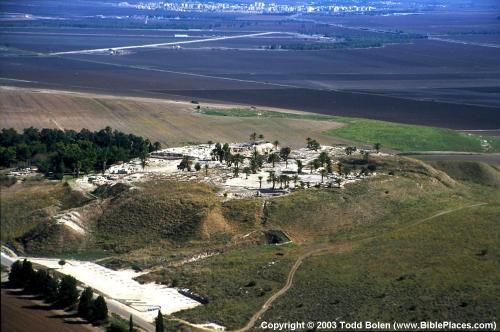
Ἁρμαγεδών [Harmagedōn]: “A Hebrew place-name meaning Mount or Hill of Megiddo and generally identified as the fortress overlooking a pass through the Carmel Range into Galilee.”52 From a combination of Hebrew הָר [hār], mountain, and מְגִדּוֹן [meḡiddôn] (Zec. 12:11), Megiddo. “Megiddo probably means a place of troops (from גַד [ḡaḏ]), a troop (Gen. 49:19); and the verb גָדַד [ḡāḏaḏ]), to cut to pieces.”53 Strong gives the meaning as “place of crowds.”54 “Since there is no specific mountain by that name, and Har can refer to hill country, it is probably a reference to the hill country surrounding the Plain of Megiddo, some sixty miles north of Jerusalem. More than two hundred battles have been fought in that region.”56Some find a reference to the hill country near Megiddo unconvincing and look for an alternative understanding:Har-Magedon would mean “the Mountain of Megiddo,” but here a difficulty arises: there is no Mount Megiddo. None of the solutions offered is especially persuasive. It is possible that Har-Magedon could be a reference to the hill country near Megiddo or perhaps a reference to Megiddo and Mount Carmel in the same breath (Farrer, p. 178). In John’s day the tell or mount upon which Megiddo was built was about seventy feet in height, hardly enough to justify the designation Mount. One frequent suggestion is that the Apocalyptist began with Ezekiel’s prophecy of a great eschatological slaughter of the nations on “the mountains of Israel” (Eze. 38:8-21; 39:2, 4, 17) and then made the reference more specific by adding the name Megiddo as the place where so often in Israel’s history the enemies of God were destroyed (Beckwith, p. 685). Still others interpret the term in reference to some ancient myth in which an army of demons assault the holy mountain of the gods. If one reads Armageddon (instead of Har-Magedon), the reference could be to the city of Megiddo rather than to a mountain. Others interpret Har-Magedon without reference to Megiddo. Bruce (p. 657), following C. C. Torrey, mentions har mōʿēd, the mount of assembly (Isa. 14:13). Or it could be a corruption in the Hebrew text for “his fruitful mountain” or the “desirable city” (i.e., Jerusalem). . . . Yet another suggestion is that Megiddo could be derived from a root meaning “to cut, attack, or maraud.” In this case Mount Megiddo would mean “the marauding mountain” (a variant to Jeremiah’s “destroying mountain,” Jer. 51:25) and indicate that John expected the battle not in northern Palestine but at Rome [Mounce takes Babylon to be Rome] (Caird, p. 207; cf. Kiddle, pp. 329-31). As in the case of the number of the beast (Rev. 13:18‣), the cryptic nature of the reference has thus far defeated all attempts at a final answer.57
It is our view that the phrase probably denotes the hill country near Megiddo, at the edge of the Jezreel Valley which is an optimum place to access the Promised Land by sea and to serve as a staging area for vast armies. The drying up of the Euphrates river, a real geographical location, so that kings from the east can be gathered to Armageddon argues that Armageddon itself is a real geographical location west of the Euphrates rather than to be taken as a spiritual concept. See Megiddo the seventh angel poured out his bowl into the air
The bowl is poured out into the air, ἀέρα [aera]. Elsewhere, Scripture gives Satan the title “prince of the power of the air (ἀέρος [aeros])” (Eph. 2:2). Paul explains that believers wrestle against “hosts of wickedness in the heavenly places” (Eph. 6:12), a reference to Satan and the angels which joined him in his rebellion (Rev. 12:4‣). Having been cast to the earth (Rev. 12:9‣), they no longer have access to the third heaven (the throne of God) or perhaps even the second heaven (starry space), but now are constrained to the earth and its immediate atmosphere, the “air.” At the Second Coming of Christ, the Beast and the False Prophet are captured and cast alive into the Lake of Fire (Rev. 19:20‣), but no mention is made of the fate of Satan until afterwards. It is at the pouring forth of this seventh bowl, that Satan’s realm is judged. The pouring forth of this bowl corresponds to the binding and sealing of Satan in the abyss (Rev. 20:1-3‣) and the confinement of the demons to the region of the wasteland that was previously Babylon (Rev. 18:2‣). See commentary on Revelation 18:2 and Revelation 20:1.a loud voice came out of the temple
Temple is ναοῦ [naou], which generally describes the inner sanctuary. See commentary on Revelation 11:1. The Temple was filled with God’s shekinah presence and then closed for the duration of the seven bowls (Rev. 15:8‣). The voice must be that of God the Father Who was alone in the Temple during this time. Thus, the declaration which follows gives the divine perspective on the results of the bowl judgments.it is done!
It is done is Γέγονεν [Gegonen], perfect tense, it has come to be. In the seventh bowl, the wrath has been poured out and the present condition of things at the time of the pronouncement reflects the destruction brought about by that wrath. This agrees with what John was told: that in these seven last plagues, the wrath of God is complete (Rev. 15:1‣).Here is more evidence against the idea that the bowl judgments are a recapitulation of previous seal or trumpet judgments, merely providing additional detail. For there is no indication at the opening of the seventh seal (Rev. 7:8‣) or in the sounding of the seventh trumpet (Rev. 11:15‣) that judgment has been completed, as here.58 The impossibility of a recapitulation is also seen in the closure of the heavenly Temple for the duration of the bowl judgments (Rev. 15:8‣), whereas during the seal and trumpet judgments, the heavenly Temple is not so sealed (Rev. 7:15‣; 11:19‣; 14:15‣, 17‣; 15:6‣). See Sequential Events.This may be the declaration of which Isaiah wrote :The sound of noise from the city! A voice from the temple! The voice of the LORD, Who fully repays His enemies! “Before she was in labor, she gave birth; before her pain came, she delivered a male child. Who has heard such a thing? Who has seen such things? Shall the earth be made to give birth in one day? Or shall a nation be born at once? For as soon as Zion was in labor, she gave birth to her children. Shall I bring to the time of birth, and not cause delivery?” says the LORD. “Shall I who cause delivery shut up the womb?” says your God. “Rejoice with Jerusalem, and be glad with her, all you who love her; rejoice for joy with her, all you who mourn for her; that you may feed and be satisfied with the consolation of her bosom, that you may drink deeply and be delighted with the abundance of her glory.” (Isa. 66:6-11)
The voice of the LORD is heard. The context is the full repayment of His enemies, as here. The woman in labor is the same woman we saw in Revelation 12‣. There, she struggled in a protracted labor. Here, she gives birth as soon as her labor pains began. There, her labor spoke of the age-long struggle to bring forth the promised Redeemer (Gen. 3:15). Here, her labor speaks of her time of Jacob’s Trouble which, although intense, is relatively short (7 years) in comparison with the thousands of years during which she labored to produce Messiah (Rev. 9:5‣). Of those seven, the last half were especially difficult, the “time, times, and half a time; and when the power of the holy people has been completely shattered, all these things shall be finished” (Dan. 12:7‣). At this birth, those who love Jerusalem are to rejoice with her for the long standing promise of Isaiah 62 will have found fulfillment in the ushering in of the Millennial Kingdom. See commentary on Revelation 12:2.Even in the finality of the statement by God attending the pouring forth of the seventh bowl, the full effects of the judgment have yet to play out and will not be finally behind until we reach Revelation 20:4‣. Even then, after the Millennial Kingdom, some cleanup operations remain. Satan will be loosed to lead the unfaithful in one last rebellion (Rev. 20:7-10‣) which will be put down by God. The unbelieving dead will be resurrected, judged, and undergo the second death (Rev. 20:11-15‣). The millennial heaven and earth will flee away (Rev. 20:11‣) to be recreated (Rev. 21:1‣) and then God will repeat this pronouncement in its absolute final sense—when death is no more and sin has been forever vanquished. “It is done!” (Rev. 21:6‣). The eternal state has then begun.Some may object to the interpretation of a statement of such finality found here by God as being other than that which ushers in the eternal state. Yet Scripture is clear that there are numerous “finishings” of God, depending on the task at hand: “So when Jesus has received the sour wine, He said, ‘It is finished!’ And bowing His head, He gave up His spirit” (John 19:30). there were noises and thunderings and lightnings
Noises is φωναὶ [phōnai] which could also be translated as “voices.” Initially, these sounds of judgment and power were manifested in heaven (Rev. 4:5‣). There, they were a warning of what has now finally come to the earth. See commentary on Revelation 4:5. In the prelude to the seven trumpet judgments, the angel of the altar threw his censer full of fire to the earth with similar results (Rev. 8:5‣). Together with the earthquake and the great hail, these manifestations of judgment point to the ark of the covenant containing the Ten Commandments (the “testimony”) by which the godless behavior of the earth dwellers is rightfully judged. See commentary on Revelation 16:21.there was a great earthquake
There are numerous earthquakes associated with the time of the end.For thus says the LORD of hosts: ‘Once more (it is a little while) I will shake heaven and earth, the sea and dry land; and I will shake all nations, and they shall come to the Desire of All Nations, and I will fill this temple with glory,’ says the LORD of hosts. (Hag. 2:6-7)
as had not occurred since men were on the earth
This earthquake is the most powerful earthquake since the sixth day when Adam and Eve were created. Although some tie it to the earthquake which attends Gog’s attack upon Israel, it is not the same earthquake. The attack by Gog upon Israel (Eze. 38, 39) is not part of the Tribulation events associated with the Campaign of Armageddon. Also, that earthquake, although felt all around the world, is localized in its immediate effects to the “land of Israel” (Eze. 38:19). The mountains that are thrown down, in the context, are the mountains of Israel where Gog will be defeated (Eze. 39:2). This may be the earthquake which attends the pressure of Messiah’s foot upon the Mount of Olives and results in its being split in two (Zec. 14:4). Now the great city was divided into three parts
Great city probably refers to Jerusalem,59 as it is contrasted with the cities of the nations (“Gentiles”) and Babylon. Although the same phrase elsewhere refers to Babylon (Rev. 14:8‣; 17:18‣; 18:10‣, 16‣, 18‣, 21‣), it is not exclusively hers. It is also used of Jerusalem (Rev. 11:8‣) and of the heavenly Jerusalem (Rev. 21:10‣). The division into three parts would more naturally speak of Jerusalem, for we know that the Mount of Olives will divide in two when Messiah returns (Zec. 14:4). Perhaps this causes a three-way division (north, south, and west) within Jerusalem itself.60 “First of all, the effects of the earthquake upon the great city, Jerusalem, are seen. It is not mentioned by name, but it is so clearly distinguished from ‘the cities of the nations,’ that there can be no doubt. Here is the moment of the fulfillment of several prophecies concerning geographical changes in Jerusalem.”61 The destruction which is prophesied for Babylon is far more severe than a mere division into three parts, but involves an overwhelming devastation resulting in her complete unfitness for further habitation. See The Destruction of Babylon.Thus, the purpose of the earthquake as it relates to Jerusalem is not to judge the city, but to enhance it. Jerusalem was judged earlier in the Tribulation by an earthquake, which led to the salvation of those who were not killed (Rev. 11:13‣). Thus, there is no need for further judgment on that city.62
Jerusalem alone, of all the great cities of the earth, is thus to be spared destruction by the earthquake at the end of the tribulation. It is the one eternal city, and will survive as long as the earth endures in its present form, finally being replaced as the new Jerusalem, in the new earth.63
and the cities of the nations fell
Nations is ἐθνῶν [ethnōn], translated elsewhere as “Gentiles,” (Mat. 4:15; 6:32; 10:5; 12:18; 20:19; Rev. 11:2‣; etc.). This refers to all the cities other than Jerusalem, including that center of ungodliness, Babylon itself. The cities of the nations fall because they are aligned implacably against God and have supported the Harlot (Rev. 17:13‣). Moreover, they are drunk with the “wine of the wrath of her fornication” (Rev. 14:8‣). Having participated in her fornication, they now suffer God’s wrath. See commentary on Revelation 14:8.Man has a proverb that God made the country and man made the town. Truly these great cites of the earth are heartless and cruel, and those who have lived close enough to their hearts to hear their poisonous beats, know how much evil is hid behind the great lights of the world’s great agglomerations. They are all to fall. . . . We believe, beyond any shadow of a doubt, that this prophecy covers Peking and Philadelphia, Moscow and Melbourne, Berlin and Buenos Aires, Cairo and the Cape, Bombay and Boston, Istanbul and Chicago, Naples and New York. In short, all the cities shall be destroyed. It cannot be otherwise.64
And great Babylon was remembered before God
The phrase great Babylon alludes to Nebuchadnezzar’s boastful statement made immediately before he was struck with an affliction by God, living like a beast for seven years (Dan. 4:30‣).65 Both Jerusalem and Babylon are “great” cities, and are affected by this mighty earthquake. But they are affected differently based on God’s different purposes for their future. Jerusalem is to be restored (Isa. 62) to be the home of The Abiding Presence of God (Isa. 60:3; Eze. 43:2-4) and serve as the capital of the Millennial Kingdom. Babylon is to be completely destroyed, permanently uninhabitable, and become a prison for unclean spirits (Isa. 13:21-22; Rev. 18:2‣). See commentary on Revelation 14:8. See The Destruction of Babylon.It should be noticed that there is a gradation in the judgments here meted out to the cities of the world. Just as the Lord announced that some would be beaten with few stripes and some with many, so there is a progress in the devastation that falls upon the habitations of men. Two parts of Jerusalem seem to be destroyed, all of the Gentile cities, but the greatest of all judgments is kept for Babylon, seat of Satan’s power.66
the cup of the wine of the fierceness of His wrath
Fierceness is θυμοῦ [thymou], translated as wrath in Rev. 14:10‣. Wrath is ὀργῆς [orgēs], translated as indignation in Rev. 14:10‣. Of the two, θυμοῦ [thymou] (here translated fierceness) is the more intense and shorter lasting. See commentary on Revelation 14:10. Concerning God’s wrath, see commentary on Revelation 16:17.The same cup with which she intoxicated the nations will now be used to serve her the wine of God’s wrath. “Render to her just as she rendered to you, and repay her double according to her works; in the cup which she has mixed, mix double for her” (Rev. 14:6‣). every island fled away and the mountains were not found
Unlike the earthquake attending the opening of the sixth seal in which “every mountain and island was moved out of its place” (Rev. 6:12-14‣), now every island flees away and the mountains are no longer found.Scientists cannot laugh at this idea because they, themselves, teach most earnestly that the mountains once rose to their present heights, and furnish us with abundance of geological data to prove their points. We agree, although we believe it was done, not by any slow process of evolution, but . . . just as God pours out his final wrath upon this earth.67
Such geographic alteration of the earth’s surface would seem to be attended by massive loss of life. And so Scripture attests by Jeremiah:I beheld the earth, and indeed it was without form, and void; and the heavens, they had no light. I beheld the mountains, and indeed they trembled, and all the hills moved back and forth. I beheld, and indeed there was no man, and all the birds of the heavens had fled. I beheld, and indeed the fruitful land was a wilderness, and all its cities were broken down at the presence of the LORD, by His fierce anger. For thus says the LORD: “The whole land shall be desolate; yet I will not make a full end. For this shall the earth mourn, and the heavens above be black, because I have spoken. I have purposed and will not relent, nor will I turn back from it.” (Jer. 4:23-28)
The scope of the vision, like so many prophetic glimpses of Old Testament prophets, transcends the then-impending application [the destruction of Judah wrought by the Babylonian armies] and envisions the worldwide woe of Israel in the “time of Jacob’s trouble” (Jer. 30:5-7) preceding Kingdom blessing (Rev. 6:1‣-19:21‣).68
Those saints yet living on the earth during this time will understand Psalm 46 in a completely literal way: “God is our refuge and strength, a very present help in trouble. Therefore we will not fear, even though the earth be removed, and though the mountains be carried into the midst of the sea . . . The nations raged, the kingdoms were moved, He uttered His voice, the earth melted” (Ps. 46:1-2, 6).The earth is essentially a ruin by the Second Coming of Christ. All of man’s environmental efforts and their pagan foundations will be for naught. For appeal to mother earth (Gaia) for shelter and sustenance will be of no avail when she herself is judged by Father God Who created the earth.In a similar way to how God will create a new heavens and a new earth after the final judgment (Rev. 21:1‣), He will regenerate the earth prior to the Millennial Kingdom. Jesus promised his disciples, “In the regeneration (παλιγγενεσίᾳ [palingenesia], again Genesis), when the Son of Man sits on the throne of His glory, you who have followed Me will also sit on twelve thrones, judging the twelve tribes of Israel” (Mat. 19:28). Isaiah also saw a “new heavens and a new earth,” but which is followed by childbirth, sin, and death (Isa. 65:17, 20, 23).69 It is by this regeneration that Jerusalem is lifted up above the surrounding lands (Zec. 14:10) to form the mountain of the Lord’s house from which will flow the river of life during the Millennium (Isa. 2:2; 27:13; 30:29; 56:7; Eze. 17:24; 20:40; 40:2; Mic. 4:1).Then Isaiah’s prophecy will become a literal reality:The voice of one crying in the wilderness: “Prepare the way of the LORD; make straight in the desert a highway for our God. Every valley shall be exalted and every mountain and hill brought low; the crooked places shall be made straight and the rough places smooth; the glory of the LORD shall be revealed, and all flesh shall see it together; for the mouth of the LORD has spoken.” (Isa. 40:3-5)
And the LORD rained hail on the land of Egypt. So there was hail, and fire mingled with the hail, so very heavy that there was none like it in all the land of Egypt since it became a nation. And the hail struck throughout the whole land of Egypt, all that was in the field, both man and beast; and the hail struck every herb of the field and broke every tree of the field. (Ex. 9:23b-25).
In Joshua’s long day, God stoned the Amorites with huge hailstones. “There were more who died from the hailstones than the children of Israel killed with the sword” (Jos. 10:11). This is the “treasury of hail which I have reserved for the time of trouble, for the day of battle and war” (Job 38:22). In his time, Gog is to suffer a similar fate upon the mountains of Israel (Eze. 38:22).70Bullinger mentions an interesting historical record which shows that large hail occurs even in the absence of God’s supernatural hand as in this time of the end:“Hail is of frequent occurrence in these unhappy districts, and the dimensions of the hailstones are generally enormous. We have seen some that weighted twelve pounds. One moment sometimes suffices to exterminate whole flocks. In 1843, during one of these storms, there was heard in the air a sound as of a rushing wind, and therewith fell in a field near a house, a mass of ice larger than an ordinary millstone. It was broken to pieces with hatchets; yet though the sun burned fiercely, three days elapsed before these pieces entirely melted.” [Travels in Tartary, by M. Huc, vol. i., p. 12. “National Illustrated Library”]71
The earth dwellers are being stoned for blasphemy and rebellion against the righteous commands of God, the “testimony” in the “tabernacle of the testimony,” from which the angels having the last seven plagues came forth (Rev. 15:6‣). The “testimony” which witnesses against them is the tablets of stone stored within the ark of the covenant upon which God wrote the Ten Commandments in his own hand. Similar manifestations of judgment as these attended John’s vision of the ark following the sounding of the seventh trumpet prior to the pouring forth of the seven bowls of God’s wrath (Rev. 11:19‣). These manifestations included lightnings, noises, thunderings, an earthquake, and great hail—all of which have now been delivered to the blasphemers in the pouring of the last bowl. See commentary on Revelation 11:19. See The Plagues of Egypt and the Tribulation.about the weight of a talent
Ὡς ταλαντιαία [Hōs talantiaia], as a talent. “A measure of weight varying in size from about 58 to 80 lb. (26 to 36 kg.).”72Just as there are long and short tons of differing weights, so there are various talents. That with which the Jews weighed silver was about 120 pounds Troy, or 96 pounds avoirdupois. That for weighing other materials was about 135 pounds. The Babylonian talent was even heavier while the Greek talent was about 86 pounds. The lightest of all was the Attic talent which weighted 57.7 pounds. In biblical usage, it would be the silver talent of 96 pounds that would almost certainly be designated. However, even if we take the smaller Attic talent, we have a weight that is considerable.73
These are no ordinary hailstones, but the supernatural work of God. “A point of similarity between Joshua 10:11 and Revelation 16:21‣ is found in the fact that both passages describe the hailstones as large in size. . . . Clearly Joshua 10:11 describes a supernatural event.”74True to form, the preterist interpreters attempt to find fulfillment of this obviously supernatural drama in the relatively puny machinations of Rome’s siege of Jerusalem (remember that for many preterists, “Babylon” = “Jerusalem”). They make much ado about a passage in Josephus which mentions the weight and color of the stones thrown by the Roman “engines” [catapults] in the siege of Jerusalem:The engines, that all the legions had ready prepared for them, were admirably contrived; but still more extraordinary ones belonged to the tenth legion: those that threw darts and those that threw stones, were more forcible and larger than the rest, by which they not only repelled the excursions of the Jews, but drove those away that were upon the walls also. (270) Now, the stones that were cast were of the weight of a talent, and were carried two furlongs and farther. The blow they gave was no way to be sustained, not only by those that stood first in the way, but by those that were beyond them for a great space. (271) As for the Jews, they at first watched the coming of the stone, for it was of a white color, and could therefore not only be perceived by the great noise it made, but could be seen also before it came by its brightness. [emphasis added]75
Notice the priority inversion typical of preterist interpretation.76 They attach great importance to small details which happen to match the text (e.g., the stones were white, they weighed a talent), but then ignore the many details from the wider context which completely preclude their conclusion. In the A.D. 70 destruction of Jerusalem:Men blasphemed God
They are being stoned for earlier blasphemies, as per the penalty recorded in the “testimony” (Rev. 15:5‣):Take outside the camp him who has cursed; then let all who heard him lay their hands on his head, and let all the congregation stone him. Then you shall speak to the children of Israel, saying: ’Whoever curses his God shall bear his sin. ’And whoever blasphemes the name of the LORD shall surely be put to death. All the congregation shall certainly stone him, the stranger as well as him who is born in the land. When he blasphemes the name of the LORD, he shall be put to death. (Lev. 24:14-16)
Since the law of God provided that blasphemers should be stoned with stones until they died, so we see in the last moments of earth’s civilization, God Himself upholds His law and stones blasphemers with hailstones.77
By now there is no possibility of repentance, their doom is sealed: those that remain alive continue in their blasphemous cursing.that plague was exceedingly great
Μεγάλη ἐστὶν ἡ πληγὴ αὐτῆς σφόδρα [Megalē estin hē plēgē autēs sphodra], great it is the plague of it extremely. In case the reader is tempted to take the passage as hyperbole, the Spirit reemphasizes the supernatural aspect of the judgment of hail. Consider the devastation wrought, not only by the huge earthquake, but by such large hailstones striking the earth at one hundred and eighty miles an hour.78 Exceedingly great may be an understatement!When God’s word guarantees such a stark day of doom, why do many continue in their rejection of Him? Indeed, looking back, why did I myself reject God for some 34 years? Oh that their eyes would be opened to the truth of His abundant mercy and great patience while there is yet the possibility of turning to Him! A time is coming upon the earth when it will no longer be possible to repent. Then, their fate will be sealed. But today, there is still time to reconsider and come into the saving faith of Jesus Christ.God’s eschatological and eternal wrath is inevitable; no one can prevent or hinder it from coming (Isa. 43:13). But there is a way to escape it, because “there is now no condemnation for those who are in Christ Jesus” (Rom. 8:1). Those who by faith trust in Christ alone for salvation will escape both God’s eschatological wrath (Rev. 3:10‣) and His eternal wrath (1Th. 1:10). They will not face judgment, because their sins were judged when Jesus died in their place on the cross (2Cor. 5:21; 1Pe. 2:24). In light of the inevitable judgment to come, the warning to all unrepentant sinners is “Today if you hear His voice, do not harden your hearts” (Heb. 4:7).79
Has your conscience never smitten you, and made your sleep uneasy, and tinged your thinking with bitterness, for the sort of life you have been leading? Is there not some conscious shame and sense of wretchedness going along with the indulgence even of those darling lusts and dislike of sacred things which you allow to have place in your heart? And what is all this but the premonitory drops of that wrath of God which must presently come in great deluging showers? O child of man, give heed, and turn, and fly, before the threatening avalanche of the Almighty’s judgments comes!80
Notes
1Merrill F. Unger, Unger’s Commentary on the Old Testament (Chattanooga, TN: AMG Publishers. 2002), Ps. 78:2-3.
2“This verse continues by saying the Lord has ‘decreed’ the following: (1) the atrocities will not go on forever (cf. Luke 21:24) but will have an end, and (2) ‘the desolating one’ (שֹׁמֵם [šōmēm], a Qal active participle alluding to the antichrist) will be judged. ‘The desolating one’ or ‘one who makes desolate’ is preferred to ‘make [something] desolate’ because שֹׁמֵם [šōmēm] is intransitive.”—Charles H. Ray, “A Study of Daniel 9:24-17, Part IV,” in The Conservative Theological Journal, vol. 6 no. 18 (Fort Worth, TX: Tyndale Theological Seminary. August 2002), 212. Thus: “even until a complete destruction, one that is decreed, is poured out on the one who makes desolate” (NASU).
3“The choice of ‘is poured out’ (תִּתַּךְ [tittak], a Qal imperfect) as the verb reminds the reader of ‘flood’ in v. 26. It can be used figuratively (Job 10:10) or literally (Ex. 9:33). Students of prophecy also look to Revelation 16‣ where bowls of God’s wrath are poured out during the end times.”—Ibid.
4Donald Grey Barnhouse, Revelation (Grand Rapids, MI: Zondervan Publishing House. 1971), 288.
5E. W. Bullinger, Commentary On Revelation (Grand Rapids, MI: Kregel Publications. 1984, 1935), Rev. 16:1.
6J. A. Seiss, The Apocalypse: Lectures on the Book of Revelation (Grand Rapids, MI: Zondervan Publishing House. 1966), 871.
7Timothy Friberg, Barbara Friberg, and Neva F. Miller, Analytical Lexicon of the Greek New Testament (Grand Rapids, MI: Baker Books. 2000), 144.
8Frederick William Danker and Walter Bauer, A Greek-English Lexicon of the New Testament and Other Early Christian Literature (Chicago, IL: University of Chicago Press. 2000), 397.
9Ibid., 690.
10Robert H. Mounce, The Book of Revelation (Grand Rapids, MI: William B. Eerdmans Publishing Co. 1977), Rev. 16:1.
11Monty S. Mills, Revelations: An Exegetical Study of the Revelation to John (Dallas, TX: 3E Ministries. 1987), Rev. 16:3.
12Mounce, The Book of Revelation, 291.
13Barnhouse, Revelation, 291.
14John MacArthur, Revelation 12-22 : The MacArthur New Testament Commentary (Chicago, IL: Moody Press. 2000), Rev. 16:4.
15No reference is intended to the angel which “went down at a certain time into the pool and stirred up the water” (John 5:4). Nor is this meant to indicate some sort of special angel: “He is undoubtedly a creature of the order of angels, and it is interesting to note that he has a title that would indicate that he had been placed in charge of the flowing waters of earth. Here we have an angel who is master of the waters.”—Barnhouse, Revelation, 292. We disagree—the most natural meaning is merely a reference to the angel in the previous verse who poured forth the bowl upon the water. “There is some merit in the suggestion that the ‘angel of the waters’ is simply the angel of the previous verse who poured out his bowl upon ‘the waters’ (Lenski, p. 469).”—Mounce, The Book of Revelation, Rev. 16:5.
16Bullinger, Commentary On Revelation, Rev. 16:7.
17Danker, A Greek-English Lexicon of the New Testament and Other Early Christian Literature, 425.
18“This plague will apparently affect the whole of mankind, including the saints alive at the time (Rev. 7:16‣).”—Mills, Revelations: An Exegetical Study of the Revelation to John, Rev. 16:8.
19Concerning worship of heavenly bodies: Gen. 11:4; Deu. 4:19; 17:3; 2K. 17:16; 23:5, 11; 2Chr. 33:3; Job 31:26-28; Isa. 47:13; Jer. 8:2; 10:2; 19:13; Acts 7:42; Rom. 1:25; Rev. 8:12‣.
20Barnhouse, Revelation, 296.
21MacArthur, Revelation 12-22 : The MacArthur New Testament Commentary, Rev. 16:8.
22Unger, Unger’s Commentary on the Old Testament, Isa. 24:6.
23Barnhouse, Revelation, 297.
24William R. Newell, Revelation: Chapter by Chapter (Grand Rapids, MI: Kregel Publications. 1994,c1935), Rev. 16:10.
25Barnhouse, Revelation, 298.
26From lux, “light,” and fero, “to bear, bring, carry.”
27Friberg, Analytical Lexicon of the Greek New Testament, 322.
28A. R. Fausset, “The Revelation of St. John the Divine,” in Robert Jamieson, A. R. Fausset, and David Brown, A Commentary, Critical and Explanatory, on the Old and New Testaments (Oak Harbor, WA: Logos Research Systems, Inc. 1997, 1877), Rev. 16:10.
29Seiss, The Apocalypse: Lectures on the Book of Revelation, 374.
30It is likely that its name is among the oldest names of rivers, but that its modern source and location probably do not match that of the pre-flood Euphrates due to the great changes in geography which almost certainly attended the break up of the fountains of the deep at the Flood.
31Herodotus, History of the Persian Wars, 1:190-191 cited by [John F. Walvoord, Daniel: The Key to Prophetic Revelation (Chicago, IL: Moody Bible Institute. 1971), 129-130].
32Henry Morris, The Revelation Record (Wheaton, IL: Tyndale House Publishers. 1983), Rev. 16:12.
33Unger, Unger’s Commentary on the Old Testament, Isa. 11:12.
34“Only the floods of the Nile . . . are mentioned, because the allusion to the slavery of Israel in Egypt predominates, and the redemption of the Israelites out of all the lands of the nations is represented as bringing out of the slave-house of Egypt. The drying up of the flood-depths of the Nile is therefore a figure denoting the casting down of the imperial power in all its historical forms.”—Carl Friedrich Keil and Franz Delitzsch, Commentary on the Old Testament (Peabody, MA: Hendrickson. 2002), Zec. 10:11.
35“Thus the Red Sea and the Euphrates in the former part of the verse answer to ‘Assyria’ and ‘Egypt’ in the latter.”—Fausset, The Revelation of St. John the Divine, Zec. 10:11.
36Arnold G. Fruchtenbaum, The Footsteps of Messiah, rev ed (Tustin, CA: Ariel Ministries. 2003), 316.
37Bullinger, Commentary On Revelation, Rev. 16:12.
38John F. Walvoord, The Revelation of Jesus Christ (Chicago, IL: Moody Press. 1966), Rev. 16:12.
39Seiss, The Apocalypse: Lectures on the Book of Revelation, 378.
40Mounce, The Book of Revelation, Rev. 16:13.
41The spirit provided a rumor, an untruth. Hence we can conclude that it was not the spirit of an elect angel. Moreover, elect angels are not portrayed as disembodied spirits.
42Concerning demons as unclean spirits: Mat. 8:16; 10:1; 12:43; Mark 1:23, 26, 27; 5:2, 8, 13; 6:7. 7:25. 9:25; Luke 4:33, 36; 6:18; 8:29; 9:42; 11:24; Acts 5:16; 8:7; Rev. 16:13‣; 18:2‣.
43Danker, A Greek-English Lexicon of the New Testament and Other Early Christian Literature, 561.
44Richard Chenevix Trench, Commentary on the Epistles to the Seven Churches in Asia (Eugene, OR: Wipf and Stock Publishers. 1861), 337.
45Alan F. Johnson, Revelation: The Expositor’s Bible Commentary (Grand Rapids, MI: Zondervan Publishing House. 1966), Rev. 16:15.
46Seiss, The Apocalypse: Lectures on the Book of Revelation, 379.
47Robert L. Thomas, Revelation 8-22 (Chicago, IL: Moody Press. 1995), Rev. 16:15.
48The Gregorian chant is named after St. Gregory, the watching one.
49Concerning the need for watchfulness: Mat. 24:42; 25:13; Mark 13:33, 35, 37; Luke 12:36-40; 21:36; 1Cor. 1:7; 16:13; Php. 3:20; 1Th. 1:10; 5:6; 2Ti. 4:8; Tit. 2:13; Heb. 9:28; 2Pe. 3:12; Rev. 3:2-3‣; Rev. 16:15‣.
50Friberg, Analytical Lexicon of the Greek New Testament, 80.
51The scenarios which involve one will be taken and the other left (e.g., Mat. 24:40-44; Luke 17:34-37) appear to speak of being taken in judgment at the time of His second advent.
52Ibid., 74.
53Bullinger, Commentary On Revelation, Rev. 16:16.
54James Strong, The Exhaustive Concordance of the Bible (Ontario: Woodside Bible Fellowship. 1996), H4023.
55Copyright © 2003 www.BiblePlaces.com. This image appears by special permission and may not be duplicated for use in derivative works.
56MacArthur, Revelation 12-22 : The MacArthur New Testament Commentary, Rev. 16:18.
57Mounce, The Book of Revelation, Rev. 16:16.
58At the sounding of the seventh trumpet, declaration is made of the eventual result of the completion of judgments, but the final judgments themselves remain future.
59Several interpreters take “great city” here to refer to Babylon: [Bullinger, Commentary On Revelation], [Fausset, The Revelation of St. John the Divine].
60Preterist interpreters see mention of three parts as an application of the judgment to befall Jerusalem in the days of Ezekiel. “It is an echo of Ezekiel 5:1-12, where the prophet was required to shave his hair from his head, divide it into three parts, and conduct a symbolic action upon each part. He was told by God ‘This is Jerusalem’ (Eze. 5:5). One third of the hair was burned, another third was to be chopped up with a sword, and the remaining third was to be scattered into the wind. This symbolized the fate of the inhabitants of Jerusalem in 586 B.C.: some were to be burned inside the city, some would be slain by the swords of the Babylonians, and the rest would be scattered among the nations. That which happened in 586 B.C. happened again in A.D. 70. The dividing of the city into three parts symbolizes that fact.”—Steve Gregg, Revelation Four Views: A Parallel Commentary (Nashville, TN: Thomas Nelson. 1997), 392. No statistics from the A.D. 70 destruction are given in support of this claim.
61Barnhouse, Revelation, 307.
62MacArthur, Revelation 12-22 : The MacArthur New Testament Commentary, Rev. 16:19.
63Morris, The Revelation Record, Rev. 16:19.
64Barnhouse, Revelation, 308.
65As we noted elsewhere, a striking parallel to the 70th Week of Daniel during which another Beast prevails.
66Ibid., 308-309.
67Ibid., 309.
68Unger, Unger’s Commentary on the Old Testament, Jer. 4:23.
69Either Isaiah saw the regeneration prior to the Millennium, or the text of Isaiah 65 is not strictly sequential—a characteristic not unknown in prophetic passages.
70Concerning hailstones from God: Ex. 9:23-25; Jos. 10:11; Job 38:22; Ps. 18:12; 78:47; 105:32; 147:17; 148:8; Isa. 28:2, 17; 30:30; 32:19; Eze. 13:11; 38:22; Hag. 2:17; Rev. 8:7‣; 11:19‣; 16:21‣.
71Bullinger, Commentary On Revelation, Rev. 16:21.
72Danker, A Greek-English Lexicon of the New Testament and Other Early Christian Literature, 803.
73Barnhouse, Revelation, 309.
74Larry Spargimino, “How Preterists Misuse History to Advance their View of Prophecy,” in Tim LaHaye and Thomas Ice, eds., The End Times Controversy (Eugene, OR: Harvest House Publishers. 2003), 217.
75Flavius Josephus, The Complete Works of Josephus (Grand Rapids, MI: Kregel Publications. 1981), s.v. “Wars V, vi, 3.”
76 [Gregg, Revelation Four Views: A Parallel Commentary, 394], [David Chilton, The Days of Vengeance (Tyler, TX: Dominion Press. 1987), 417].
77Barnhouse, Revelation, 310.
78The terminal velocity of ice. [Mills, Revelations: An Exegetical Study of the Revelation to John, Rev. 16:18]
79MacArthur, Revelation 12-22 : The MacArthur New Testament Commentary, Rev. 16:21.
80Seiss, The Apocalypse: Lectures on the Book of Revelation, 375.