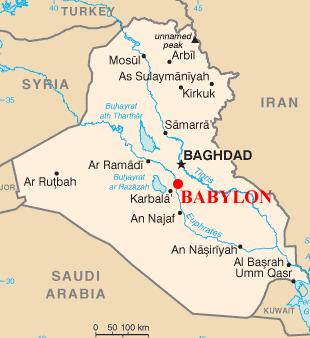
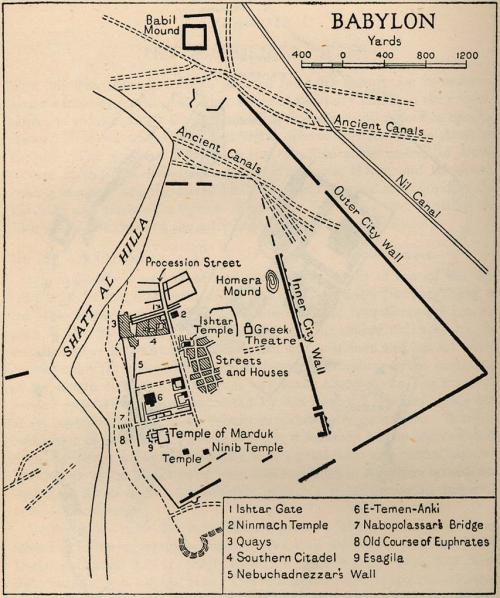
Cush begot Nimrod; he began to be a mighty one on the earth. He was a mighty hunter before the LORD; therefore it is said, “Like Nimrod the mighty hunter before the LORD.” And the beginning of his kingdom was Babel, Erech, Accad, and Calneh, in the land of Shinar. From that land he went to Assyria and built Nineveh, Rehoboth Ir, Caleh and Resen between Nineveh and Calah (that is the principal city). (Gen. 10:8-12 cf. 1Chr. 1:10)2 [emphasis added]
It was Nimrod who established a kingdom at Babel. In fact, this is the first mention of the concept of kingdom in Scripture. In a very real sense, Nimrod was the first king. And in order to be a king, one needs to have subjects and a realm. This implies centralization in a way which ran counter to God’s command following the flood: “Be fruitful and multiply, and fill the earth” (Gen. 9:1, 7 cf. Gen. 1:22, 28). Reading between the lines, we can already see the seeds of rebellion.Now the whole earth had one language and one speech. And it came to pass, as they journeyed from the east, that they found a plain in the land of Shinar, and they dwelt there. Then they said to one another, “Come, let us make bricks and bake them thoroughly.” They had brick for stone, and they had asphalt for mortar. And they said, “Come, let us build ourselves a city, and a tower whose top is in the heavens; let us make a name for ourselves, lest we be scattered abroad over the face of the whole earth.” But the LORD came down to see the city and the tower which the sons of men had built. And the LORD said, “Indeed the people are one and they all have one language, and this is what they begin to do; now nothing that they propose to do will be withheld from them. Come, let Us go down and there and confuse their language, that they may not understand one another’s speech.” So the LORD scattered them abroad from there over the face of all the earth, and they ceased building the city. Therefore its name is called Babel, because there the LORD confused the language of all the earth; and from there the LORD scattered them abroad over the face of all the earth. (Gen. 11:1-9)
Although Scripture is not overtly negative concerning Nimrod, his involvement establishing the first kingdom and initiating a building project which resulted in a severe judgment from God (the introduction of languages) clearly indicates his sinful ambitions.Babylon has from its inception symbolized evil and rebellion against God. It was founded by Nimrod (Gen. 10:9), a proud, powerful, God-rejecting ruler. Babel (Babylon) was the site of the first organized system of idolatrous false religion (Gen. 11:1-4). The Tower of Babel, the expression of that false religion, was a ziggurat; an edifice designed to facilitate idolatrous worship. God judged the people’s idolatry and rebellion by confusing their language and scattering them over the globe (Gen. 11:5-9). Thus the seeds of idolatry and false religion spread around the world from Babylon, to take root wherever these proud rebels and their descendants settled.3
There is also abundant tradition concerning the rebellion of Nimrod:Now it was Nimrod who excited them to such an affront and contempt of God. He was the grandson of Ham, the son of Noah,— a bold man, and of great strength of hand. He persuaded them not to ascribe it to God as if it was through his means they were happy, but to believe that it was their own courage which procured that happiness. He also gradually changed the government into tyranny,—seeing no other way of turning men from the fear of God, but to bring them into a constant dependence upon his power. He also said he would be revenged on God, if he should have a mind to drown the world again; for that he would build a tower too high for the waters to be able to reach! and that he would avenge himself on God for destroying their forefathers!4
According to the Sages, Nimrod was the primary force behind this rebellion. The Midrashim explain his sinister motive. He planned to build a tower ascending to Heaven and, from it, wage war against God.5
The Targum of Jonathan says, “From the foundation of the world none was ever found like Nimrod, powerful in hunting, and in rebellions against the Lord.” The Jerusalem Targum says, “He is powerful in hunting and in wickedness before the Lord, for he was a hunter of the sons of men, and he said to them, ‘Depart from the judgment of the Lord, and adhere to the judgment of Nimrod!’ Therefore as it is said, ‘As Nimrod is the strong one, strong in hunting, and in wickedness before the Lord.’ ” The Chaldee paraphrase of I Chronicles 1:10 says, “Cush begat Nimrod, who began to prevail in wickedness, for he shed innocent blood, and rebelled against Jehovah.”6
In the founding of Babel was the foundation for what would later flower as Babylon under Nebuchadnezzar and figure so highly in the events of Scripture, especially the book of Daniel which we have seen is key to understanding much of the book of Revelation.Another negative connotation concerning Babel may be seen in the proverb taken up by Isaiah concerning the king of Babylon:Take up this proverb against the king of Babylon . . . How you are fallen from heaven, O Lucifer, son of the morning! How you are cut down to the ground, You who weakened the nations! For you have said in your heart: ‘I will ascend into heaven, I will exalt my throne above the stars of God; I will also sit on the mount of the congregation on the farthest sides of the north; I will ascend above the heights of the clouds, I will be like the Most High.’ Yet you shall be brought down to Sheol, to the lowest depths of the Pit. Those who see you will gaze at you, and consider you, saying: ‘Is this the man who made the earth tremble, who shook kingdoms?’ (Isa. 14:4, 12-16)
The connection between Satan (here Lucifer) and Babylon is seen in this proverb which begins with the human king in view, but soon goes far beyond what could be said of the human king to identify the spiritual power motivating the king (cf. Eze. 28:12). Since Satan has been active in the affairs of the world since the creation of mankind, it is no surprise to find his influence in the realm of corrupt kings and kingdoms extending far back in history. Portions of the proverb, “Is this the man who made the earth tremble, who shook kingdoms”, appear to speak of the ultimate king of Babylon at the time of the end, the Antichrist:Isaiah thus makes the Babylonian monarch speak according to the ideas of his people . . . and at the same time reflects the satanic spirit of self-deification to appear in fullest development in the last king of Babylon, the Antichrist (Rev. 13:8‣).7
Prior to the introduction of languages by God, the majority of mankind refused to disperse across the globe, but gathered in the region of Shinar instead. The result of the introduction of language was the scattering of different language groups over the face of all the earth (Gen. 11:9). This initial centralization, followed by the global distribution, is the primary mechanism by which Babylon became the central influence in all cultures and civilizations which followed. This is how she came to sit on “peoples, multitudes, nations, and tongues” (Rev. 17:15‣).In the record of Babel, as minimal as it is, we see the first human king and kingdom in direct rebellion to the commands of God resulting in judgment. In Babylon of the end, we will see the last human king and kingdom in ultimate rebellion to the commands of God resulting in the final judgment of all human kingdoms to be replaced by the Millennial Kingdom ruled by Messiah. See The Beast. See #16 - Beast.The city fell by complete surprise. Half of the metropolis was captured before the rest of it was “aware” of the fact, according to Herodotus. Cyrus diverted the waters of the Euphrates and by night entered the city through the dried up channel (Dan. 5:30-31‣).8
Rather than being physically overthrown, as predicted by Isaiah (Isa. 13, 14, 47) and Jeremiah (Jer. 50, 51), the city and its occupants were treated with considerable respect:On . . . Oct. 29, 539 B.C., sixteen days after the capitulation, Cyrus himself entered the city amid much public acclaim, ending the Chaldean dynasty as predicted by the Hebrew prophets (Isa. 13:21; Jer. 50f). Cyrus treated the city with great respect, returning to their own shrines the statues of the deities brought in from other cities. The Jews were sent home with compensatory assistance. He appointed new governors, so ensuring peace and stable conditions essential to the proper maintenance of the religious centers.9
Babylon generally flourished under the Persians, although there is record of a revolt against Xerxes I which resulted in a harsh response:Under the Persians, Babylon retained most of its institutions, became capital of the richest satrapy in the empire, and, according to Herodotus, the world’s most splendid city. A revolt against Xerxes I (482) led to destruction of its fortifications and temples and the melting down of the golden image of Marduk.10
In subsequent campaigns which took control of Babylon, rather than being violently overthrown, the city slowly decayed due to competition and neglect:On October 12, 539 B.C., Babylon fell to Cyrus of Persia, and from that time on the decay of the city began. Xerxes plundered it. Alexander the Great thought to restore its great temple, in ruins in his day, but was deterred by the prohibitive cost. During the period of Alexander’s successors the area decayed rapidly and soon became a desert. From the days of Seleucus Nicator (312-280 B.C.), who built the rival city of Seleucia on the Tigris, queenly Babylon never revived.11
Even when Greece, the great leopard beast of Daniel’s night vision (Dan. 7:6‣) came calling in the person and empire of Alexander the Great, the city was not destroyed:[On] Oct. 1, 331 B.C., Alexander marched to Babylon, where the Macedonian was triumphantly acclaimed, the Persian garrison offering no opposition. He offered sacrifices to Marduk, ordered the rebuilding of temples that Xerxes allegedly had destroyed, and then a month later moved on to Susa.12
Alexander subsequently returned to Babylon with great construction plans to make it his capital, but these were interrupted by his death in 323 B.C. After Alexander, the city was ruled by a series of kings including Seleucus I (323-250) during which Babylon’s economic—but not religious importance—declined sharply due to competition with the establishment by Antiochus I of a new capital at Seleucia on the Tigris (274 B.C.). Later, the city remained a center of Hellenism, supporting Jews in Palestine who opposed Herod.13 After the destruction of the Second Temple by Rome in A.D. 70, many Jews left Jerusalem for the area of Babylon. This trend increased after the Bar Kokhba war.14 The region of Babylon became an important center for Jewry outside Israel:After the destruction of the Second Temple in 70 C.E., and especially after the war of Bar Kokhba (132-35 C.E.), some scholars went down from Palestine to Babylon. The arrival of “Abba the Tall,” Rab, in approximately 219, brought about a period of prosperity in the study of the Law in Babylon. Rab in Sura and Shmuel in Nehardea gave public instruction in the Law and trained many pupils. In this period academies were established, and they continued to exert an influence on Jews, not only in Babylon but throughout all the lands of their dispersion, as late as the 12th century.15
Although the city still stood when Roman emperor Trajan entered it in A.D. 115, by about A.D. 200 the site of the city was deserted.16 Thereafter, the city was mostly forgotten until the 1800s when archaeological expeditions began to investigate the site. In the mid-1960s, the Iraqi Department of Antiquities carried out further work at the site. “The Ishtar gateway . . . was partially restored together with the Procession Way . . . The Ninmah temple was reconstructed, and a museum and rest house built on the site, which is also partially covered by the village of Jumjummah.”17 In more recent times, Saddam Hussein built himself a palace on a man-made hill beside the footprint of the original city. Then, in 1987, he ordered construction of a replica of Nebuchadnezzar’s vast palace on the original site. Museums were also built. But since his fall from power in 2003, his private palace was ransacked by mobs and two museums at the site were looted. During almost this entire time, there have been people occupying the site or living nearby—in stark contrast to the predictions of Scripture concerning the uninhabitable wasteland it is predicted to one day become.19And Babylon, the glory of kingdoms, the beauty of the Chaldean’s pride, will be as when God overthrew Sodom and Gomorrah. It will never be inhabited, nor will it be settled from generation to generation; nor will the Arabian pitch tents there, nor will the shepherds make their sheepfolds there. (Isa. 13:19-20)
“And look, here comes a chariot of men with a pair of horsemen!” Then he answered and said, “Babylon is fallen, is fallen! And all the carved images of her gods He has broken to the ground.” Oh, my threshing and the grain of my floor! That which I have heard from the LORD of hosts, The God of Israel, I have declared to you. (Isa. 21:9-10)
Therefore evil shall come upon you; you shall not know from where it arises. And trouble shall fall upon you; you will not be able to put it off. And desolation shall come upon you suddenly, which you shall not know. (Isa. 47:11)
Because of the wrath of the Lord she shall not be inhabited, but she shall be wholly desolate. Everyone who goes by Babylon shall be horrified and hiss at all her plagues. (Jer. 50:13)
Come against her from the farthest border; open her storehouses; cast her up as heaps of ruins, and destroy her utterly; let nothing of her be left. (Jer. 50:26)
“Therefore the wild desert beasts shall dwell there with the jackals, and the ostriches shall dwell in it. It shall be inhabited no more forever, nor shall it be dwelt in from generation to generation. As God overthrew Sodom and Gomorrah and their neighbors,” says the Lord, “So no one shall reside there, nor son of man dwell in it.” (Jer. 50:39-40)
“They shall not take from you a stone for a corner nor a stone for a foundation, but you shall be desolate forever,” says the LORD. (Jer. 51:26)
And the land will tremble and sorrow; for every purpose of the LORD shall be performed against Babylon, to make the land of Babylon a desolation without inhabitant. (Jer. 51:29)
Her cities are a desolation, a dry land and a wilderness, a land where no one dwells, through which no son of man passes. (Jer. 51:43)
Thus says the Lord of hosts: “The broad walls of Babylon shall be utterly broken, and her high gates shall be burned with fire; the people will labor in vain, and the nations, because of the fire; and they shall be weary.” (Jer. 51:58)
And Jeremiah said to Seraiah, “When you arrive in Babylon and see it, and read all these words, then you shall say, ‘O LORD, You have spoken against this place to cut it off, so that none shall remain in it, neither man nor beast, but it shall be desolate forever.’ ” (Jer. 51:61-62)
And the ten horns which you saw on the beast, these will hate the harlot, make her desolate and naked, eat her flesh and burn her with fire. (Rev. 17:16‣)
And he cried mightily with a loud voice, saying, “Babylon the great is fallen, is fallen, and has become a dwelling place of demons, a prison for every foul spirit, and a cage for every unclean and hated bird!” (Rev. 18:2‣)
Therefore her plagues will come in one day-death and mourning and famine. And she will be utterly burned with fire, for strong is the Lord God who judges her. The kings of the earth who committed fornication and lived luxuriously with her will weep and lament for her, when they see the smoke of her burning, standing at a distance for fear of her torment, saying, “Alas, alas, that great city Babylon, that mighty city! For in one hour your judgment has come.” (Rev. 18:8-10‣)
For in one hour such great riches came to nothing. Every shipmaster, all who travel by ship, sailors, and as many as trade on the sea, stood at a distance and cried out when they saw the smoke of her burning, saying, “What is like this great city?” They threw dust on their heads and cried out, weeping and wailing, and saying, “Alas, alas, that great city, in which all who had ships on the sea became rich by her wealth! For in one hour she is made desolate.” (Rev. 18:17-19‣)
Then a mighty angel took up a stone like a great millstone and threw it into the sea, saying, “Thus with violence the great city Babylon shall be thrown down, and shall not be found anymore.” (Rev. 18:21‣)
Again they said, “Alleluia! Her smoke rises up forever and ever!” (Rev. 19:3‣)
Her destruction is said to be literal and catastrophic like that of Sodom and Gomorrah. Her walls will be completely destroyed and her gates burned with fire. There will be nothing left of her, no person shall ever reside there, nor will any building material be taken from her ruins. This destruction will be sudden, complete, and permanent. It seems clear that Babylon has yet to suffer in the way which God has so extensively foretold.Not only are the OT prophecies of Isaiah and Jeremiah unfulfilled in the history of Babylon, but John’s vision recorded in approximately 95 A.D. reiterates and even extends these predictions. Either God is a God of wholesale and extensive exaggeration or a literal destruction remains pending. It is impossible, unscriptural, and irreverent to believe that such an extensive portion of God’s word is to be spiritualized or taken as hyperbole.Wail, for the day of the LORD is at hand! It will come as destruction from the Almighty. Therefore all hands will be limp, every man’s heart will melt, and they will be afraid. Pangs and sorrows will take hold of them; they will be in pain as a woman in childbirth; they will be amazed at one another; their faces will be like flames. Behold, the day of the LORD comes, cruel, with both wrath and fierce anger, to lay the land desolate; and He will destroy its sinners from it. For the stars of heaven and their constellations will not give their light; the sun will be darkened in its going forth, and the moon will not cause its light to shine. I will punish the world for its evil, and the wicked for their iniquity; I will halt the arrogance of the proud, and will lay low the haughtiness of the terrible. I will make a mortal more rare than fine gold, a man more than the golden wedge of Ophir. Therefore I will shake the heavens, and the earth will move out of her place, in the wrath of the LORD of hosts and in the day of His fierce anger. (Isa. 13:6-13)
In another key passage concerning the destruction of Babylon, Jeremiah relates that the time is to be connected with the national regeneration of Israel: “ ‘In those days and in that time,’ says the LORD, ‘The iniquity of Israel shall be sought, but there shall be none; And the sins of Judah, but they shall not be found; For I will pardon those whom I preserve’ ” (Jer. 50:20). This is the time when the Deliverer comes out of Zion and turns ungodliness from Jacob (who is Israel, Rom. 11:26-27), as prefigured in Ezekiel’s vision of the dry bones (Eze. 37). This connects the destruction of Babylon with the time of Jacob’s trouble—the Tribulation which precedes the Millennial Kingdom. This is confirmed by the book of Revelation where the destruction of Babylon is found under the very last judgment, the seventh bowl of God’s wrath (Rev. 16:19‣).Five prominent approaches for identifying Babylon in Revelation 17‣-18‣ [include]: the world, Jerusalem, Rome, an end time religious system, and futuristic, literal, rebuild Babylon. Other interpretive options exists, such as viewing Babylon as the Roman Catholic Church or as an eclectic amalgamation of two or more of these views.21
We will attempt to acquaint the reader with the most popular views together with what we believe to be their weaknesses in comparison with the literal view. There is considerable overlap between some of the views so our treatment is general and intended mainly to serve as background information for understanding why we believe Babylon is best understood as the literal city on the banks of the Euphrates River. For a more thorough treatment of the alternative views, see [Woods, What is the Identity of Babylon In Revelation 17-18?].Babylon stands for all that is the world, as over against the call of the heart of God. . . . There is a form of Babylon which is political, and there is a form which is religious.22
What is before us now is the mystic Babylon, that huge system of spiritual adultery and corruption which holds sway over the whole prophetic scene. It is scarcely possible [writing before 1860!] to conceive of a huge system of wickedness eagerly embraced by the nations once called Christian. It will nevertheless be so.23
[Isaiah 13:6 is a] prefigurement of the final destruction of Babel (Babylon), connoting prophetically the disordered political and governmental system that characterizes the earth during “the times of the Gentiles” (Luke 21:24; Rev. 18:1-24‣). This political Babylon, together with ecclesiastical Babylon . . . shall be destroyed at the second advent of Christ. Political Babylon stands in contrast to the divine order (Isa. 11:1-12:6) with Israel in her own land, the center of spiritual blessing and the divine world government of the King-Messiah (Isa. 2:1-5).24
In this view, the term Babylon is not to be associated with any physical location, but denotes the practices which originated in Babylon and then spread throughout the world. Thus, to destroy “Babylon” is to destroy these religious and commercial systems, wherever they may be found.The ancient Babylon is better understood here as the archetypal head of all entrenched worldly resistance to God. Babylon is a trans-historical reality including idolatrous kingdoms as diverse as Sodom, Gomorrah, Egypt, Babylon, Tyre, Nineveh, and Rome. Babylon is an eschatological symbol of satanic deception and power; it is a divine mystery that can never be wholly reducible to empirical earthly institutions. It may be said that Babylon represents the total culture of the world apart from God.25
We believe this view, while having some measure of truth, is inadequate. It properly accounts for the global influence clearly attributed to Babylon (Rev. 17:5‣, 15‣, 18‣; 18:24‣), but in doing so it also overlooks many aspects which are difficult to interpret as pertaining to anything other than a specific physical location. Babylon is called a city and is associated with the Euphrates River. She is destroyed at the hands of the Beast and his ten kings (Rev. 17:16-18‣), but they themselves are not destroyed by this same event. Yet they represent worldly ungodliness in the extreme. At her destruction, she becomes a dwelling place for demons (Rev. 18:2‣). Mention is made of merchants, ships, musicians, and craftsmen. Furthermore, she is differentiated from the nations which she influenced (Rev. 14:8‣; 17:2‣; 18:2‣, 23‣). If she deceived the nations (Rev. 18:23‣), how can she be those ungodly systems whom she herself produced by her deception? Another weakness of this view, which is shared by other views, is the artificial distinction which is made between The Great Harlot and the city Babylon. We believe this distinction is brought to the text, but not derived from the text which indicates they are one and the same (Rev. 17:18‣; 18:21‣-19:2‣).26A variation of this view takes Babylon to be a literal city, but as any commercial center at the time of the end which God chooses to judge, wherever located: “As far as we are concerned, the ‘city’ that represents commercial Babylon could be any great port city in the world to which the commerce of the world should be transferred, and which should thus head up the whole idea of commerce to be brought into judgment and sudden destruction.”27 Thus Babylon could have been Liverpool when it was a great shipping port or New York today or any ungodly city of tomorrow. The “city” represents the concept of commercialism, wherever God happens to decide to judge it when the time is right. But contrary to Barnhouse and others, Scripture knows of no commercial Babylon as opposed to any other noncommercial Babylon. See One or Two Babylons? See The Great Harlot See Babylon is Babylon!Tertullian, Irenaeus, and Jerome use Babylon as representing the Roman Empire. In the Middle Ages Rome is frequently styled “the Western Babylon.” The sect of the Fraticelli, an eremitical organization from the Franciscans in the fourteenth century, who carried the vow of poverty to the extreme and taught that they were possessed of the Holy Spirit and exempt from sin—first familiarized the common mind with the notion that Rome was the Babylon, the great harlot of the Book of Revelation.28
This interpretation goes back at least to the time of Tertullian (AdvMarc iii.13). It was adopted by Jerome and Augustine and has been commonly accepted by the Church. There are some strong reasons for accepting it. (1) The characteristics ascribed to this Babylon apply to Rome rather than to any other city of that age:(a) as ruling over the kings of the earth (Rev. 17:18‣); (b) as sitting on seven mountains (Rev. 17:9‣); (c) as the center of the world’s merchandise (Rev. 18:2‣f 19:2‣); (d) as the persecutor of the saints (Rev. 17:6‣).29
Because Rome, with the Vatican, is home to the global system of Roman Catholicism, the identity of Babylon as the city of Rome has often gone hand-in-hand with the view that The Great Harlot represents Roman Catholicism, possibly wed with other religious systems. See Mystery Babylon?The identity of Babylon with Rome has been bolstered by three events of history:The Rome view is also built upon the assumption that the seven hills of Revelation 17:9‣ identify the topography of the ancient city of Rome. Because literature of the ancient world contains dozens of references to the seven hills of Rome, the ancient city of Rome was universally known as the city of the seven hills. Thus, such a topographical reference would immediately suggest Rome in the minds of John’s original audience. This suggestion is especially true given the fact that the seven hills were the nucleus of the city on the left bank of the Tiber River and given the fact that an unusual festival called the septimontium received its name because of this topographical feature.
In addition, the notion that John’s audience would have understood the imagery of Revelation 17‣ as referring to the topography of Rome seems strengthened by the discovery of the Dea Roma Coin minted in A.D. 71 in Asia Minor. One side of the coin contains the portrait of the emperor. The reverse side of the coin depicts Rome, a Roman pagan goddess, sitting on seven hills seated by the waters of the Tiber River. There are obvious similarities between the Dea Roma Coin and the imagery of Revelation 17‣. In both cases, the goddess and the harlot are seated on seven hills and are seated either on or by the waters (Rev. 17:1‣). In addition, the name of the goddess was thought by many Romans to be Amor, which is Roma spelled backwards. Amor was the goddess of love and sexuality. Thus, both the woman on the coin and the woman in Revelation 17‣ represent harlotry (Rev. 17:5‣). Furthermore, the coin equates Roma with the power of the Roman Empire, which was active in persecuting Christians of John’s day. The placement of Vespasian on one side of the coin and Roma on the other makes this connection. . . . The goddess is also pictured as holding a sword, which may depict Rome’s imperial power. This imagery parallels with the woman in Revelation 17‣ who is said to be drunk with the blood of the saints [Rev. 17:6‣].36
The points of correspondence between Rev. 17‣ and the history of Romanism are too many and too marked to be set down as mere co-incidences. Undoubtedly the Papacy has supplied a fulfillment of the symbolic prophecy found in Rev. 17‣. And therein has lain its practical value for God’s people all through the dark ages. It presented to them a warning too plain to be disregarded. It was the means of keeping the garments of the Waldenses (and many others) unspotted by her filth. It confirmed the faith of Luther and his contemporaries, that they were acting according to the revealed will of God, when they separated themselves from that which was so manifestly opposed to His truth. But, nevertheless, there are other features in this prophecy which do not apply to Romanism, and which compel us to look elsewhere for the complete and final fulfillment. We single out but two of these. . . . In Rev. 17:5‣ Babylon is termed ‘the Mother of harlots and abominations of the earth.’ Is this an accurate description of Romanism? Were there no ‘harlot’ systems before her? . . . The Papacy had not come into existence when John wrote the Revelation, so that she cannot be held responsible for all the ‘abominations’ which preceded her. . . . Again; in Rev. 17:2‣ we read of ‘the great Whore’ that ‘the kings of the earth have committed fornication’ with her. Is that applicable in its fulness to Rome? Have the kings of Asia and the kings of Africa committed fornication with the Papacy? It is true that the Italian pontiffs have ruled over a wide territory, yet it is also true that there are many lands which have remained untouched by their religious influence. It is evident from these two points alone that we have to go back to something which long antedates the rise of the Papacy, and to something which has exerted a far wider influence than has any of the popes. . . . Papal Rome, was only one of the polluted streams from this corrupt source [Babel] - one of the filthy ‘daughters’ of this unclean Mother of Harlots.37
The biblical accounts from the OT give greater attention to Babel, Assyria, Egypt, Babylon, Persia, and Greece because they were great powers far in advance of Rome. Thus, Rome cannot be a mother in the sense required of the Harlot on the Beast. Nor can Rome provide the necessary support for the ride of the Harlot throughout history as implied by the seven heads on the Beast she rides (Rev. 17:3‣ cf. Rev. 13:1‣) which are associated with the dragon (Rev. 12:3‣) who has ruled kingdoms throughout history (Luke 4:5-6; John 12:31; 1Jn. 5:19).Those who identify Babylon as Rome often place great emphasis upon the similarities between what is said of the Harlot and what history records of Roman Catholicism. Yet, taking the Harlot as Rome also conflicts with the Roman connection which Scripture records concerning the Beast (Dan. 7:8‣, 20‣; Dan. 9:26‣ ):The identification of the harlot as Rome is problematic because one ends up with two images for Rome; the beast and the harlot. . . . If these two characters represent the same entity, why are they depicted as two separate entities in [Rev. 17:11‣ and 17:18‣]? Why is the beast punished in Revelation 19‣ after the harlot has already been destroyed in Revelation 18‣? If these two characters represent the same entity, how are they able to interact with one another? Revelation 17:3‣ depicts the woman as riding on the beast. How can Rome ride upon Rome? Revelation 17:16-17‣ depicts the beast destroying the woman. How can Rome destroy Rome? Perhaps it is possible to propose that the imagery could be satisfied through Nero’s burning of Rome in A.D. 64. However, the destruction of Rome portrayed in Revelation 17:16-17‣ cannot be a picture of Nero burning Rome because Nero did not destroy Rome in its entirety. Rather he only wanted to destroy part of Rome in order to make room for a building project. In sum, the imagery makes more sense if Rome destroys a rival power. This fact should prevent interpreters from identifying the woman with Rome.38
Although the idea that Babylon is Rome may seem intriguing at first, we believe there are significant liabilities attending the view. Chief among them are the problem of language—making OT passages which speak of Babylon be reinterpreted hundreds of years later to denote an entirely different city—and the lack of the necessary historical significance in Rome’s early history to account for her as the mother of harlotry and abominations. See Old Testament Context.The primary thrust of the prophecy has been directed against Jerusalem . . . John gives us no indication that the subject has been changed. As we shall see in Chapters 17 and 18, the evidence that the prophetic Babylon was Jerusalem is nothing short of overwhelming.40
In his first epistle, presumably written before the Revelation, St. Peter described the local church from which he wrote as “she who is in Babylon” (1Pe. 5:13). Many have supposed this to be Rome, where St. Peter was (according to tradition) later martyred, but it is much more likely that the apostle was in Jerusalem when he wrote these words. Based on data from the New Testament itself, our natural assumption should be that “Babylon” was Jerusalem, since that was where he lived and exercised his ministry.41
Preterists find support for this surprising claim in the great similarity between passages concerning apostate Jerusalem and what is said concerning the Harlot. But if the Harlot is the mother of all harlots, this is to be expected. It is important to recognize that the Harlot influenced all nations, including Israel. For “in her [the Harlot] was found the blood of prophets and saints, and of all who were slain on the earth” (Rev. 18:24‣). Thus, similarities between apostate Israel and the Harlot are certain to occur. But, as we have seen before, similarity does not make identity! An impressive array of OT Scriptures can be lined up in an attempt to prove that the Harlot is Jerusalem or Israel. However, this fails to account for another extensive list of passages which prove otherwise (often omitted by the Babylon is Jerusalem proponents).Identifying Babylon as Jerusalem completely contradicts the OT foundation upon which the destruction of Babylon set forth within the book of Revelation stands (Isa. 13, 14, 47; Jer. 50, 51). When we examine these OT passages, we find a consistent distinction between Babylon, the subject of God’s wrath, and Jerusalem and Israel, whom God will avenge:For the LORD will have mercy on Jacob, and will still choose Israel, and settle them in their own land. The strangers will be joined with them, and they will cling to the house of Jacob. Then people will take them and bring them to their place, and the house of Israel will possess them for servants and maids in the land of the LORD; they will take them captive whose captives they were, and rule over their oppressors. It shall come to pass in the day the LORD gives you rest from your sorrow, and from your fear and the hard bondage in which you were made to serve, that you will take up this proverb against the king of Babylon, and say: “How the oppressor has ceased, The golden city ceased!” (Isa. 14:1-4) [emphasis added]
Listen to Me, O Jacob, And Israel, My called: I am He, I am the First, I am also the Last. Indeed My hand has laid the foundation of the earth, and My right hand has stretched out the heavens; When I call to them, they stand up together. All of you, assemble yourselves, and hear! Who among them has declared these things? The LORD loves him; He shall do His pleasure on Babylon, and His arm shall be against the Chaldeans. (Isa. 48:12-14) [emphasis added]
“Israel is like scattered sheep; the lions have driven him away. First the king of Assyria devoured him; now at last this Nebuchadnezzar king of Babylon has broken his bones.” Therefore thus says the LORD of hosts, the God of Israel: “Behold, I will punish the king of Babylon and his land, as I have punished the king of Assyria. But I will bring back Israel to his home, and he shall feed on Carmel and Bashan; His soul shall be satisfied on Mount Ephraim and Gilead. In those days and in that time,” says the LORD, “The iniquity of Israel shall be sought, but there shall be none; and the sins of Judah, but they shall not be found; for I will pardon those whom I preserve.” (Jer. 50:17-20) [emphasis added]
Thus says the LORD: “Behold, I will raise up against Babylon, against those who dwell in Leb Kamai, a destroying wind. And I will send winnowers to Babylon, who shall winnow her and empty her land. For in the day of doom they shall be against her all around. Against her let the archer bend his bow, and lift himself up against her in his armor. Do not spare her young men; utterly destroy all her army. Thus the slain shall fall in the land of the Chaldeans, and those thrust through in her streets. For Israel is not forsaken, nor Judah, by his God, the LORD of hosts, though their land was filled with sin against the Holy One of Israel. Flee from the midst of Babylon, and every one save his life! Do not be cut off in her iniquity, for this is the time of the LORD’S vengeance; He shall recompense her.” (Jer. 51:1-6) [emphasis added]
“And I will repay Babylon And all the inhabitants of Chaldea For all the evil they have done in Zion in your sight,” says the LORD. (Jer. 51:24) [emphasis added]
“Let the violence done to me and my flesh be upon Babylon,” the inhabitant of Zion will say; “And my blood be upon the inhabitants of Chaldea!” Jerusalem will say. (Jer. 51:35) [emphasis added]
As Babylon has caused the slain of Israel to fall, so at Babylon the slain of all the earth shall fall. (Jer. 51:49) [emphasis added]
If language means anything, the interpreter cannot simply reverse the meaning of numerous passages of Scripture to suit his own predilection! But this is exactly what the preterist does. Between the OT and the NT, he completely reverses the meaning of words. Israel no longer means the nation of Israel, but now is to be read Church. Babylon no longer means the city on the banks of the Euphrates River in the land of Shinar, but now is to be read as Jerusalem!This illustrates some of the many dangers of Replacement Theology as fueled by the preterist interpretation:If the Babylon = Jerusalem hypothesis is correct then Jerusalem will never be rebuilt again. Revelation 18:21-23‣ describes the permanent destruction of Babylon. . . . according to the Babylon = Jerusalem view, Jerusalem was destroyed in A.D. 70 and will never be rebuilt again. Yet, how can this be a description of Jerusalem when scripture repeatedly speaks of its return to prominence during the millennial reign (Isa. 2:3; Zec. 14:16; Rev. 20:9‣)? Scripture is quite plain that God still has a plan for ethnic Israel and yet the Jerusalem view seems to teach the opposite.43
We also saw that at her destruction, Babylon will never be inhabited again. Clearly, Babylon cannot be Jerusalem, for Jerusalem is currently inhabited and has never been—nor shall ever be—destroyed in the manner which Scripture describes of Babylon. See The Destruction of Babylon.There is also a problem of pedigree when an attempt is made to identify Jerusalem as Babylon. Babylon is said to be, “the mother of harlots and of the abominations of the earth” (Rev. 17:5‣). Scripture indicates Jerusalem, at her worst times, is merely a daughter harlot:Thus says the LORD God to Jerusalem, . . . “Indeed everyone who quotes proverbs will use this proverb against you: ‘Like mother, like daughter!’ You are your mother’s daughter, loathing husband and children; and you are the sister of your sisters, who loathed their husbands and children; your mother was a Hittite and your father an Amorite.’ ” (Eze. 16:3, 44-45) [emphasis added]
Son of man, there were two women, The daughters of one mother. They committed harlotry in Egypt, They committed harlotry in their youth; Their breasts were there embraced, Their virgin bosom was there pressed. Their names: Oholah the elder and Oholibah her sister; They were Mine, And they bore sons and daughters. As for their names, Samaria is Oholah, and Jerusalem is Oholibah. (Eze. 23:2-4) [emphasis added]
God, through Ezekiel, goes on to describe how Oholiah (Samaria, the northern kingdom) derived her harlotry from Egypt (Eze. 23:8) and was given into the hands of her lovers, Assyria (Eze. 23:9). When her sister, Oholibah (Jerusalem, representing the southern kingdom) saw her fate, rather than repenting she became even more corrupt. Then, her eyes lusting after the equivalent of pornographic images:She increased her harlotry; She looked at men portrayed on the wall, Images of Chaldeans portrayed in vermilion, Girded with belts around their waists, Flowing turbans on their heads, All of them looking like captains, In the manner of the Babylonians of Chaldea, The land of their nativity. (Eze 23:14-15) [emphasis added]
In this significant passage of Ezekiel, Israel’s harlotry is repeatedly said to derive from Egypt (Eze. 23:8, 19, 27). Thus, she is a daughter harlot. In this same passage describing Jerusalem’s harlotry, Ezekiel links the nativity of her partners to Babylon. Like Rome, Jerusalem lacks the necessary antiquity to bear the dubious label of mother of harlots. See commentary on Revelation 17:5.Beale notes that evidence is lacking that “Babylon” has ever been a symbolic name for Israel: “There is not one example of ‘Babylon’ ever being a symbolic name for Israel, either before or after 70 A.D. . . . the burden of proof rests on those maintaining the Babylon = Jerusalem identification.”44Another major weakness of the view that Babylon is Jerusalem is found in the dating of the book of Revelation. Unless John wrote the book before the fall of Jerusalem in A.D. 70, then it becomes impossible to assign the destruction of Babylon in the book of Revelation to that event:The view that Babylon is a code name for Jerusalem derives from a worldview that requires the writing and fulfillment of the Apocalypse before A.D. 70. Besides an impossible date for the book’s writing, this view goes against the historical fact that Jerusalem is related to the people of God and Babylon to the world at large (Lee).45
Nor does it make sense for Jerusalem to be Babylon when the earthly Jerusalem is a type or pattern for the New Jerusalem which is contrasted at every point with Babylon. See Babylon and the New Jerusalem.The view that Babylon means Jerusalem has almost nothing to recommend it and represents a most serious distortion of the word of God.What is the explanation for this reluctance to believe that John meant Babylon when he wrote “Babylon”? Even at the time John was writing, Babylon was still a viable city, with a substantial colony of Jews (the famous Babylonian Talmud originated in or near there, about 500 years after the time of Christ) and there was a significant Christian church there as well (1 Peter. 5:13). At the very least, it would be confusing to John’s first century readers, as well as to later generations, for him to write so much about Babylon when he really meant Rome . . . or “the false church.”46
The current situation in regard to the literal city of Babylon reminds us of the position of many earlier interpreters concerning the predictions of the OT in regard to Israel. Prior to her reestablishment in 1948, it was difficult for many to believe that unfulfilled passages concerning a people who had been dispersed for nearly 2,000 years could ever be taken in a literal fashion as pertaining to a physical nation yet future. Today, we thrill to read those interpreters who held to a literal understanding of Israel over the many years when Israel seemed but a dusty recollection of history. May we be found among a similar cadre of interpreters in our own time concerning the city of Babylon!This is exactly what is foretold in Jer. 1. There the destruction of Babylon is foretold; for it is “the word that the LORD spake against Babylon” (Jer. 1:1). We have not yet heard of any commentator who thought Jeremiah prophesied this of Rome, or of any other city except the literal Babylon.49
Although we believe there are numerous reasons why Babylon in the book of Revelation designates the literal city on the banks of the Euphrates, this issue alone is determinative. The proper historical-grammatical interpretation of the OT passages in their original context precludes all other meanings. As with all passages of Scripture, there will be many different applications, but only a single meaning based on the original context.The best solution is to assign Babylon its literal significance of the city on the Euphrates by that name. Mentions of the Euphrates River at other points (Rev. 9:14‣; 16:12‣) corroborate this which is the natural way to understand it. Place names have their literal significance in Revelation 1:9‣; 2:1‣, 8‣, 12‣, 18‣; 3:1‣, 7‣, 14‣ and the writer is very clear to point it out when he intends a figurative meaning as in Revelation 11:8‣. A reference to a literal city does not exclude further implications regarding political and religious systems connected with the city (Walvoord).50
If Babylon in the book of Revelation is to denote something other than the literal city, we should expect to see significant differences in what is said concerning her. But we do not. Both OT and NT speak in concert on the matter of Babylon. It would seem these passages are in agreement concerning their subject—the literal city on the Euphrates:The imagery of many waters (Rev. 17:1‣, 15‣) is reminiscent of the waters of Babylon (Ps. 137:1; Jer. 51:13). . . . The boast of Babylon, “I sit as queen and am no widow, and will not see sorrow” (Rev. 18:7‣) echoes that of ancient Babylon (Isa. 47:7-9). John also employs imagery from the Tower of Babel. When Revelation 18:5‣ says, “her sins have piled up as high as heaven,” the allusion is possibly to the use of bricks in building the Tower of Babel. . . . Revelation 17‣-18‣ also repeatedly draws imagery from the description of Babylon and its destruction given in Jeremiah 50-51. For example, both passages describe Babylon as holding a golden cup (Jer. 51:7; Rev. 17:3-4‣; 18:6‣), dwelling on many waters (Jer. 51:13; Rev. 17:1‣), involved with the nations (Jer. 51:7; Rev. 17:2‣), and having the same name (Jer. 50:1; Rev. 17:5‣; 18:10‣). Moreover, both passages illustrate Babylon’s destruction the same way (Jer. 51:63-64; Rev. 18:21‣) and depict Babylon’s destruction as sudden (Jer. 51:8; Rev. 18:8‣), caused by fire (Jer. 51:30; Rev. 17:16‣; 18:8‣), final (Jer. 50:39; Rev. 18:21‣), and deserved (Jer. 51:63-64; Rev. 18:21‣). Furthermore, both passages describe the response to Babylon’s destruction in terms of God’s people fleeing (Jer. 51:6, 45; Rev. 18:4‣) and heaven rejoicing (Jer. 51:48; Rev. 18:20‣). Other commentators have also noticed how frequently John in Revelation 17‣-19‣ draws from the imagery of Jeremiah 50-51. For example, Thomas observes ten parallels between the two sections of Scripture. Aune also observes at least ten parallels between Jeremiah 50-51 and Revelation 18‣.51
Another piece of evidence in favor of a literal Babylon is a literal Israel. As we saw in our discussion concerning Babylon is Jerusalem?, the OT passages dealing with the destruction of Babylon compare and contrast her with Jerusalem. This was one reason why Babylon cannot be Jerusalem. It also provides strong evidence that Babylon is to be taken as the literal city because Jerusalem is taken that way in the same passages. The restoration of the literal, earthly city of Jerusalem (Isa. 62) and the future rule of Messiah from her midst (Jer. 3:17; Zec. 14:16) are as sure as God’s word. If Babylon is consistently contrasted with Jerusalem in OT passages, then it is inconsistent to take Jerusalem literally, but Babylon figuratively. If Jerusalem is the literal city on Mount Moriah, then Babylon cannot be said to be New York or merely a commercial or religious system.Without any spirit of dogmatism, and without entering into the question of the identity and significance of the Babylon in the Revelation—whether mystical or actual—we would express our conviction that there are Scriptures [e.g., Zec. 5] which cannot, according to our judgment, be satisfactorily explained except on the supposition of a revival and yet future judgment of literal Babylon, which for a time will be the centre and embodiment of all the elements of our godless Western “civilisation,” and which especially will become the chief entrepôt of commerce in the world, . . . To this conviction we are led chiefly by the fact that there are prophecies in the Old Testament concerning the literal Babylon which have never in the past been exhaustively fulfilled, and that Scripture usually connects the final overthrow of Babylon with the yet future restoration and blessing of Israel.52
One reason some reject a literal interpretation is the picture of “mystery” and harlotry associated with Babylon in the book of Revelation (Rev. 17:5‣). As we shall see in our discussion of Mystery Babylon?, the “mystery” is not related to the identification of the city, but her relationship with the beast upon which she rides. The angel who explains the mystery to John devotes most of the passage talking about her relationship with the seven-headed beast with ten horns (Rev. 17:7-14‣) and relatively little to the Harlot herself (Rev. 17:15-18‣). Even then, he concludes by saying, “And the woman whom you saw is that great city which reigns over the kings of the earth” (Rev. 17:18‣). He makes sure John understands that the Harlot is a city—the literal city of Babylon. The use of harlot imagery does not preclude a related literal meaning, for the angel is showing John that she is both a city and a worldwide polluting influence:The Old Testament uses harlot imagery to depict the Gentile cities of Tyre (Isa. 23:16-17) and Nineveh (Nah. 3:4) while never hinting that these cities are not meant to be understood literally. . . . The same sort of harlot imagery that describes the city in chapter 17 is also employed in chapter 18 (Rev. 18:3‣, 9‣). Yet, despite these similarities, Walvoord interprets the city in Revelation 17‣ non-literally while simultaneously interpreting the city in Revelation 18‣ literally.53
First, [Babylon] signifies a literal city, which shall yet be built in the Land of Shinar, on the banks of the Euphrates. Proof of this was furnished in our last chapter so that we need not pause here to submit the evidence. Six times (significant number!) is ‘Babylon’ referred to in the Apocalypse, and nowhere is there a hint that the name is not to be understood literally. In the second place, the ‘great city’ (unnamed) signifies an idolatrous system - ‘mother of harlots’ a system of idolatry which originated in the Babylon of Nimrod’s day, and a system which is to culminate and terminate in another Babylon in a day soon to come.54
Another reason in favor of taking Babylon as a literal city rather than a symbol or figure is found in its representation as the Harlot: “The Whore represents a City. . . . Babylon, must therefore be understood literally, otherwise we should have the anomaly of a figure representing a figure.”55The literal view of Babylon has numerous proponents and was held well in advance of the circumstances of our own time (the Gulf War and the overthrow of Iraq by the United States). The literal view is not a reaction to these events, as if an attempt to pour prophecy into the politics of our day. In fact, the literal view has just the opposite characteristic: it is far less susceptible to reinterpretation as the movements and situations of history change with time:The Babylon view has been criticized as being the product of reading current events regarding the present Iraqi crisis back into the text rather than being the product of sound exegetical principles. . . . However, this accusation seems unfair in light of the fact that numerous interpreters held the view long before Saddam Hussein rose to power. Such commentators include Newell (1935), Jennings (1937), Cooper (1942), and Lang (1948). Other commentators held the view even before Iraq became a nation in 1932. Such commentators include Seiss (1909) and Larkin (1919). It is true that Dyer released his book advocating the literal Babylon view on the eve of the Gulf War and recently on the eve of the present war with Iraq. However, it should also be noted that the content of these books is based upon Dyer’s master’s thesis that was completed in May of 1979 long before Hussein’s rise to power and escalating tensions between America and Iraq.56
In my limited library, I have found a number of men who taught a future [literal] Babylon from Rev. 17:1-18‣ and 18‣. They include the following: B. W. Newton (1853), G. H. Pember (1888), J. A. Seiss (1900), Clarence Larkin (1918), Robert Govett (1920), E. W. Bullinger (1930), William R. Newell (1935), F. C. Jennings (1937), David L. Cooper (1942), G. H. Lang (1945). I am sure that more could be added to the list.57
Further evidence for taking Babylon as the literal city is found in the way in which her destruction is illustrated by an angel in the book of Revelation. The angel takes up a stone and throws it into the sea, saying, “Thus with violence the great city Babylon shall be thrown down, and shall not be found anymore” (Rev. 18:21‣). This is an intentional allusion to a similar prophetic enactment found in Jeremiah:The word which Jeremiah the prophet commanded Seraiah the son of Neriah, the son of Mahseiah, when he went with Zedekiah the king of Judah to Babylon in the fourth year of his reign. And Seraiah was the quartermaster. So Jeremiah wrote in a book all the evil that would come upon Babylon, all these words that are written against Babylon. And Jeremiah said to Seraiah, “When you arrive in Babylon and see it, and read all these words, then you shall say, ‘O LORD, You have spoken against this place to cut it off, so that none shall remain in it, neither man nor beast, but it shall be desolate forever.’ Now it shall be, when you have finished reading this book, that you shall tie a stone to it and throw it out into the Euphrates. Then you shall say, ‘Thus Babylon shall sink and not rise from the catastrophe that I will bring upon her. And they shall be weary.’ ” Thus far are the words of Jeremiah. (Jer. 51:59-64) [emphasis added]
The angel virtually duplicates the pronouncement and activity of Seraiah in Jeremiah’s day. Of particular import is the fact that Jeremiah sent Seraiah with Zedekiah to Babylon in order to make his pronouncement of judgment. This is similar to how Jonah was sent to Nineveh. In both cases, the pronounced judgment concerned a specific geographic location which God would judge. Morever, the pronouncement by Seraiah was that of a permanent destruction where neither man nor beast would ever remain there. As we have seen, the historical record of literal Babylon does not match the seriousness of this prophecy.The question proponents of a non-literal Babylon must answer is why did Jeremiah go to the trouble of instructing Seraiah to make such a pronouncement at the specific geographical location of literal Babylon if the fulfillment is to be found somewhere else? Either at a different city (e.g., Rome, New York) or in the destruction of a generic system? It would seem that the actions of Jeremiah, entrusting the message to Seraiah who was traveling to Babylon, point to God’s intention to judge the specific city over which the pronouncement was made. See commentary on Revelation 18:21.First, the prophet sees as “ephah” (or bath) which was the largest measure for dry goods among the Jews. It would, therefore, be the natural symbol for Commerce. Next, we note that twice over it is said that the ephah “goeth forth” (Zec. 5:5, 6). As the whole of the preceding visions concern Jerusalem and her people, this can only mean that the center of Jewish commerce is to be transferred from Palestine elsewhere. Next, we are told that there was a “woman” concealed in the midst of the ephah (Zec. 5:7). We say “concealed,” for in Zec. 5:5 and Zec. 5:6 the “woman” is not seen - the leaden cover (cf. Zec. 5:8) had to be lifted before she could be beholden. The writer is satisfied that this hidden woman in the ephah is “the Woman” which is fully revealed in Revelation 17‣ and 18‣. Next, we are told that “wickedness” (lawlessness) was cast into the ephah, before its cover was closed again. Then, in what follows, we are shown this ephah, with the “woman” and “wickedness” shut up therein, being rapidly conveyed from Palestine to “the land of Shinar” (Zec. 5:11). The purpose for this is stated to be, “to build a house,” i.e. a settled habitation. Finally, we are assured, “it shall be established, and set there (in the land of Shinar) upon her own base.” This vision or prophecy contains the germ which is afterwards expanded and developed in such detail in Rev. 17‣ and 18‣, where it is shown that “the house” which is established for this system of commerce is “Babylon the great.”59
When the woman attempts to escape, she is thrown back into the ephah, which becomes, so to say, the chariot in which she is carried away as something which is defiled and defiling, from the land in which God shall dwell; and the talent with which she carries on her unrighteous trace becomes the heavy weight by which she is held down till she is landed safely “in her own place,” where, after a season of lawless liberty in which she will allure men to their own destruction by her seductive attractiveness and luxury, she will be judged and destroyed, together with him who is pre-eminently styled “The Wicked One,” by the brightness of the Lord’s parousia (2Th. 2:8).60
One of the helpful aspects of this passage is the mention made of the destination: “the land of Shinar.” This locale is mentioned only a handful of times (Gen. 10:10; 11:2; 14:1, 9; Isa. 11:11; Dan. 1:2‣; Zec. 5:11) and is clearly established as the region of Babel and Babylon. It points to the geographical location of Babel and, later, Babylon:61Shinar: the ancient name of the great alluvial tract through which the Tigris and Euphrates pass before reaching the sea—the tract known in later times as Chaldea or Babylonia. It was a plain country, where brick had to be used for stone and slime for mortar. Gen. 11:3. Among the cities were Babel (Babylon), Erech or Orech (Orchoe), Calneh or Calno (probably Niffer), and Accad, the site of which is unknown. It may be suspected that Shinar was the name by which the Hebrews originally knew the lower Mesopotamian country where they so long dwelt, and which Abraham brought with him from “Ur of the Chaldees.”62
We believe the transport of “Wickedness!” back to the land of Shinar is another piece of evidence that Babylon of the end is a rebuilt literal city in the same geographic location as Babel, the site of man’s original rebellious city ruled by Nimrod. The history of man is to be brought full circle: in the same place where the first king rebelled against God, so too will the last king rule before his demise and the institution of the Millennial Kingdom:It shows from actual facts and events which are before us the very strong probability that “the land of Shinar”—which in the past was so “prominent in connection with the manifestation of evil on the part of man, and of judgment on the part of God, that it stands peculiarly as a memorial of proud ungodliness met by the visitation of righteous vengeance from above”—will yet, as Scripture forecasts, play a very important part in the consummation of human “wickedness” in the final anti-Christian apostasy, in which a godless Judaism and a corrupt, unbelieving Christianity will be united for the sake of the false peace, and pomp, and luxury, and a humanitarianism dissociated from God and the truth, which the system, outwardly symbolized by the ephah, will for a time minister to them, but which, as Scripture also warns us, will end in the most terrible judgment which has yet befallen man upon the earth.63
There are significant similarities between the woman in the basket and what John sees concerning Babylon in Revelation 17‣ and 18‣. We believe these similarities are intentional and that the two are to be connected. The transport of the basket to the land of Shinar establishes the location of end-time Babylon. She will be right where God said! The correlation between Zechariah’s vision and that of John is more than uncanny:| Zechariah 5:5-11 | Revelation 17‣-18‣64 |
| Woman sitting in a basket. | Woman sitting on the beast, seven mountains, and many waters (Rev. 17:3‣, 9‣, 15‣). |
| Emphasis on commerce (a basket for measuring grain). | Emphasis on commerce. |
| Woman’s name is wickedness. | Woman’s name is Babylon the Great, Mother of Harlots and Abominations of the Earth. |
| Focus on false worship (a temple is built for the woman). | Focus on false worship (Rev. 17:5‣). |
| Woman is taken to Babylon. | Woman is called Babylon. |
And the LORD answered me, and said, write the vision, and make it plain upon tables, that he may run that readeth it. For the vision is yet for an appointed time, but at the end it shall speak, and not lie: though it tarry, wait for it; because it will surely come, it will not tarry. (Hab. 2:2-3) [emphasis added]
Was there no idolatry before Pagan Rome? Whence then came the worship of “Moloch” and “Remphan,” and “Chiun,” in the wilderness (Acts 7:43; Amos 5:25-26); and the worship of Ashtoreth, the abomination (i.e., idol) of the Zidonians, and Chemosh, the abomination of the Moabites, and Milcom, the abomination of the children of Ammon, which were introduced by Solomon (1K. 11:5; 2K. 13:11). Was Rome the mother of these?65
Now we turn to the matter of her harlotry. Harlot (Rev. 17:16‣) is πόρνης [pornēs], denoting a prostitute66 and used of Rahab (Jos. 2:1; 6:17, 23, 25—LXX; Heb. 11:31; Jas. 2:25). Harlotry often describes spiritual idolatry—forsaking the One True God:Take heed to yourself, lest you make a covenant with the inhabitants of the land where you are going, lest it be a snare in your midst. But you shall destroy their altars, break their sacred pillars, and cut down their wooden images ’(for you shall worship no other god, for the LORD, whose name is Jealous, is a jealous God), lest you make a covenant with the inhabitants of the land, and they play the harlot with their gods and make sacrifice to their gods, and one of them invites you and you eat of his sacrifice, and you take of his daughters for your sons, and his daughters play the harlot with their gods and make your sons play the harlot with their gods. You shall make no molded gods for yourselves. (Ex. 34:12-17) [emphasis added]
And the LORD said to Moses: “Behold, you will rest with your fathers; and this people will rise and play the harlot with the gods of the foreigners of the land, where they go to be among them, and they will forsake Me and break My covenant which I have made with them.” (Deu. 31:16) [emphasis added]
And if the people of the land should in any way hide their eyes from the man, when he gives some of his descendants to Molech, and they do not kill him, then I will set My face against that man and against his family; and I will cut him off from his people, and all who prostitute themselves with him to commit harlotry with Molech. (Lev. 20:4-5) [emphasis added]
But come here, you sons of the sorceress, You offspring of the adulterer and the harlot! Whom do you ridicule? Against whom do you make a wide mouth And stick out the tongue? Are you not children of transgression, offspring of falsehood, Inflaming yourselves with gods under every green tree, slaying the children in the valleys, under the clefts of the rocks? (Isa. 57:3-5) [emphasis added]
“But you trusted in your own beauty, played the harlot because of your fame, and poured out your harlotry on everyone passing by who would have it. You took some of your garments and adorned multicolored high places for yourself, and played the harlot on them. Such things should not happen, nor be. You have also taken your beautiful jewelry from My gold and My silver, which I had given you, and made for yourself male images and played the harlot with them. You took your embroidered garments and covered them, and you set My oil and My incense before them. Also My food which I gave you-the pastry of fine flour, oil, and honey which I fed you-you set it before them as sweet incense; and so it was,” says the Lord GOD. “Moreover you took your sons and your daughters, whom you bore to Me, and these you sacrificed to them to be devoured. Were your acts of harlotry a small matter, that you have slain My children and offered them up to them by causing them to pass through the fire? And in all your abominations and acts of harlotry you did not remember the days of your youth, when you were naked and bare, struggling in your blood. Then it was so, after all your wickedness-‘Woe, woe to you!’ says the Lord GOD- that you also built for yourself a shrine, and made a high place for yourself in every street. You built your high places at the head of every road, and made your beauty to be abhorred. You offered yourself to everyone who passed by, and multiplied your acts of harlotry. You also committed harlotry with the Egyptians, your very fleshly neighbors, and increased your acts of harlotry to provoke Me to anger.” (Eze. 16:15-26) [emphasis added]
As the mother of Harlots, she is the originator of an idolatrous influence which was passed on to her daughters. Her priorities and intent are such that she distracts those she influences away from a right recognition of God and suggests that they turn their attention to other things, any other thing than the one true God.67The figure of harlotry, expressing forgetfulness of God in selfish preoccupation with worldly gain, appropriately describes covetousness, which was the besetting sin of Tyre, and is closely allied with idolatry and licentiousness (Eph. 5:5; Col. 3:5). . . . [Such] operate upon the principle of “do anything for worldly gain,” which is what, in a spiritual sense, harlotry is [Isa. 23:16-18].68
She is said to sit on many waters (Rev. 17:1‣). The many waters are said to be “peoples, multitudes, nations, and tongues.” The woman is also said to be a great city (Rev. 17:18‣). These two characteristics of her description are in tension. How can she be sitting on (supported by or influencing and controlling) a global community—including diverse nations spanning separate geographic regions—and at the same time be a great city? The answer would seem to be found in recognizing her primary identity as a single city, yet one that historically has influenced the global community, much like Nineveh: “Because of the multitude of harlotries of the seductive harlot, The mistress of sorceries, Who sells nations through her harlotries, And families through her sorceries” (Nah. 3:4). Her global influence is also seen in her global guilt, for “in her was found the blood of prophets and saints, and of all who were slain on the earth” (Rev. 18:24‣ cf. Rev. 17:6‣).As the celebrated worldly Harlot, she is to be contrasted with the persecuted virgin of Revelation 12‣ who brought forth the male child (see A Virgin and a Harlot) and the Lamb’s Wife (Babylon and the New Jerusalem).The first question is whether musterion should be interpreted as being in apposition with onoma? If not, John would be saying that the name on the woman’s forehead is “Mystery Babylon the Great.” If so, John would be saying that the name “Babylon the Great” written upon the woman’s forehead is a mystery. . . . The repetition of the woman’s title as “Babylon the Great” (Rev. 14:8‣; 16:19‣; 18:2‣) rather than “Mystery Babylon the Great” favors the appositional relationship.69
By printing (on its own authority) the word “mystery” in large capital letters, the AV. has made it appear as part of the name. The Revisers have followed this example, printing the name in small capitals instead of large. But they have, in the margin, said “or, a mystery, BABYLON THE GREAT,” as though the word “mystery” did not form part of the title. We believe this to be the case.70
We also observe that in the immediate context, the angel offers to tell John “the mystery of the woman and of the beast which carries her” (Rev. 17:7‣). This provides further evidence against taking mystery as her title for the mystery pertains to understanding the vision, not her character. Moreover, the mystery extends beyond the woman herself to include the seven-headed beast with ten horns. In fact, an examination of the remainder of the chapter will show that the angel spends more time discussing the mystery of the heads and horns (Rev. 17:8-14‣) than the woman (Rev. 17:15-18‣). Although the Beast predominates in the explanation of the mystery, he has no such title.Thus, we disagree with the terminology “Mystery Babylon,” which is often used to define a second Babylon of sorts which bears little, if any, relationship to the city. This we believe is a misreading of the text and an unfortunate side-effect of how several translations have chosen to render Revelation 17:5‣.| Attribute | The Harlot
(Revelation 17‣) | The City
(Revelation 18‣, 19‣) |
| Named “Babylon the Great.” | Rev. 17:5‣ | Rev. 18:2‣ |
| Called “The Great Harlot.” | Rev. 17:1‣ | Rev. 19:2‣ |
| Holding a cup. | Rev. 17:4‣ | Rev. 18:6‣ |
| Fornicating with kings. | Rev. 17:2‣ | Rev. 18:3‣ |
| Drunk with wine of immorality. | Rev. 17:2‣ | Rev. 18:3‣ |
| Persecuting believers. | Rev. 17:6‣ | Rev. 18:20‣, 24‣; 19:2‣ |
| Destroyed by fire. | Rev. 17:16‣ | Rev. 18:8‣, 18‣ |
| Destroyed by God. | Rev. 17:17‣ | Rev. 18:5‣, 8‣ |
| Clothed with purple, scarlet, gold, precious stones, pearls. | Rev. 17:4‣ | Rev. 18:16‣ |
| Wealthy. | Rev. 17:4‣ | Rev. 18:3‣, 7‣, 12-14‣ |
| Sitting. | Rev. 17:1‣, 7‣, 15‣ | Rev. 18:7‣ |
| Global influence. | Rev. 17:1-2‣, 15‣, 18‣ | Rev. 18:3‣, 9‣, 11‣, 19:2‣ |
| Spiritual wickedness. | Rev. 17:5‣ | Rev. 18:23‣ |
The question is, how different from the Babylon of chapter 17 is the Babylon of chapter 18? Undoubtedly the city is the same in both instances. Both have the name “Babylon the great” (Rev. 17:5‣; 18:2‣). Both are guilty of fornication (Rev. 17:1‣, 2‣, 4‣, 5‣, 16‣; 18:3‣) and of causing the kings of the earth and the earth-dwellers to imbibe of the wine (of the anger) of the city’s fornication (Rev. 17:2‣; 18:3‣). The destiny of both is to be burned with fire (Rev. 17:16‣; 18:8‣, 9‣, 18‣) and to become an utter desolation (Rev. 17:16‣; 18:17‣, 19‣). In both chapters Babylon is “the great city” (Rev. 17:18‣; 18:10‣, 16‣, 18‣. 19, 21) and wears the apparel and adornment of a harlot (Rev. 17:4‣; 18:16‣). Both are responsible for the martyrdom of the faithful (Rev. 17:6‣; 18:20‣, 24‣ [cf. 19:2‣]).72
We also note that in the prediction of Babylon’s demise by the flying angel there is not the slightest intimation of two systems or two destructions. Moreover, in the angel’s description of Babylon, he calls it a “great city” (commercial) which is guilty of “fornication” (spiritual idolatry) (Rev. 14:8‣). There the self-same Babylon is described using both commercial and spiritual attributes. This unity is also evidenced under the seventh bowl where “Babylon was remembered before God, to give her the cup of the wine of the fierceness of His wrath” (Rev. 16:19‣). Only one Babylon is in view and its destruction is associated with a single judgment—the pouring forth of the last bowl of the wrath of God. We see no evidence of a separate judgment for the Harlot and a subsequent judgment of the city—as if they were two different entities.Another factor favoring the unity of Revelation 17‣ and 18‣ is the announced mission of the angel sent to John: “I will show you the judgment of the great harlot who sits on many waters” (Rev. 17:1‣). This angel is with John from Revelation 17:1‣ throughout both chapters and speaks to him again in Revelation 19:19‣.73 The act of showing John the judgment (singular) of the great harlot (singular) spans Revelation 17:1‣ through Revelation 19:4‣. The same event is in view the entire time. The angel gives not the slightest indication that John is being shown two entities and two destructions.If we look at these two chapters carefully [Rev. 17‣ and 18‣], we fail to find the distinction so persistently affirmed. Some one states a thing as a fact; and then others think they see it. There is no such thing as “Mystic Babylon.” The Babylon mentioned in chapter 17‣ is the same as that in chapter 18‣. It is the “Woman” which is a secret symbol or sign. But that means only that we are not to take it literally as a woman, but as “that great city,” as is explained in [Rev. 17:18‣].74
The idea that the Harlot is something other than the city of Babylon is difficult to maintain if Scripture alone is our guide. The Harlot is called a city (Rev. 17:18‣) while the city is described as a harlot (Rev. 18:3‣, 9‣, 23-24‣) and called “the great harlot” (Rev. 19:2‣). The Harlot is that great city Babylon!What is found in these verses is the final form of religious apostasy, ending in a one-world super-church. It is the final form of the woman Jezebel cast into the Great Tribulation (Rev. 2:20-22‣) and united with the Laodicean Church. This is the counterfeit bride of messiah, presented as a prostitute, in contrast with the true Bride of Messiah, presented as a pure virgin (2Cor. 11:2; Eph. 5:25-27; Rev. 19:6-8‣).75
During the Tribulation, all the world’s diverse false religions will be reunited into one great world religion. That ultimate expression of false religion will be an essential element of Antichrist’s final world empire, in holding together his military, economic, and political structure. Only religion can unite the world in the most compelling way.76
The current trend of ecumenical liberalism, which places unity and relationship above doctrinal distinctions, is seen as evolving into a one-world super church. This global system of unified worship is suggested as the source from which the False Prophet arises (Rev. 13:11‣).The modern ecumenical movement, active first among apostate Protestant churches in the first half of the twentieth century, then essentially combining (or at least fellowshiping) with the Catholic and Orthodox churches in the second half of the twentieth century, will eventually amalgamate with all other world religions, especially after the departure of all true churches to be with Christ. The second beast, or false prophet, will most likely emerge as the patriarch (or pope, or ayatollah, or guru or, more likely, simply “prophet”) of this universal religion.77
At a critical juncture, probably the revival of the Beast from the dead, the one-world “worship-what-you-will” system of religion is thought to be put down in order to direct all worship to the Beast (Rev. 13:15‣). The Beast, elevating himself over all that is called god (2Th. 2:4) and empowered by the worship-hungry dragon, will not allow competition so the worldwide ecumenical movement which rode him as the Harlot will then be viciously turned upon and destroyed (Rev. 17:16-18‣).Having used the false religious system to help him gain control of the world, Antichrist will discard it. In his rampant megalomania, he will want the world to worship only him. He will also no doubt covet the vast wealth of the false religious system. Thus, he will turn on the harlot.78
Thus, the religious state of the end-time is thought to be characterized by two phases. During the first phase, ecumenical globalism is pervasive. During the second phase, only the Antichrist is worshiped.Just as there will be two political systems during the Tribulation, one during the first half (the ten kings) and one during the second half (the Antichrist), there will also be two religious systems, one for each half of the Tribulation. This passage describes the religious system of the first half of the Tribulation.79
As plausible sounding as such a scenario might be, the Scriptures themselves provide precious little detail to support such ideas. If Scripture speaks for itself, the Harlot is seen to be one-and-the-same as the city Babylon. Just as Tyre and Jerusalem are described as harlots, so too is Babylon. If the Harlot is a city (Rev. 17:18‣) and the city is a harlot (Rev. 19:2‣) and their characteristics overlap as we’ve shown above, then there is little room for making the Harlot a separate ecclesiastical system.It is indeed surprising how any mistake could have been made in the identification of this woman. For the Holy Spirit first shows us her very name upon her forehead. Then in [Rev. 17:18‣], He tells us as plainly as words can tell anything that “the woman which thou sawest is that great city, which reigneth over the kings of the earth”; and [Rev. 16:19‣], as well as [Rev. 17:5‣] identifies this city with Babylon. God says it is a “city.” He does not say a system or a religion, but a “CITY.”80
The woman is identified as the great city (Rev. 17:18‣) whose fall is described in chapter 18‣. From internal evidence, the identity of Babylon the woman (ch. 17‣) with Babylon the great city (ch. 18‣) is so unmistakable that it would be inappropriate to make them different entities.81
We believe a better solution is to recognize the essential unity concerning all that is related about Babylon. The Harlot and the city are one. But the city has two aspects: both a religious aspect and a commercial aspect. Both of these date back to the time of Nimrod and the tower of Babel (Gen. 11:4). These streams of influence have spanned both history and geography: she “sits on many waters” which are “peoples, multitudes, nations, and tongues” (Rev. 17:1‣, 15‣). Therefore, what Scripture relates concerning her harlotry we should expect, and indeed do see, in any number of the centers of civilization of our age. In that sense, there is some truth and overlap between the views that Babylon is the World? and Babylon is Babylon!It is certainly possible that an ecumenical one-world religion will unite the people of the world prior to the rise of Antichrist. Such a movement would be a valuable tool for the forces of globalism which will prevail prior to the ten-horn kingdom out of which the little horn eventually arises. Although Scripture does not preclude such a development, neither does it predict it. For it is equally possible that a single repressive faith, such as Islam, could gain ascendancy and bring a forced unity by the sword—Scripture simply does not say.82What is most important to recognize is the dual aspect of Babylon of the end, that it will unite both commercial and religious aspects into a powerful force which has always proven too great a temptation in the hands of fallen men:Various astute rulers in the long history of human government, rightly estimating the tremendous power of religion over the minds of men, have been greatly intrigued with the idea of some kind of union between church and state, in which the government would establish and support some widely accepted religion and this religion in turn would lend its influence to the state. All such alliances thus humanly originated have been based on selfish motives and opportunist policies on both sides, and hence must always break down in the end. Since each side pays a price for the unnatural union, and the price is ever increasing, the break becomes inevitable (cf. Rev. 17:1-18‣). A union between church and state is safe only when inaugurated and controlled by the one true God in a kingdom of His own (Zec. 14:9, 14:16-21).83
This is why Scripture relates that only when Messiah comes will the function of both priest and king be safely united in a single person as predicted by Zechariah:Then take silver and gold, and make crowns, and set them upon the head of Joshua the son of Josedech, the high priest; and speak unto him, saying, thus speaketh the LORD of hosts, saying, behold the man whose name is The BRANCH; and he shall grow up out of his place, and he shall build the temple of the LORD: Even he shall build the temple of the LORD; and he shall bear the glory, and shall sit and rule upon his throne; and he shall be a priest upon his throne: and the counsel of peace shall be between them both [the two crowns or roles]. (Zec. 6:11-13, KJV) [emphasis added]
The American policy of complete separation of church and state, which most sensible men fully approve under present conditions, is not however the ideal policy. It is rather a policy of precaution in a sinful world, where political and ecclesiastical power too often get into the wrong hands, and the result is intolerable oppression. But under the personal rule of the Messianic King the union of church and state will not only be safe; it will also be the highest possible good.84
Notes
1Image courtesy of the Perry-Castañeda Library Map Collection, University of Texas at Austin. [www.lib.utexas.edu/maps]
2Translations differ as to whether Nimrod established Nineveh: “From that land Asshur went forth and built Nineveh. . . .” [ Tanakh: The Holy Scriptures: A New Translation of the Holy Scriptures According to the Traditional Hebrew Text (Philadelphia, PA: Jewish Publication Society, 1997, c1985), Gen. 10:11-12], [Scherman, ed., Tanach (New York, NY: Mesorah Publications, Ltd., 2001), Gen. 10:11]. If “the land of Nimrod” means “Assyria” in Micah 5:5-6, then that would lend support for the view that Nimrod established Nineveh.
3John MacArthur, Revelation 12-22 : The MacArthur New Testament Commentary (Chicago, IL: Moody Press, 2000), Rev. 14:8.
4Flavius Josephus, The Complete Works of Josephus (Grand Rapids, MI: Kregel Publications, 1981), s.v. “Antiquities I, iv 1.”
5Scherman, Tanach, Gen. 11:1-9n.
6Donald Grey Barnhouse, Revelation (Grand Rapids, MI: Zondervan Publishing House, 1971), 294.
7Merrill F. Unger, Unger’s Commentary on the Old Testament (Chattanooga, TN: AMG Publishers, 2002), Isa. 14:13.
8Ibid., Jer. 50:23.
9D. J. Wiseman, “Babylon,” in Geoffrey W. Bromiley, ed., The International Standard Bible Encyclopedia, Revised (Grand Rapids, MI: William B. Eerdmans Publishing Co., 1979, 1915), 1:389.
10Michael Levy, ed., Britannica 2012 Deluxe Edition CDROM, s.v. “Babylon.”
11Merrill Frederick Unger, R. K. Harrison, Frederic F Vos, and Cyril J. Barber, The New Unger’s Bible Dictionary (Chicago, IL: Moody Press, 1988), s.v. “Babylon.”
13“Dated cuneiform texts up to A.D. 110 show that the site was still occupied.”—Ibid.
14Moshe Beere, “Judaism (Babylonian Judaism),” in David Noel Freeman, ed., The Anchor Bible Dictionary (New York, NY: Doubleday, 1996, c1992), 3:1080.
15Ibid., 3:1082.
16“According to Septimius Severus the site was deserted by A.D. 200.”—Wiseman, Babylon, 1:390.
17Ibid.
18Image courtesy of the Perry-Castañeda Library Map Collection, University of Texas at Austin. [www.lib.utexas.edu/maps]
19How strange then to find Barnhouse commenting: “What we have seen of the state of the ruins of literal Babylon satisfies us that the prophecies of Isaiah and Jeremiah have been fulfilled.”—Barnhouse, Revelation, Rev. 18:1-3. Barnhouse essentially suggests that God’s language of prophecy is “sloppy.”
20Some hold that it is neither possible nor important to identify Babylon: “There is no way to be really sure of the identity of the city, nor is its identity important.”—Alan F. Johnson, Revelation: The Expositor’s Bible Commentary (Grand Rapids, MI: Zondervan Publishing House, 1966), Rev. 14:20. We would ask why God gave such a large body of information concerning her, if we were not to be concerned about her identity?
21Andy Woods, What is the Identity of Babylon In Revelation 17-18?.
22Barnhouse, Revelation, 265.
23Walter Scott, Exposition of The Revelation (London, England: Pickering & Inglis, n.d.), Rev. 14:8.
24Unger, Unger’s Commentary on the Old Testament, Isa. 13:6.
25Johnson, Revelation: The Expositor’s Bible Commentary, 158.
26Barnhouse, normally a very reliable commentator, is interesting in this regard. After a lengthy and informative exposition of most of Revelation 17‣ wherein he holds the Harlot to be an ecclesiastical system, he concludes some nineteen pages of discussion with an exposition of the 17th verse. There the commentary ends and runs off into a blank page! Not only doesn’t he comment on the last verse, verse 18, he doesn’t even mention it! MacArthur is similarly silent at the end of his commentary on Revelation 17‣, commenting on verse 17‣ but not 18. Why? We can only guess because this verse stands as a contradiction to their schemes of interpretation which take the Harlot to be an ecclesiastical system. For verse 18‣ tells us that the woman is “that great city.”
27Barnhouse, Revelation, 335.
28M. R. Vincent, Vincent’s Word Studies (Escondido, CA: Ephesians Four Group, 2002), Rev. 17:5.
29A. W. Fortune, “Babylon in the NT,” in Geoffrey W. Bromiley, ed., The International Standard Bible Encyclopedia, Revised (Grand Rapids, MI: William B. Eerdmans Publishing Co., 1979, 1915), 1:391.
30“David S. Clark . . . takes the view of many others (Moses Stuart, Jay Adams, etc.) that the increased attention to Babylon in the second half of Revelation should be taken as a mystic reference to Rome, the persecuting city after the fall of Jerusalem: ‘Rome was called Babylon because [she was] sort of a duplicate of old Babylon, in that she was a persecutor of God’s people, she was intensely idolatrous, and she was doomed to overthrow for her sins.’ ”—Steve Gregg, Revelation Four Views: A Parallel Commentary (Nashville, TN: Thomas Nelson, 1997), Rev. 14:8.
31Fortune, Babylon in the NT, 1:391.
32A. R. Fausset, “The Revelation of St. John the Divine,” in Robert Jamieson, A. R. Fausset, and David Brown, A Commentary, Critical and Explanatory, on the Old and New Testaments (Oak Harbor, WA: Logos Research Systems, Inc., 1997, 1877), Rev. 17:5.
33Robert H. Mounce, The Book of Revelation (Grand Rapids, MI: William B. Eerdmans Publishing Co., 1977), Rev. 14:8.
34Robert L. Thomas, Revelation 8-22 (Chicago, IL: Moody Press, 1995), Rev. 14:8.
35We believe this view is bolstered by the many aspects of his epistle which indicate he is ministering primarily to Jewish Christians of the Diaspora (1Pe. 1:1). Although Fortune favors the Roman identification, he offers two alternatives to understanding Peter’s use of Babylon as denoting Rome: “(1) That the Egyptian Babylon, or Old Cairo, is meant. Strabo (xvii.1.30), who wrote as late as A.D. 18, says the Egyptian Babylon was a strong fortress, founded by certain refugees from the Mesopotamian Babylon. But during the 1st cent this was little more than a military station, and it is quite improbable that Peter would have gone there. There is no tradition that connects Peter in any way with Egypt. (2) That the statement is to be taken literally and Babylon in Mesopotamia is meant. Many good scholars hold to this view, among them Weiss and Thayer; but there is no evidence that Peter was ever in Babylon, or that there was even a church there during the 1st century. Mark and Silvanus are associated with Peter in the letter and there is no tradition that connects either of them with Babylon. According to Josephus (Ant. xviii.9.5-9), the Jews at this time had largely been driven out of Babylon and were confined to neighboring towns, and it seems improbable that Peter would have made that his missionary field.”—Fortune, Babylon in the NT, 1:391.
36Woods, What is the Identity of Babylon In Revelation 17-18?.
37Arthur Walkington Pink, The Antichrist (Oak Harbor, WA: Logos Research Systems, 1999, 1923), s.v. “Antichrist and Babylon.”
38Woods, What is the Identity of Babylon In Revelation 17-18?.
39“J. Stuart Russell and others (Terry, Chilton, etc.) believe Babylon to be a symbolic designation for Jerusalem.”—Gregg, Revelation Four Views: A Parallel Commentary, Rev. 14:8.
40David Chilton, The Days of Vengeance (Tyler, TX: Dominion Press, 1987), Rev. 14:8.
41Ibid.
42We are not talking here about progressive revelation which is a matter altogether different. Progressive revelation adds information and understanding to broaden an original prediction or promise. It does not deny the original content or understanding, nor does it reverse or drastically change its meaning to something that denies the basic understanding of the original recipients.
43Woods, What is the Identity of Babylon In Revelation 17-18?.
44Gregory K. Beale, The Book of Revelation: A Commentary on the Greek Text (Grand Rapids, MI: William B. Eerdmans Publishing Co., 1999), 25.
45Thomas, Revelation 8-22, Rev. 14:8.
46Henry Morris, The Revelation Record (Wheaton, IL: Tyndale House Publishers, 1983), 323.
47All but one reference to Babylon in the NT outside the book of Revelation are obviously literal: Mat. 1:11-12, 17; Acts 7:43; 1Pe 5:13. The reference at 1Pe. 5:13 is disputed, but there is no real reason for taking Peter’s use as non-literal since there was a significant contingent of Jews who remained in Babylon at the time of the NT.
48We reject the idea of a complementary hermeneutic as embraced by proponents of progressive dispensationalism which attempts to provide a mechanism by which the original meaning can be modified and even changed.
49E. W. Bullinger, Commentary On Revelation (Grand Rapids, MI: Kregel Publications, 1984, 1935), Rev. 18:4.
50Robert L. Thomas, Revelation 1-7 (Chicago, IL: Moody Press, 1992), Rev. 14:8.
51Woods, What is the Identity of Babylon In Revelation 17-18?.
52David Baron, Zechariah: A Commentary On His Visions And Prophecies (Grand Rapids, MI: Kregel Publications, 1918), 167-168.
53Woods, What is the Identity of Babylon In Revelation 17-18?.
54Pink, The Antichrist, s.v. “Antichrist in Babylon.”
55Ibid., s.v. “Antichrist.”
56Woods, What is the Identity of Babylon In Revelation 17-18?.
57Thomas Ice, “Babylon in Bible Prophecy,” in Pre-Trib Perspectives, vol. 7 no. 11 (Dallas, TX: Pre-Trib Research Center, March 2003), 5.
58Having wings of a stork, an unclean bird.
59Pink, The Antichrist, s.v. “Antichrist and Babylon (Rev. 18).”
60Baron, Zechariah: A Commentary On His Visions And Prophecies, 164.
61“The Beast is a man (Rev. 13:18‣); therefore his throne is in a definite place: rebuilt Babylon on the Euphrates, we believe,—Satan’s ancient capital, in the ‘land of Shinar,’ where ‘wickedness’ is to be set on its base in the end-time (Zec. 5:5-10).”—William R. Newell, Revelation: Chapter by Chapter (Grand Rapids, MI: Kregel Publications, 1994,c1935), Rev. 16:10.
62William Smith, Smith’s Bible Dictionary (Nashville, TN: Thomas Nelson, 1997), s.v. “Shinar.”
63Baron, Zechariah: A Commentary On His Visions And Prophecies, 170.
64Mark Hitchcock, The Second Coming of Babylon. (Sisters, OR: Multnomah Publishers, 2003), p. 109, cited by [Woods, What is the Identity of Babylon In Revelation 17-18?].
65Bullinger, Commentary On Revelation, Rev. 17:5.
66Frederick William Danker and Walter Bauer, A Greek-English Lexicon of the New Testament and Other Early Christian Literature (Chicago, IL: University of Chicago Press, 2000), 693.
67Concerning spiritual harlotry: Ex. 34:15; Lev. 17:16; Deu. 31:16; Jdg. 2:18; 1Chr. 5:25; 2Chr. 21:13; Ps. 106:39; Isa. 57:3-8; Jer. 2:20; 3:1-13; 13:27; Eze. 6:9; 16:15-41; 23:5, 19, 30; 44; Hos. 2:5; 3:3; 4:12, 14; 9:1; Mic. 1:7; Nah. 3:4; Mat. 12:39; Rev. 17:1‣, 15‣; Rev. 19:2‣.
68Unger, Unger’s Commentary on the Old Testament, Isa. 23:16.
69Woods, What is the Identity of Babylon In Revelation 17-18?.
70Bullinger, Commentary On Revelation, Rev. 17:5.
71“A strong exegetical case can be made to support the proposition that Revelation 17‣ and 18‣ should be viewed as a unit speaking of one Babylon rather than two separate units speaking of two Babylons. The notion of viewing Revelation 17‣ and 18‣ as a unit is buttressed by noting the similarities between the chapters. Both chapters refer to Babylon as having the same name (Rev. 17:5‣; 18:2‣), holding a cup (Rev. 17:4‣; 18:6‣), fornicating with kings (Rev. 17:2‣; 18:3‣), being drunk with the wine of immorality (Rev. 17:2‣; 18:3‣), persecuting believers (Rev. 17:6‣; 18:24‣), experiencing destruction by fire (Rev. 17:16‣; 18:8‣), and experiencing destruction by God (Rev. 17:17‣; 18:5‣, 8‣).”—Woods, What is the Identity of Babylon In Revelation 17-18?.
72Thomas, Revelation 8-22, Rev. 18:1.
73“The speaker [at Rev. 19:9‣] is one of the angels of the seven last plagues who initiated his role as John’s guide in Rev. 17:1‣.”—Ibid., Rev. 19:9.
74Bullinger, Commentary On Revelation, Rev. 18:2.
75Arnold G. Fruchtenbaum, The Footsteps of Messiah, rev ed (Tustin, CA: Ariel Ministries, 2003), 237.
76John MacArthur, Revelation 1-11 : The MacArthur New Testament Commentary (Chicago, IL: Moody Press, 1999), Rev. 17:1.
77Morris, The Revelation Record, Rev. 13:11.
78MacArthur, Revelation 12-22 : The MacArthur New Testament Commentary, Rev. 17:16.
79Fruchtenbaum, The Footsteps of Messiah, 236.
80Bullinger, Commentary On Revelation, Rev. 17:5.
81Johnson, Revelation: The Expositor’s Bible Commentary, 158.
82Because of the Roman origin of the prince to come (Dan. 9:26‣), we think the Islamic scenario to be less likely. We offer it only to underscore the possibility of other scenarios quite different than those frequently proposed.
83Alva J. McClain, The Greatness Of The Kingdom (Winona Lake, IN: BMH Books, 1959), 75.
84Ibid., 245.