the Shechinah Glory is the visible manifestation of the presence of God. It is the majestic presence or manifestation of God in which He descends to dwell among men. Whenever the invisible God becomes visible, and whenever the omnipresence of God is localized, this is the Shechinah Glory. The usual title found in Scriptures for the Shechinah Glory is the glory of Jehovah, or the glory of the Lord. The Hebrew form is Kvod Adonai, which means ‘the glory of Jehovah’ and describes what the Shechinah Glory is. The Greek title, Doxa Kurion, is translated as ‘the glory of the Lord.’ Doxa means ‘brightness,’ ‘brilliance,’ or ‘splendor,’ and it depicts how the Shechinah Glory appears. Other titles give it the sense of ‘dwelling,’ which portrays what the Shechinah Glory does. The Hebrew word Shechinah, from the root shachan, means ‘to dwell.’ The Greek word skeinei, which is similar in sound as the Hebrew Shechinah (Greek has no ‘sh’ sound), means ‘to tabernacle.’. . . In the Old Testament, most of these visible manifestations took the form of light, fire, or cloud, or a combination of these. A new form appears in the New Testament: the Incarnate Word [John 1:14].7
The concept of the Shekinah is behind the wonder of the incarnation. The very glory of God “tabernacled” within human flesh and was handled and beheld. “And the Word became flesh and dwelt among us (ἐσκήνωσεν [eskēnōsen]), and we beheld His glory, the glory as of the only begotten of the Father, full of grace and truth” [emphasis added] (John 1:14).Σκηνή [Skēnē] was the word used by the translators of the Septuagint for the Hebrew מִשְׁכָּן [miškān], “tabernacle” (Ex. 25:9). During Israel’s pilgrimage from Egypt to Canaan the tabernacle was the place of worship for the people. The tabernacle or tent in the wilderness was the “tent of Jehovah,” Himself a pilgrim among His pilgrim people. In sound and meaning σκηνόω [skēnoō] recalls the Hebrew verb שָׁכַּן [šākkan] meaning “to dwell,” which is sometimes used of God’s dwelling with Israel (Ex. 25:8; 29:46). In postbiblical Hebrew the Jews used the term שְׁכִינָה [šeḵînâ] (“Shekinah,” literally, “presence”) of the bright cloud of the presence of God that settled on the tabernacle. The Shekinah glory was nothing less than the visible manifestation of God.8
The manifestation of the Shekinah is at the heart of understanding the meeting of God with man. In the earliest communion of man with God, God is said to have been “walking in the Garden in the cool of the day” (Gen. 3:8). This must speak of a localized presence with which Adam and Eve could interact—the Shekinah. The word itself embodies the notion of dwelling or abiding. This emphasizes the single most important aspect concerning God’s localized presence: where is He abiding? For wherever the Shekinah is, there is relationship with God in a more intimate way and all the benefits which come from His special presence. This is the essence of the promise made to the overcomer in Philadelphia, the fulfillment of that first love which was lacking in Ephesus: to walk once again in full fellowship with God (Gen. 3:8; 5:24; Rev. 21:3‣, 22‣). This was the ultimate desire of the psalmist (Ps. 23:6; 65:4). Thus, it is an incredible blessing to enjoy the presence of God.This was the primary purpose of the Temple throughout history: to house the Shekinah glory of God among men. It is in the Temple where God’s presence “dwells between the cherubim” over the mercy seat of the Ark of the Covenant (Ex. 25:22; Num. 7:89; 1S. 4:4; 2S. 6:2; 1K. 7:29; 2K. 19:15; 1Chr. 13:6; 2Chr. 5:7; 6:41; Ps. 80:1; Ps. 99:1; Isa. 37:16; Eze. 41:18). Unless the glory of God “inhabits” the Temple (1K. 8:10-11; 2Chr. 7:1; Eze. 43:2-4; 44:1-2; Hag. 2:7-9; Mat. 20:12) it is just a dead architectural edifice.9Conversely, in the history of the Temple, there are grave consequences when the Shekinah departs from the Temple, for it indicates God’s displeasure with those among whom He previously dwelt and the removal of His protection and blessing in His departure. The Temple, the house of Israel, is left desolate when the glory of God departs. In at least two occasions in history, the result has been the destruction of the Temple. When the Shekinah left Solomon’s Temple in the days of Ezekiel’s prophecy (Eze. 10:18; 11:22-23), the eventual result was the destruction of the Temple by Nebuchadnezzar of Babylon. When the Shekinah left the Second Temple in the days of Jesus (Mat. 23:38), the eventual result was the destruction of the Temple by Titus Vespasian of Rome (Mat. 24:1-3). Whether God remains in His house is serious business!Although it is beyond the scope of our treatment here to consider an extensive discussion of God’s abiding presence, it will be helpful to note some of the most significant historical events related to the Shekinah.10 The Shekinah glory:11The mountain which is so clearly defined and located in this prophecy [Zec. 14:4] is already associated with many events and crises in Israel’s history. . . it was from this mountain, which is before Jerusalem on the east, that the prophet Ezekiel saw the glory of Jehovah finally taking its departure. It was from this mountain also that He, who was not only the symbol, but the living personal revelation of the glory of Jehovah, finally took His departure from the land, after He had been rejected by the nation. He led His handful of disciples out as far as Bethany (on the Mount of Olives), and He lifted up His hands and blessed them. ‘And it came to pass while He blessed them, He was parted from them, and carried up to heaven’ [Luke 24:50-51; Acts 1;9]; since then a still darker era in the long Ichabod period of Israel’s history commenced. . . . And what is this but a prophecy in symbolic language of the same event which the heavenly messengers announced to the men of Galilee [Acts 1:9-11]. We love to think that this same mountain on which He once shed tears of sorrow over Jerusalem, the slope of which witnessed His agony and bloody sweat, shall be the first also to witness His manifestation in glory; and that His blessed feet, which in the days of His flesh walked wearily over this mountain on the way to Bethany shall, ‘in that day,’ be planted here in triumph and majesty.12
In summary, the Shekinah is the visible representation of the localized presence of God. By God’s design, the Temple is the location where His abiding presence is intended to dwell and where He has put His name (Deu. 12:5, 11, 21; 2Chr. 6:20; 7:16; 20:19; Ezra 6:12; Ne. 1:9; Mat. 21:13; Mark 11:17; Luke 19:46).Therefore [the sacrifice of Isaac took] place nowhere else than on “Moriah,” the mount where “God is seen” (Gen. 22:14), where later the Temple stood (2Chr. 3:1), where upon the altar of burnt offering all the sacrifices which pointed to Christ would be brought, and where in the death hour on Golgotha the veil between the holy and all-holy places would be rent (Mark 15:38).17
| Type (Model) | Antitype (Fulfillment) |
| Abraham offered his only son (Gen. 22:2, 12). | God offered his only Son (John 3:16). |
| Isaac carried the wood for the sacrifice (Gen. 22:5). | Jesus carried the cross for the sacrifice (John 19:17). |
| Isaac cried out to his father (Gen. 22:7). | Jesus cried out to His Father (Mat. 27:46; Mark 15:34). |
| Isaac escaped death after three days (Gen. 22:4). | Jesus rose from the dead on the third day (Mat. 16:21; Mark 16:2-4; Luke 9:22). |
| Abraham indicated God will provide a lamb for the sacrifice (Gen. 22:8). | God provided Jesus as The Lamb for the sacrifice (Isa. 53:7; John 1:29, 36; Rev. 5:6‣; 7:17‣). |
| God provided a ram, a male sheep, as a substitutionary sacrifice (Gen. 22:13). | God provided a male, Jesus, as a substitutionary sacrifice. |
| The ram was caught by its horns (head) in a thicket (thorns) (Gen. 22:13). | Jesus wore a crown of thorns on his head (Mat. 27:29), a symbol of the sin He bore (Gen. 3:18). |
| Sacrifice offered at specific location on Mount Moriah (Gen. 22:2, 9). | For hundreds of years, sacrifices would be offered from the same spot inside Solomon’s Temple and the Second Temple (2Chr. 3:1). When Jesus is crucified outside the city walls on the same mountain, the veil within the Temple is rent in two (Mark 15:38). |
| The ram was God’s provision (Gen. 22:13-14). | Abraham prophetically named the place pointing to the crucifixion where God made the ultimate provision: the sacrifice of His Son for sin (Heb. 9:26-28). |
| Description | Earthly | Heavenly |
| Date21 | Temple | Description | References |
| Prior to The Fall and the entry of sin, Adam and Eve enjoyed full communion with God. No Temple was needed. | Gen. 2:25 cf. Gen. 3:8 | ||
| A portable and temporary structure housing the Ark of the Covenant and the location of God’s presence among the Jews in their wilderness wanderings. | Ex. 24:15-18; 25:8-22 | ||
| Erected in Jerusalem according to God’s instructions. Planned by King David who gathered the materials, but built by his son Solomon. Destroyed by Nebuchadnezzar, king of Babylon. | 1K. 5-8; 2K. 24:13; 2Chr. 36:7 | ||
| Rebuilt under the direction of Zerubbabel upon the return of the Jews from Babylon. Desecrated by Antiochus IV (Epiphanes), later cleansed and rededicated by Judas Maccabaeus in 165 B.C. (first Hanukkah). Rebuilt by Herod the Great (from 20 B.C. - A.D. 64). Destroyed by Roman General Titus in A.D. 70. | 2Chr. 36:22-23; Ezra 1:1-4; 3:1-13; 5:1-17; 6:1-18; Dan. 9:26‣; Mat. 23:37-38; 24:2; Mark 13:2; Luke 21:6, 20-24 | ||
| This Temple was created with the formation of the Body of Christ, the Church, on the Day of Pentecost—when believers began to be baptized with the Spirit. Without physical structure or geographic location (John 4:20-24), the Temple is comprised of believers who come to faith during the Church age. | John 4:20-24; 7:37-39; 14:16-18; 16:7; Acts 1:5; 11:15; 1Cor. 6:19; 12:13; 2Cor. 6:16; Eph. 1:22-23; Eph. 2:19-22; Col. 1:18; Heb. 4:16; 10:19-22 | ||
| A future Jewish Temple which will be built where sacrifices will be offered until the midpoint of the Tribulation. The Beast will sit in this Temple and proclaim himself to be God. | Isa. 66:1-6?; Dan. 9:27‣; 12:11‣; Mat. 24:15; 2Th. 2:4; Rev. 11:1-2‣; Rev. 13:6‣? | ||
| The Temple will be built by Messiah Jesus and serve as the center for His worship and rule during the thousand year reign on earth. All nations will keep the Feast of Tabernacles in Jerusalem. | Eze. 40:5-43:27; Zec. 6:12-15; 14:16-21; Isa. 24:23; 56:6-7; Rev. 20:2-4‣ | ||
| Sin no longer exists. Man is restored to full fellowship with God. God is the Temple (Rev. 21:22‣). | Rev. 21‣, 22‣ |
The arrangement of the Garden of Eden’s landscape corresponds to that of the Tabernacle and the Temple with its furniture. Eastward movement (out of the Garden) is away from God’s presence; westward movement (through the Sanctuary) is a return [to] God. On the Day of Atonement the high priest reverses the peoples spiritual exile from God and restores them to a relationship with God (through blood sacrifice for sin). [emphasis added]27
Five events of national tragedy have been associated with this date. The first of these national tragedies, and the supposed cause of all that followed, was the failure of the Israelites to enter the Promised Land under Moses [Num. 14:23]. . . oral tradition recounts that this lamentation took place on the Ninth of Av. . . The next four events occurring on the Ninth of Av all relate to the Temple. The second and third disasters involve Solomon’s first Temple and Herod’s second Temple, which were both destroyed on the same day 656 years apart. The last two disasters occurred 65 years later on the same day (A.D. 135). The first of these was the defeat of the army of Bar Kokhba at Betar. The second followed as a consequence of the first. It was the plowing of the site of the Temple Mount by the Roman governor of Judea, Tineius Rufus.31
(1) In the first year of the reign of Cyrus, which was the seventieth from the day that our people were removed out of their own land into Babylon, God commiserated the captivity and calamity of these poor people, according as he had foretold to them by Jeremiah the prophet, before the destruction of the city, (2) that after they has served Nebuchadnezzar and his posterity, and after they had undergone that servitude seventy years, he would restore them again to the land of their fathers, and they should build their temple, and enjoy their ancient prosperity; and these things God did afford them; (3) for he stirred up the mind of Cyrus, and made him write this throughout all Asia: “Thus saith Cyrus the King:—Since God Almighty hath appointed me to be king of the habitable earth, I believe that he is that God which the nation of the Israelites worship; (4) for indeed he foretold my name by the prophets; and that I should build him a house at Jerusalem, in the country of Judea.” 2. (5) This was known to Cyrus by his reading the book which Isaiah left behind him of his prophecies; for this prophet said that God had spoken thus to him in a secret vision: “My will is, that Cyrus, whom I have appointed to be king over many and great nations, send back my people to their own land, and build my temple.” (6) This was foretold by Isaiah one hundred and forty years before the temple was demolished. Accordingly, when Cyrus read this, and admired the divine power, an earnest desire and ambition seized upon him to fulfill what was so written; so he called for the most eminent Jews that were in Babylon, and said to them, that he gave them leave to go back to their own country, and to rebuild their city Jerusalem, and the temple of God, (7) for that he would be their assistant, and that he would write to the rulers and governors that were in the neighborhood of their country of Judea, that they should contribute to them gold and silver for the building of the temple, and, beside that, beasts for their sacrifices. 3. (8) When Cyrus had said this to the Israelites, the rulers of the two tribes of Judah and Benjamin, with the Levites and priests, went in haste to Jerusalem, yet did many of them stay at Babylon, as not willing to leave their possessions; (9) and when they were come thither, all the king’s friends assisted them, and brought in, for the building of the temple, some gold, and some silver, and some a great many cattle and horses. So they performed their vows to God, and offered the sacrifices that had been accustomed of old time; I mean this upon the rebuilding of their city, and the revival of the ancient practices relating to their worship. (10) Cyrus also sent back to them the vessels of God which king Nebuchadnezzar had pillaged out of the temple, and carried to Babylon.32
The destruction of Solomon’s Temple and the subsequent building of the Second Temple did not require a purification ceremony, as was done later following the subsequent defilement of Antiochus IV (Epiphanes). “Foreigners who enter the Temple generally bring about only desecration, not defilement, and for this reason the Second Temple could be rebuilt after its desecration and destruction by the Babylonians without requiring a purification ceremony (Ezra 3:2-13). However, the Second Temple later required purification (channukah, ‘dedication’) because an apostate Israelite priest sacrificed an unclean animal (a sow) on the altar (under orders of the Seleucid king Antiochus IV Epiphanes) and thereby brought defilement. In addition, the presence of idols or idolatrous practices is an ‘abomination’ (shiqqutz) that brings both desecration and defilement to the Temple and the Land, which has harbored such abominations.”33 Sacrifice was resumed at the site of the Second Temple while construction was in progress:Temple sacrifices were renewed on the first day of the month of Tishri 538 B.C.E. at a festival known as the Feast of Trumpets. . . Seven months later, work began on building the Second Temple itself, using cedarwood ordered from Lebanon.} . . . The king’s treasury even helped to finance the cost of the rebuilding of the ruined Temple, which was finally completed on the 3rd of Adar (February-March) 515 B.C.E.34
After the Jews rebuilt the Temple, there is no indication that God’s presence ever dwelt there as it had in the Tabernacle or Solomon’s Temple. God’s presence would eventually come to the Second Temple (see below), but in a form which the Jews would fail to recognize (John 1:14).Since these verses [Eze. 43:1-7] on the return and restoration of God’s glory to the new Temple are one of the strongest evidences for the eschatological interpretation of chapters 40-48, it is important to give closer attention to this event. Nowhere in Scripture nor in extrabiblical Jewish literature is it stated that the divine presence filled the Second Temple as it did the Tabernacle (Ex. 40:34-35) and the First Temple (1K. 8:10-11; 2Chr. 5:13-14; 2Chr. 7:13). Rather, Jewish sources made a point of its absence (see Tosefta Yom Tov) and relegated such a hope to the eschatological period known as ‘the period of the restoration of all things’ (Acts 3:21).35
During the Second Temple period, there was a great deal of political upheaval, both before and after the birth of Christ. Perhaps the two most significant events involving the Second Temple prior to the birth of Jesus were the defilement of the Temple at the time of Antiochus IV (Epiphanes) and the entry into the Holy of Holies years later by Pompey of Rome. The first event was predicted by Daniel and serves as a model—which Jesus pointed to (Mat. 24:15)—of the future desolation by Antichrist:Antiochus further desecrated the Temple by sacrificing an unclean animal (a pig) on the Temple altar and by erecting a statue of Zeus Olympians in the Holy of Holies in 168 B.C. This action had been predicted by the prophet Daniel (Dan. 8:23-25‣; Dan. 11:21-35‣) and served as a partial fulfillment of the type of desecration the Temple would one day suffer under the Antichrist (Dan. 7:24-26‣; Dan. 9:24-27‣; Dan. 11:36-45‣).36
This grievous event precipitated the Hasmonean Revolt and the rededication of the Temple, which came to be celebrated as Hanukkah, also mentioned in John’s gospel (John 10:22):37 “On the twenty-fifth day of the month of Kislev—then October 16, for the Hebrew lunar calendar had not been intercalated since 167 B.C.E.—in the year 164 B.C.E., the Jews celebrated the rededication of the temple sacrificial service.”38 Thereafter, Judea enjoyed a period of independence, albeit a politically turbulent one. This came to an end in 63 B.C. with the triumphal entrance of Roman general Pompey into Jerusalem. It appears that the priests were prepared for his arrival for the Temple articles had been removed:Not only did [Pompey] enter the Holy Place, but he also tore away its veil of separation and marched into the Holy of Holies itself. A record of the event was preserved by the Roman historian Tacitus: ‘By right of conquest he entered their Temple. It is a fact well known, that he found no image, no statue, no symbolical representation of the Deity: the whole presented a naked dome; the sanctuary was unadorned and simple.’39
After Herod was proclaimed King of Judea by the Roman Senate (40 B.C.), he returned to the “Roman Palestine” and began to reconquer the country while liquidating the Hasmonean dynasty. During this period, he began a project to rebuild the Second Temple. “Herod began rebuilding the Temple in 19 B.C., and the work was dedicated ten years later, although detail work continued on it for the next 75 years.”40 It was the rebuilt Second Temple, “Herod’s Temple,” to which the glory of the Lord would return.During the ministry of Jesus, He recognized the Second Temple as being the “Father’s house” (Luke 2:49; John 2:16). It was in the days of Jesus that the glory of the Lord (John 1:14) returned to His Temple (Mat. 12:6; 21:23), yet once again sin resulted in the departure of the glory—as Jesus left the Temple for the Mount of Olives, retracing the steps of the departure of the glory in Ezekiel’s day (Mat. 23:38-39; Mat. 24:3; Luke 13:35). Although Jesus had previously indicated the Temple was the house of the Father (Luke 2:49; John 2:16), in His final departure from the Temple He referred to it as “your house,” indicating it was being left desolate (Mat. 23:38)—an indication that it would be destroyed (Mat. 24:2).41At the crucifixion, when the Lamb of God (Isa. 53:7; John 1:29; 1Pe. 1:19; Rev. 5:6‣) was offered on the cross, God created a new and living way for man to approach Him. See Temple of the Believer. Yet the Temple remained standing with sacrifices continuing to be offered for almost another four decades: “On August 6 [70 A.D.] the daily sacrifice ceased in the temple. It had been offered every morning for more than five hundred years save for the period of the Syrian persecution when an abomination had occupied the Holy of Holies.”42 Price relates several historical indicators of divine disfavor during the period following the crucifixion of Messiah Jesus and the subsequent destruction of the Temple at the hands of Rome:Josephus (Jewish Wars 6:293-96) noted that at the time of the Passover c. A.D. 66, as the Roman siege was about to begin, the huge Nicanor gate that secured the inner court of the Eastern (Shushan) Gate was observed at the sixth hour to open of its own accord. This event was ultimately interpreted negatively as evidence of divine displeasure. . .This interpretation is also given in a story told in the Babylonian Talmud (Yoma 39b), along with another concerning the Temple service, which reflected the problem of divine favor: “Our Rabbis taught: During the last forty years before the destruction of the Temple the lot ‘for the Lord’ did not come up in the right hand; nor did the crimson-colored string [suspended in the Temple to show the acceptance of the pascal sacrifice] become white; nor did the western-most light shine; and the doors of the Temple would open by themselves, until R. Yohanon b. [ben] Zakkai rebuked them, saying: ‘Temple, Temple why will you yourself be the alarmer? I know about you that you will be destroyed, for Zechariah b. [ben] Ido has already prophesied concerning you: “Open your door, O” Lebanon, that the fire may devour your cedars’ ”43
Therefore, brethren, having boldness to enter the Holiest by the blood of Jesus, by a new and living way which He consecrated for us, through the veil, that is, His flesh, and having a High Priest over the house of God, let us draw near with a true heart in full assurance of faith, having our hearts sprinkled from an evil conscience and our bodies washed with pure water. (Heb. 10:19-22) [emphasis added]
Let us therefore come boldly to the throne of grace, that we may obtain mercy and find grace to help in time of need. (Heb. 4:16) [emphasis added]
There are numerous benefits which were won for believers by Christ’s sacrifice, but perhaps the most important aspect of the work of Christ is the restoration of fellowship where man can approach God with a conscience having been cleansed by Jesus’ one-time sacrifice. Here again we touch on the theme of the Temple which we’ve been pointing to all along—the meeting place between God and man. Christ’s flesh and blood give the believer, by faith, full access to God:To the intent that now the manifold wisdom of God might be made known by the church to the principalities and powers in the heavenly places, according to the eternal purpose which He accomplished in Christ Jesus our Lord, in whom we have boldness and access with confidence through faith in Him. (Eph. 3:10-12) [emphasis added]
Many things changed in the moment of the crucifixion when the veil of the Temple was torn, but perhaps none more significant to our subject at hand than the glorification of Jesus which led the way to the giving of the Holy Spirit on the Day of Pentecost (John 7:38-39) to form a new type of spiritual Temple within the body of those who believe on Jesus. A short summary of this important transition, so essential to understanding the book of Acts, will be helpful.44 The significance of the coming of the Holy Spirit can be seen in several passages from John’s Gospel:On the last day, that great day of the feast, Jesus stood and cried out, saying, “If anyone thirsts, let him come to Me and drink. He who believes in Me, as the Scripture has said, out of his heart will flow rivers of living water.” But this He spoke concerning the Spirit, whom those believing in Him would receive; for the Holy Spirit was not yet given, because Jesus was not yet glorified. (John 7:37-39) [emphasis added]
Jesus states that rivers of living water (see Garden of Eden) will flow out of the heart of those who believe in Him. John explains to the reader that Jesus spoke of the Holy Spirit, but that the Spirit was not yet given, because Jesus was not yet glorified. The Holy Spirit could not come to take up His new ministry until Jesus had been glorified. Something about the crucifixion was necessary before the Spirit could take up permanent residence within sinful flesh.Later, in Jesus’ intimate time with His disciples on the night of His betrayal, He provides further insight into the new ministry of the Spirit:And I will pray the Father, and He will give you another Helper, that He may abide with you forever— the Spirit of truth, whom the world cannot receive, because it neither sees Him nor knows Him; but you know Him, for He dwells with you and will be in you. I will not leave you orphans; I will come to you. (John 14:16-18) [emphasis added]
Jesus is about to die on the cross and encourages His disciples by telling them that He will send another (αλλος [allos], another of the same kind) of Helper. When this helper comes, He will abide with them forever. Jesus also relates that the Helper already dwells with them, but will be in them. He goes on to identify Himself with the Helper: I will come to you. These are remarkable statements pregnant in their theology and hope! Although the Holy Spirit has ministered on earth since the beginning (e.g., Gen. 1:2), He would come in a new way, in a permanent way, in a way which emphasized indwelling, and in the identity of Christ (Rom. 8:9; Php. 1:19). Although the Holy Spirit, the Spirit of Christ, had ministered in the times preceding the crucifixion (1Pe. 1:11), there was not a permanence to this indwelling (1S. 16:14; Ps. 51:11; Eze. 2:2; 3:24). But this could not happen prior to the cross:Nevertheless I tell you the truth. It is to your advantage that I go away; for if I do not go away, the Helper will not come to you; but if I depart, I will send Him to you. (John 16:7) [emphasis added]
Can you imagine sitting at the feet of the Master and hearing words more puzzling than these? How could He claim it was to their advantage that He would leave? But note that the Helper “will not come” unless Jesus departs. This is connected with the explanation which John gave earlier: “But this He spoke concerning the Spirit, whom those believing in Him would receive; for the Holy Spirit was not yet given, because Jesus was not yet glorified” (John 7:37-39).To summarize:Or do you not know that your body is the temple of the Holy Spirit who is in you, whom you have from God, and you are not your own? (1Cor. 6:19) [emphasis added]
And what agreement has the temple of God with idols? For you are the temple of the living God. As God has said: “I will dwell in them and walk among them. I will be their God, and they shall be My people.” (2Cor. 6:16) [emphasis added]
Now, therefore, you are no longer strangers and foreigners, but fellow citizens with the saints and members of the household of God, having been built on the foundation of the apostles and prophets, Jesus Christ Himself being the chief cornerstone, in whom the whole building, being joined together, grows into a holy temple in the Lord, in whom you also are being built together for a dwelling place of God in the Spirit. (Eph 2:19-22) [emphasis added]
These passages emphasize that the body of the believer is a Temple of God in the Spirit. The Holy Spirit Who resides permanently within every believer is functioning in an analogous way as the Shekinah dwelt between the cherubim over the Ark in the Holy of Holies, but with one extremely important difference: the Holy Spirit will never depart from the Temple of the believer as the Shekinah departed from the Temple (see The Abiding Presence of God). This is why believers are said to be sealed with the Holy Spirit (2Cor. 1:22; Eph. 1:13; 4:30). Believers may grieve or quench Him (Eph. 4:30; 1Th. 5:19), but He will never leave them!How can God Himself dwell within the sinful flesh of the believer permanently when the sin of the people during Ezekiel’s day caused the glory of the Lord to depart the Temple? The answer lies in the completed sacrifice of Jesus on the cross. In the same way that the righteous dead were held in Abraham’s bosom46 but could not enter heaven until the crucifixion was accomplished (Luke 16:22 cf. Luke 23:43; 2Cor. 5:6; Php. 1:21-23), prior to the cross the Holy Spirit could enter individuals for specific purposes and times but could not permanently reside (1S. 16:14; Ps. 51:11; Eze. 2:2; Eze. 3:24)47 within sinful flesh as He now does (Eph. 1:13; 4:30). See The Coming of the Spirit.The “Branch,” as set forth by the prophet in [Zec. 6], Messiah, the true Son of David, shall not only be the real builder of the future literal Temple, which through the millennial period shall be the centre of the true worship of Jehovah on this earth, and the House of Prayer for all nations; but also of the much more glorious mystical Building, which through eternity shall be for the habitation of God through the Spirit. Of this spiritual Temple He is Himself the “sure Foundation,” the previous Corner-stone and Head-stone of the Corner, as well as the Master Builder. Nineteen centuries ago, in His life and suffering, death of atonement, and glorious resurrection, the foundation of that Temple was laid.50
While Islam today has much in common with Christianity on the essential attributes of God, there is wide divergence on His moral and relational attributes. Muslims and Christians may speak of the same subject, the true God, but they have different concepts of Him. . . . Jews have an incomplete picture of God’s nature (their view being confined to the Old Testament only), Muslims have an inaccurate picture of His nature (based on the Qur’an and the Hadith), and only Christians have the complete and accurate view of His nature (based on the Bible). For here lies the big impasse: Allah/God could not have been the source of both the Bible and the Qur’an since they have contradictory messages on the most fundamental issues, especially on the nature of God. From a Christian perspective God is the author of the Bible only. But from a Muslim perspective God is the author of both the Bible and the Qur’an, except that the present Bible is a corrupted version of the original one. . . . It is here that the issue of the nature of God comes into focus. Though Muslims and Christians may believe in the same God as subject, the nature of God as conceived by Islam is not at all identical to the nature of God within the Judeo-Christian faith.58
Therefore, the Dome of the Rock is not the temple of the God of the Bible.According to tradition, the altar which Abraham constructed upon which to offer Isaac (Gen. 22:9) stood upon a particular rock on the mount, the Stone of Binding:In the Midrashim it is written that the Rock is the Even Akkidah, the ‘Stone of Binding’ and marks the place where Abraham bound his son Isaac and laid him on an altar, but that the Holy of Holies was built over the place where the ram was caught in the thicket, a short distance away. Tradition further contends that the Rock is not only the place where the offering of Isaac was attempted, but that it was also the threshing floor of Arunah the Jebusite which King David purchased and upon which he pitched the Tabernacle.59
It is this “Rock” which is referred to in the name Dome of the Rock, although Islam distorts the OT teaching by claiming that Abraham offered Ishmael rather than Isaac. Interestingly, the passage within the Qur’an which describes the offering never mentions Ishmael by name, associating Isaac’s name more closely with the account.60In A.D. 638, the Muslims invaded Israel and Jerusalem which had previously been under the control of Byzantine Christians. Caliph Omar caused a mosque to be built on what was considered to be the ancient site of the Temple of David. He is said to have set an example of reverence by personally clearing away some of the garbage which had been discarded upon the Rock marking the location of the Temple on the Mount.In 691 the Umayyad Caliph ’Abd al-Malik built a wooden cupola over the Rock that Caliph Omar had cleared, giving it the misnomer, “the mosque of Omar,” or as it is properly known, the Dome of the Rock (Arabic, Qubbet es-Sakhra). In a further show of conquest over the Christians, Caliph Omar later built a wooden mosque on the compound over the foundations of an early Christian church. This mosque, known as the Al-Aqsa Mosque, was completed in A.D. 715 and has been rebuilt many times since. Today this mosque is regarded as the third holiest place in Islam (after Mecca and Medina), but it is the Dome of the Rock which is considered the crown of the Haram al-Sharif (Temple Mount).61
Originally, Islam had little use for Jerusalem:Today the Muslims call Jerusalem Al-Quds (‘the Holy’); however, the earliest Arab name for the city was Iliyia, derived from the Roman renaming of the city as Aelia (Capitolina). In the Islamic period, the name was Bayt al Maqdis from the Hebrew Beit Hamiqdash (‘the Holy House,’ i.e., the Temple), revealing the city’s Israelite origin. Only later was the name changed to Al-Quds.62
But over time, it was asserted that the destination of Mohammed’s journey described in the Qur’an (Surah 17:1) was Jerusalem, the “Farthest Mosque”:63Glory to (Allah) who did take His Servant for a journey by night from the Sacred Mosque to the Farthest Mosque, whose precincts We did Bless—in order that We Might show him some of Our Signs: for He is the One Who heareth and seeth (all things). (Surah 17:1) [emphasis added]64
It was only after centuries—and most likely to justify the continued Muslim presence in Jerusalem—that the stories of Jerusalem being the place of Mohammed’s night journey and his final ascension (supposedly at the time of Byzantine Christian rule when the Rock was under a dung heap!) were invented. . . this is obvious from the fact that the name of Jerusalem is not mentioned in the Qur’an. . . . While some Muslim authorities have argued that there is a reference to Jerusalem in the night journey of Mohammed when the account says that he went to Al-Aqsa, the name of the mosque which today is built south of the Dome of the Rock, the word Al-Aqsa simply means “far corner”—a term originally applied to the east corner of Mecca, not Jerusalem.65
The current status of the Temple Mount is that it is effectively owned by Israel, but jurisdiction is completely in the hands of the Muslims. Even though Israel took back the Temple Mount in the Six-Day War of 1967, by a strange turn of events (God is sovereign, remember?), within ten days the Jews gave up control of the very site of their historic Temples:66Rabbi Shlomo Goren, the chief rabbi of the Israeli Defense Forces . . . recounts the events of that day: “In the midst of deliberations, in both governmental and religious frameworks, about renewing Jewish prayer on the Temple Mount and building a permanent synagogue on the open southern plain, the Minister of Defense told me, to my great surprise, that he decided to pass the auspices and responsibilities for all arrangements on the Temple Mount to the Islamic Wakf. He ordered me to take the Torah study center of the Military Rabbinate down from the Temple Mount and to remove all officers of the Temple Mount. From then on, according to him, the Military Rabbinate has no responsibility for the arrangements there, and I should stop organizing Jewish prayer on the Temple Mount. I accepted the order with anger and pain, and I told the Minister of Defense that this is likely to bring about a third destruction, since the key to our sovereignty over Judea, Samaria, and Gaza is the Temple Mount.”67
Previously, Islam recognized the Temple Mount as the location of the Jewish Temple,68 it has more recently become politically expedient to deny the Jewish history which transpired at the location.69Controversy continues to rage as to whose site it should be and whether Jews should have access to the site for religious purposes. Even the Jewish rabbis disagree about allowing Jews upon the Temple Mount due to fear that they would accidentally defile the Holy places out of ignorance and lack of preparation:Does Halakhah [Jewish law] permit Jews to enter the Temple Mount? The Bible specifically forbids those who are ritually impure - as we are today - from entering the inner areas of the Holy Temple. However, many hareidi and religious-Zionist rabbis say that after immersion in a mikveh [ritual bath] and taking other precautions, one may enter the other areas of the Temple Mount. Rabbi Yehuda Edri, of the Movement to Establish the Temple, a principal and educational supervisor for ten years in the hareidi Shas Party’s El HaMa’yan educational system, spoke about this with Yosef Zalmanson today. “Several of our great sages of the Rishonim period,” he said, “such as Maimonides and Ishtori HaParchi, actually set foot on the Temple Mount. In addition, Rabbi Akiva Eiger [d. 1837] tried to find out if the Turks would allow Jews to bring the Passover offering... Over the centuries, the Jews simply got used to not frequenting the Temple Mount because the Moslems allowed neither Christians nor Jews to do so.” Rabbi Edri said that even now, “not one religious authority forbids entry into the Temple Mount per se. It is only that because the sin of entering the Holy of Holies is so grave, they are afraid that Jews who either don’t know or don’t care will also ascend to the Temple Mount and will enter the wrong places. But this does not affect Jews who do know and who are careful.” He agreed that these rulings, ironically, prevent only knowledgeable Jews from entering, while having no influence on those whose entry they wish to stop. 70
The Yesha Rabbis Council issued a Halakhic ruling today not only permitting Jews to ascend to the Temple Mount, but even mandating it, contingent upon proper precautions. Excerpts from the announcement of the ruling: “...One of the rabbis commented that by refraining from ascending, we are thereby declaring to the world as if we, G-d forbid, have no part in the Mountain of G-d - and we thus strengthen the Arabs’ feeling that the Temple Mount is theirs. The public is not aware that many rabbis are of the opinion that we currently have the information necessary to enable one to ascend without transgressing, and that therefore those who permit it are not being ‘lenient’ and are not disputing those who came before them - but are rather clearly relying on that which is now known. We therefore call on every rabbi who [agrees with this] to actually visit the Temple Mount, and to guide his congregants in doing so according to Halakhah [Jewish law]. It is a disgrace for us that the Arabs - ‘who say let us seize for ourselves the pastures of G-d’ [Psalms 88] - ascend to the site by the tens of thousands, while barely any Jews do so... All those who continue to feel that it is forbidden did not check the matter sufficiently, and forbade it only because of uncertainty [as to the permitted locations] - but this doubt has been cleared up, and it can be clearly delineated where on the Mount we are permitted to walk. It is our tradition that ‘we do not add decrees.’ In order to forbid something, the Sanhedrin, or all the generation’s Torah leaders, would have to convene and make this decision - but that has not occurred, and therefore the Law remains as it was, namely, permitting ascent to the Temple Mount, as Maimonides himself did and as the Meiri testified that it is a ‘common-place custom’ to do so. Even a prophet cannot uproot a commandment except as a temporary measure. Those who wish to be extra careful [should know that] their stringency is leading to a leniency, in that many people who would be happy to follow the Halakhah actually transgress it out of ignorance - simply because the proper laws are not publicized. The Yesha Rabbis’ announcement, which quotes Maimonides’ ruling [Bait HaMikdash 3,4], states that one who ascends to the Mount while adhering to three conditions - immersion in a mikveh; keeping the laws of Awe of the Temple (no leather shoes, etc.); and knowledge of the precise permitted areas - is fulfilling a ‘great mitzvah [Torah commandment].’ ” 71
For additional information on Islam from a Christian perspective, see:Regarding Preterist assertion that this is Herod’s temple, to be destroyed in 70 A.D., there are at least two problems with this view. Firstly, most scholars date the book of Revelation after that destruction and secondly, It does not matter at all whether the temple is thought to still be standing in Jerusalem at the time that John sees the vision, since that would not necessarily have any bearing upon a vision. John is told by the angel accompanying him during the vision to ‘measure the temple’ (Rev. 11:1‣). Measure what temple? The temple in the vision. In fact, Ezekiel, during a similar vision of a temple (Eze. 40-48) was told to measure that temple. [Preterists] would agree, that when Ezekiel saw and was told to measure a temple, that there was not one standing in Jerusalem.77
There is an additional problem with the preterist view that the Tribulation Temple is the Second Temple: no one in the early church—the saints who lived closest to the times of both Nero and John—understood the preterist scheme. They did not see Nero as the Antichrist and the destruction of Jerusalem as the fulfillment of the book of Revelation. Some of the earliest interpreters, like futurist interpreters of today, expected the Temple to be a rebuilt Temple future to John’s day:Therefore, when he [the antichrist] receives the kingdom, he orders the temple of God to be rebuilt for himself, which is in Jerusalem; who after coming into it, he shall sit as God.—Ephraim the Syrian, A.D. 373.78
But when this Antichrist shall have devastated all things in this world, he will reign for three years and six months, and sit in the temple at Jerusalem; and then the Lord will come from heaven in the clouds, in the glory of the Father, sending this man and those who follow him into the lake of fire; but bringing in for the righteous the times of the kingdom, that is, the rest, the hallowed seventh day; and restoring to Abraham the promised inheritance, in which kingdom the Lord declared, that “many coming from the east and from the west should sit down with Abraham, Isaac, and Jacob.”79
As we discuss elsewhere, the Date of the writing of the book of Revelation is most likely in A.D. 95 or 96 at the end of Domitian’s reign. At that time, no Temple stood in Jerusalem. Therefore, the passages mentioned above which have not yet been fulfilled require the rebuilding of a Jewish Temple. It would appear that this Tribulation Temple must be in place no later than the midpoint of The 70th Week of Daniel in order for the man of sin to sit in the Holy Place and for the Abomination of Desolation to be set up. The Temple may actually be built well in advance of that event, especially since it appears that the breaking of the covenant between the Antichrist and “many” in Israel contravenes the resumption of sacrifice and offering which would previously have been taking place at the site of the Temple (Dan. 9:27‣). Either the Tribulation Temple will be complete by the time the sacrifice is resumed or, as in the days of the rebuilding of the Second Temple, the sacrifices will be resumed while the construction of the Temple is in progress.As we discussed in relation to the Temple of the Believer, there is nothing which precludes the existence of a Jewish Temple side-by-side with believers who are indwelt with the Holy Spirit. This was the situation for almost four decades after the Day of Pentecost until the destruction of the Second Temple:The early Jewish church—before the destruction of the Temple—was indwelt, sealed, and filled with the Spirit and yet continued to worship in the Temple! This would imply that the Third Temple could be built during the church age and even sacrifices commenced without there being a necessary conflict with “spiritual worship.”80
Moreover, a rebuilt Jewish Temple would most likely be the product of orthodox Judaism which rejects the Christian reality of the Temple of the Believer. So views concerning the compatibility of a physical Temple while a spiritual Temple already exists within each believer may be irrelevant. There is also the possibility that the Church will be taken in the Rapture prior to the construction of the Tribulation Temple. Finally, we note that during the Millennial Kingdom, a physical Temple will exist alongside believers in Jesus.As to the practicality of rebuilding the Temple, there is much controversy. Considerable debate attends the identification of the precise location of Solomon’s Temple upon the Temple Mount and whether the Dome of the Rock and Al-Aqsa Mosque preclude any possibility of a future Jewish Temple on the Mount.There is also disagreement concerning whether a Jewish Temple could be built upon the Temple Mount while the Dome of the Rock and Al-Aqsa Mosque continue to stand. Some investigators claim that the Second Temple stood at a slightly different location than that occupied by the Dome of the Rock. Others say this is a moot point because Muslims would never allow the Jews to build anything anywhere upon the Temple Mount so long as Islam controls the location. Similarly, orthodox Judaism considers all Islamic presence on the Mount to be a defilement of their historical holy location. It is beyond the scope of our treatment here to consider the issues related to the precise location and ability to rebuild. See Temple-Related Websites.See commentary on Revelation 11:1.Several non-literal interpretations have been advanced by interpreters regarding the millennial temple of Ezekiel. These are: First view— The vision was given by God for the benefit of post-exilic Jews to help them remember Solomon’s temple design when they restore the old temple. Second view— Here is an ideal blueprint of what should have been built by the Jewish remnant after their return from the Babylonian captivity. Third view— The prophecy is a grand, complicated symbol of the Christian church. This is the standard amillennial position. As Milton Terry says, “this vision of restored and perfected temple, service, and land symbolizes the perfected kingdom of God and his Messiah.” Fourth view— The glorious descriptions found in this prophecy will surely be fulfilled at the millennium, but do not fuss over the how of fulfillment. This is the covenant premillennial position which refuses to go into details.81
Those who seek to dismiss Ezekiel’s description of the Millennial Temple as being non-literal, are inconsistent because similar descriptions elsewhere in Ezekiel are manifestly literal:The Millennial Temple is not the only temple that Ezekiel describes. In [Eze. 8-11], he describes the departure of the Shechinah Glory from Israel from the First Temple. All agree that his description of the Temple and the events that happen there are very literal. In [Eze. 40-48], Ezekiel describes the future return of the Shechinah Glory into the Fourth Temple. If what he said about the First Temple was literal, then what he says about the Fourth Temple should also be taken literally.82
Scripture reveals that Messiah will build this future Temple and reign there as both king and priest:Take the silver and gold, make an elaborate crown, and set it on the head of Joshua the son of Jehozadak, the high priest. Then speak to him, saying, ‘Thus says the LORD of hosts, saying: “Behold, the Man whose name is the BRANCH! From His place He shall branch out, and He shall build the temple of the LORD; yes, He shall build the temple of the LORD. He shall bear the glory, and shall sit and rule on His throne; so He shall be a priest on His throne, and the counsel of peace shall be between them both.” ’ (Zec. 6:11-13) [emphasis added]
The Scripture says, “the counsel of peace shall be between them both.” Between both what? Unfortunately, the translation suffers from lack of precision. Where the instructions say “make an elaborate crown,” the Hebrew actually says, “make elaborate crowns” (plural).The term for crown is plural signifying that the “branch” will wear both kingly and priestly crowns (Zec. 6:13). The Hebrew word for “crown” here is עֲטֶרֶת [ʿăṭereṯ], a term never used in the OT for the priestly crown or mitre. Thus, the scene here is the investing of the priest with royal authority.83
There are two crowns: a gold crown denoting royalty and a silver crown denoting priesthood. “Both” refers to the two offices denoted by the two crowns. The Messiah will be both king and priest! This passage refers to the future earthly rule of Messiah Jesus upon the throne of David (Isa. 9:7, see The Arrival of God’s Kingdom).The rabbis understood this passage to teach that Messiah would build the Temple at His coming (in this case, the Second Coming):The medieval rabbi Rashi declared that the Temple would descend directly from heaven after the coming of the Messiah. Maimonides also argued that only the Messiah could build the Temple. The prayer at the afternoon service on Tisha B’Av reflects this thinking: “For You, O Lord, did consume it [the Temple] with fire, and with fire You will in the future restore it.”84
To this we could add the implications of Jesus’ statement: “See! Your house [the Temple] is left to you desolate; for I say to you, you shall see Me no more till you say . . .” (Mat. 23:38-39a). The desolation of the Temple is connected with the departure of Jesus, the glory of the Lord (see The Abiding Presence of God). Could it be that the restoration of the Temple is connected with His return? This is what Zechariah’s passage explains. This agrees with Daniel’s prophecy concerning the Most Holy being anointed following The 70th Week of Daniel:Seventy weeks are determined for your people and for your holy city, to finish the transgression, to make an end of sins, to make reconciliation for iniquity, to bring in everlasting righteousness, to seal up vision and prophecy, and to anoint the Most Holy. (Dan. 9:24‣) [emphasis added]
That which is to be anointed is not a person, but a future Temple, the Millennial Temple:Nowhere in Holy Writ is קֹדֶשׁ קָדָשִׁים [qōḏeš qāḏāšîm] (“a most holy”) applied to the Church or to a person. . . Each of the 39 occurrences of קֹדֶשׁ קָדָשִׁים [qōḏeš qāḏāšîm] pertains to the Tabernacle, Temple (specifically the Holy of Holies), or the things of the Temple. . . A reasonable deduction from that fact is “a most holy” is the Temple. The allusion is not likely to be the Holy of Holies proper because that term almost always has the article with it.85
The Malbim says that this [to anoint the Most Holy] refers to “the Third Temple,” since “it will be anointed.” This statement reflects the contrast with the Second Temple, which the Mishnah records had not been anointed (Yoma 21b; compare Tosefta Sotah 13:2). The “anointing” refers to the consecration of the chamber that housed the Ark of the Covenant, whose presence sanctified the Temple by virtue of the Shekinah (the divine presence). Since neither the Ark nor the Shekinah were present in the Second Temple (Yoma 21b) rabbinic tradition held that the Ark will be revealed in the future by the Messianic king, who will also build the Third Temple (Zec. 6:12-13).86
Since the destruction of the Second Temple many centuries ago and the dispersion of the Jews, the idea of a future Jewish state and a literal rebuilt Temple have seemed fantastic to many. Yet based on his simple reading of Scripture, writing over a century ago in advance of the recreation of the Jewish state, Walter Scott (1796 - 1861) said:The Jews as a nation shall be restored in unbelief both on their part and on that of the friendly nation who shall espouse their cause (Isa. 18). They then proceed to build a temple, and restore so far as they can, the Mosaic ritual. God is not in this movement, which is undertaken for political ends and purposes. But amidst the rank unbelief of these times, there shall be as ever, a true godly remnant, and it is this remnant which is here [Rev. 11:1‣] divinely recognized.87
One of the most difficult passages to harmonize with dispensational literalism is Ezekiel 40-48 . In these chapters Ezekiel recorded a vision of a new temple in which sacrificial ritual occurred. This immediately places the dispensationalist in a dilemma. If the temple is viewed as in the eschaton and the sacrifices are literal, then this seems to be at odds with the Book of Hebrews, which clearly states that Christ’s sacrifice has put an end to all sacrifice. If, on the other hand, the sacrifices are not accepted as literal, this seems to oppose one of the cornerstones of dispensationalism, namely, the normal interpretation of prophetic literature.89
Several elements contribute to an understanding of the purpose of sacrifices during the Millennial Kingdom:These sacrifices will be types and symbols of their faith in Christ’s death, but that does not make them any the less real. There will probably be mingled sorrow and joy in the sacrifices, as they recall how their fathers refused to accept Christ as the Messiah and how now they have the privilege of seeing it all so clearly.91
Most dispensationalists have explained the sacrifices in Ezekiel 40-48 through what is known as “the memorial view.” According to this view the sacrifices offered during the earthly reign of Christ will be visible reminders of His work on the cross. Thus these sacrifices will not contradict the clear teaching of Hebrews, for they will not have any efficacy except to memorialize Christ’s death. The primary support for this view is the parallel of the Lord’s Supper. It is argued that just as the communion table looks back on the Cross without besmirching its glory, so millennial sacrifices will do the same.92
The memorial view helps explain one of the purposes of millennial sacrifices which they share with OT sacrifices. Yet in itself, this explanation is lacking because the Scriptures indicate that millennial sacrifices are more than just memorial, they provide atonement (Eze. 16:63; 43:20, 26; 45:15, 17, 20). As we saw above, God’s presence will be on earth in a new way which differs from the Shekinah of the OT, the incarnation of the life of Jesus, and the Holy Spirit indwelling the Church as the spiritual Temple during the present age:Atonement cleansing was necessary in Leviticus because of the descent of the Shekinah in Exodus 40. A holy God had taken up residence in the midst of a sinful and unclean people. Similarly Ezekiel foresaw the return of God’s glory to the millennial temple. This will again create a tension between a holy God and an unclean people.93
Animal sacrifices during the millennium will serve primarily to remove ceremonial uncleanness and prevent defilement from polluting the temple envisioned by Ezekiel. This will be necessary because the glorious presence of Yahweh will once again be dwelling on earth in the midst of a sinful and unclean people.94
When we carefully read the following passage from the book of Hebrews, we notice that the author differentiates between purification of the flesh and cleansing of the conscience:Then indeed, even the first covenant had ordinances of divine service and the earthly sanctuary. For a tabernacle was prepared: the first part, in which was the lampstand, the table, and the showbread, which is called the sanctuary; and behind the second veil, the part of the tabernacle which is called the Holiest of All, which had the golden censer and the ark of the covenant overlaid on all sides with gold, in which were the golden pot that had the manna, Aaron’s rod that budded, and the tablets of the covenant; and above it were the cherubim of glory overshadowing the mercy seat. Of these things we cannot now speak in detail. Now when these things had been thus prepared, the priests always went into the first part of the tabernacle, performing the services. But into the second part the high priest went alone once a year, not without blood, which he offered for himself and for the people’s sins committed in ignorance; the Holy Spirit indicating this, that the way into the Holiest of All was not yet made manifest while the first tabernacle was still standing. It was symbolic for the present time in which both gifts and sacrifices are offered which cannot make him who performed the service perfect in regard to the conscience— concerned only with foods and drinks, various washings, and fleshly ordinances imposed until the time of reformation. But Christ came as High Priest of the good things to come, with the greater and more perfect tabernacle not made with hands, that is, not of this creation. Not with the blood of goats and calves, but with His own blood He entered the Most Holy Place once for all, having obtained eternal redemption. For if the blood of bulls and goats and the ashes of a heifer, sprinkling the unclean, sanctifies for the purifying of the flesh, how much more shall the blood of Christ, who through the eternal Spirit offered Himself without spot to God, cleanse your conscience from dead works to serve the living God? (Heb. 9:1-14) [emphasis added]
The writer of Hebrews understands that although animal sacrifices were ineffectual as a means of salvation, they were effectual for the purifying of the flesh. Animal sacrifices in the OT were not purely forward-looking memorials, but also had effectual function in their time. Their function was not that of providing redemption, but of providing ceremonial cleansing.Hebrews 9:10 and 13 state that the Levitical offerings were related to “food and drink and various washings, regulations for the body,” and the sprinkling of blood so as to sanctify and purify the flesh. Animal sacrifices were efficacious in removing ceremonial uncleanness. While Christ is superior, the fact should not be lost that animal sacrifices did in the earthly sphere cleanse the flesh and remove outward defilement. . . . Hebrews reveals that Christ’s death met certain objectives and operated in a sphere different from that of the animal sacrifices of the old economy. Hebrews states that animal sacrifices were efficacious in the sphere of ceremonial cleansing. They were not efficacious, however, in the realm of conscience and therefore in the matter of spiritual salvation. Because of this, Christ’s offering is superior in that it accomplished something the Levitical offerings never could, namely, soteriological benefits.95
With an appreciation of the effectual aspect of OT sacrifice—that OT sacrifice was more than merely a memorial to the coming work of Christ—we can begin to see why sacrifices are indicated during the Millennial Kingdom. Another way of looking at the relation of animal sacrifice to Christ’s redemptive work is to ask what the effect is of adding to Christ’s redemptive work? We know that to add anything to Christ’s redemptive work is blasphemy for it is akin to representing that His work was incomplete. This in itself indicates sacrifice which was required by the OT could not be merely a miniature form of what Christ did. For then, their efficacious value could be said to contribute to the work of Christ. Alas, this is blasphemy! This dilemma is solved by recognizing that the animal sacrifices in the OT had efficacious value which pointed to, but differed in function from the ultimate redemptive work of Christ. Once we recognize this distinction, we understand that in the same way OT sacrifices do not add to the work of Christ, neither will millennial sacrifices take away from it.Perhaps an analogy would be of further help: that of the contribution of confession in the life of the believer. When a believer is born again, he is unable to become unborn for he is among those chosen by God. As a member among the redeemed, the one-time sacrifice of Jesus paid for all his sin, both past and future. When he commits sin, it does not result in the loss of salvation, otherwise every believer would lose his salvation daily and require regeneration a multitude of times. Moreover, there would be no possibility of knowing whether he has eternal life.96 Yet sin clearly separates the believer from God. Although his salvation is secure, his fellowship is adversely affected because He becomes more distant from God. The solution is found in repentance and confession (1Jn. 1:9). We find that the confession of the believer is efficacious for cleansing, but unrelated to his essential salvation. This is analogous to the function of animal sacrifices both in the OT and the coming Millennial Kingdom. They are not salvific, but associated with cleansing and the approach of God by those who still suffer the ravages of sin.97For additional information on the Millennial Temple, see [J. Dwight Pentecost, Things to Come: A Study in Biblical Eschatology (Grand Rapids, MI: Zondervan Publishing House. 1958), 512-531] and [John F. Walvoord, The Millennial Kingdom (Grand Rapids, MI: Zondervan Publishing House. 1959), 305-315].But I saw no temple in it, for the Lord God Almighty and the Lamb are its temple. The city had no need of the sun or of the moon to shine in it for the glory of God [the Shekinah] illuminated it. The Lamb is its light. (Rev. 21:22-23‣)
In the eternal state, the purpose of every Temple through history is finally achieved: God and the Lamb are the temple. The age-long separation between man and God which has taken numerous forms is now done away with and full communion is restored. Man will once again walk with God in full fellowship as in the Garden of Eden, but now in a glorified state and in a city. Access to the tree of life, lost at The Fall, will now be restored (Rev. 22:2‣, 14‣) for man may now live eternally without the threat of sin (Gen. 3:22).In one sense there shall be “no temple” in the heavenly city because there shall be no distinction of things into sacred and secular, for all things and persons shall be holy to the Lord. The city shall be all one great temple, in which the saints shall be not merely stones, as in the spiritual temple now on earth, but all eminent as pillars: immovably firm (unlike Philadelphia, the city which was so often shaken by earthquakes, Strabo [12 and 13]), like the colossal pillars before Solomon’s temple, Boaz (that is, “In it is strength”) and Jachin (“It shall be established”): only that those pillars were outside, these shall be within the temple.98
Here is a city said to be 1,500 miles in measurement, yet with all the measurements equal (Rev. 21:16‣, 22‣). Since the Holy of Holies in the earthly Temples were built according to this design (cf. 1K. 6:19-20), it has been well recognized that what this depicts is that the entire city is a Sanctuary, or rather, an immense Holy of Holies.See Millennial Kingdom. See Genesis and Revelation as Bookends. See commentary on Revelation 21:2 and Revelation 21:9.Notes
1Concerning the Temple as God’s House and the place of His name: Deu. 12:5, 11; 12:21; 1Chr. 28:6; 2Chr. 6:20; 7:16; 20:19; Ezra 6:12; Ne. 1:9; Mat. 21:13; Mark 11:17; Luke 19:46.
2A picnic analogy may be helpful. Consider sin as tomato ketchup. When ketchup spills on a man’s clothing, it stains his clothing. But when ketchup is spilled on the coals of a fire, the coals consume the ketchup. The man’s clothing remains stained, but the coals are unaffected by the ketchup. The coals of the fire are like God: that which is sinful is consumed by His power and Holiness. Concerning God’s consuming fire: Ex. 24:17; Lev. 9:24; Num. 11:1; Deu. 4:24; 5:25; 9:3; 1K. 18:38; 1Chr. 21:26; 2Chr. 7:1; Ps. 50:3; Isa. 33:14; Jer. 21:12; Heb. 12:29.
3 [Randall Price, The Coming Last Days Temple (Eugene, OR: Harvest House Publishers. 1999)], [www.WorldOfTheBible.com].
4Gen. 32:30, 33:10; Ex. 3:6; 19:21; 33:11; Num. 12:8; Deu. 5:4; 34:10; Jdg. 13:22; 1S. 6:19; 1K. 19:13; Ps. 17:15; Isa. 6:5; John 1:18; 1Cor. 13:2; 1Jn. 3:2; 4:12; Rev. 22:4‣.
5See The Abiding Presence of God.
6Although the initial motive for the expulsion was to prevent their partaking from the tree of life, it soon becomes apparent that fellowship with God apart from sacrificial offering is no longer possible (Gen. 4:7).
7Arnold G. Fruchtenbaum, The Footsteps of Messiah, rev ed (Tustin, CA: Ariel Ministries. 2003), 599.
8David J. Macleod, “The Incarnation of the Word: John 1:14,” in Bibliotheca Sacra, vol. 161 no. 641 (Dallas, TX: Dallas Theological Seminary. January-March 2004), 77.
9The presence of God is essentially that which defines the Temple.
10Concerning God’s abiding presence in visible form: Gen. 3:8, 24; 15:17; Ex. 3:2; 13:21-22; 14:19-20, 24; 16:10; 19:18; 24:15-16; 33:18-23; 34:5-6; 40:34; Lev. 9:6, 23; Num. 14:10, 22; 16:19, 42; 20:6; Deu. 5:25-26; 33:16; 1K. 8:10-11; 2Chr. 7:1; Isa. 4:5; 35:2; 40:5; 58:8; 60:3; Eze. 1:28; 3:23; 9:3; 10:18; 43:2-4; Hag. 2:7-9; Zec. 2:5; Mat. 16:27; 17:2; 24:30; Mark 9:3; Luke 2:8-9; 9:29; John 1:14; Acts 2:3; 9:3; 22:6; 26:13; Heb. 1:3; 2Pe. 1:16-17; Rev. 1:14-16‣; 15:8‣; 21:3‣; 21:23‣.
11We have omitted the indwelling of the believer by God during the Church Age since this differs somewhat from the Shekinah in that there is no obvious outward manifestation of God’s presence upon the believer as there is with the Shekinah.
12David Baron, Zechariah: A Commentary On His Visions And Prophecies (Grand Rapids, MI: Kregel Publications. 1918), 496.
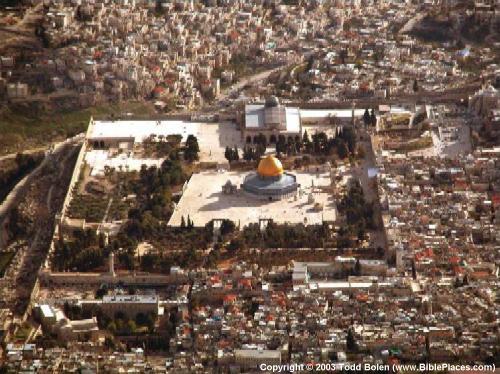
13Ariel view of the Temple Mount from the north showing the Dome of the Rock (golden dome, center) and the Al-Aqsa Mosque (gray-blue dome, above center) as of A.D. 2003. The Kidron Valley is to the left. Copyright © 2003 www.BiblePlaces.com. This image appears by special permission and may not be duplicated for use in derivative works.
14We have purposefully omitted Mohammed’s fabled night journey to Jerusalem, the Mi’raj (Surah 17:1) because we do not believe it to be factual.
15Jesus was crucified outside the gates of Jerusalem (Heb. 13:11-13) on Mount Moriah.
16Actually, all three are highly significant to all men everywhere, although most do not recognize it.
17Erich Sauer, The Dawn of World Redemption (Grand Rapids, MI: Eerdman’s Publishing Company. 1951, c1964), 102.
18Concerning the revelation of Jesus to be found in the OT: Ps. 40:7; Luke 18:31; 24:27, 44; John 5:39, 46; Acts 8:35; Acts 10:43; Heb. 10:7.
19Adapted from [Price, The Coming Last Days Temple, 57] which, in turn, is adapted from a chart by J. A. and Donald Parry in Temples of the Ancient World, p. 521.
20Ibid., 61.
21Ibid., 593-612.
22 [Floyd Nolen Jones, Chronology of the Old Testament (Woodlands, TX: KingsWord Press. 1999), 26], [James Ussher, The Annals of the World (Green Forest, AR: Master Books. 1658, c2003), 17]. See Jones for a list of 30 bible chronologers who date creation between 5426 and 3836 B.C.
23Martin Gilbert, The Illustrated Atlas of Jewish Civilization (New York, NY: Macmillan Publishing Company. 1990), 33.
24Andrew E Steinmann, From Abraham to Paul: A Biblical Chronology (St. Louis, MO: Concordia Publishing House. 2011), 342.
25See [Price, The Coming Last Days Temple, 195] for a more extensive treatment.
26[Torah scrolls are] written on parchment, sewn together, rolled onto wooden rollers called eytz chayeem (tree of life), and read regularly in the synagogue.—Israel My Glory, May/June 2001, 23.
27Ibid.
28Fruchtenbaum, The Footsteps of Messiah, 610.
29“Josephus states that the Tabernacle was brought into the First Temple [Antiquities, pp. 8. 101, 106], and that the effect of the spread-winged cherubim was to make it appear as a tent (8. 103).”—Randall Price, In Search of Temple Treasure (Eugene, OR: Harvest House Publishers. 1994), 193.
30The Jewish month of Av (also Ab) is the 5th month of the sacred year and 11th month of the civil year and falls in the months of July-August. [W. A. Criswell and Paige Patterson, eds., The Holy Bible: Baptist Study Edition (Nashville, TN: Thomas Nelson Publishers. 1991), 1314]
31Thomas Ice and Randall Price, Ready to Rebuild (Eugene, OR: Harvest House Publishers. 1992), 212-213.
32Flavius Josephus, The Complete Works of Josephus (Grand Rapids, MI: Kregel Publications. 1981), s.v. “Antiquities X, xi 7 - XI, i 3.”
33Price, The Coming Last Days Temple, 495.
34Gilbert, The Illustrated Atlas of Jewish Civilization, 32.
35Price, The Coming Last Days Temple, 526.
36Ibid., 75.
37“Dedication” translates the Aramaic word hanukkah.
38Chaim Potok, Wanderings (New York, NY: Ballantine Books. 1978), 248.
39Price, The Coming Last Days Temple, 76.
40Ice, Ready to Rebuild, 65.
41“But the nation had rejected Him; and as He leaves this temple, it is no longer named “my house” (Mat. 21:13) but ‘your house’ (Mat. 23:38). And by reason of His rejection and withdrawal, Israel’s house is left ‘desolate.’ ”—Alva J. McClain, The Greatness Of The Kingdom (Winona Lake, IN: BMH Books. 1959), 361.
42Potok, Wanderings, 285.
43Price, The Coming Last Days Temple, 82.
44For additional background on the transition associated with the Coming of the Spirit on the Day of Pentecost, see [Tony Garland, “Does Dispensationalism Teach Two Ways of Salvation?,” in The Conservative Theological Journal, vol. 7 no. 20 (Fort Worth, TX: Tyndale Theological Seminary. March 2003)].
45There is some disagreement regarding whether each individual believer comprises a Temple of God or whether only the collective body of believers is the Temple. Some note plural pronouns which occur in passages describing the Temple of the believer’s body (1Cor. 6:19; 2Cor. 6:16). Others explain this plural form as teaching concerning the individual, but delivered to the readers as a group.
46“In the rabbinic writings this is a very common term . . . the term . . . is a figure of speech describing a guest at a feast, reclining on the breast of his neighbor. Just as in the Gospel of John.”—Fruchtenbaum, The Footsteps of Messiah, 754.
47“It is said on separate occasions that the Spirit entered into Ezekiel (Eze. 2:2; Eze. 3:24). How could this be if Ezekiel was permanently indwelled [sic]?”—Mal Couch, ed., A Bible Handbook to the Acts of the Apostles (Grand Rapids, MI: Kregel Publications. 1999), 27.
48And in fact many Christians do conclude this even with Scriptural evidence to the contrary.
49“John Townsend stated in his Harvard dissertation on this point: ‘Since Paul sets the desecration of the Temple beside the ultimate blasphemy of proclaiming oneself to be God and since he regards these acts as the climax of the evil which is to precede the parousia [Christ’s second coming], there can be no doubt of Paul’s veneration for this Temple.’ ”—Price, The Coming Last Days Temple, 491. Even if we take this reference to the Temple as being the Second Temple like preterist interpreters do—although we disagree—it still demonstrates that Paul found significance in the Temple then standing after Pentecost.
50Baron, Zechariah: A Commentary On His Visions And Prophecies, 140.
51“His original name was probably Bar Koseva, and it is doubtful whether it was derived from a settlement in the Judean mountains or whether it indicates his father’s name or a general family name. The appellation Bar Kokhba was apparently given to him during the revolt on the basis of the homiletical interpretation, in a reference to messianic expectations, of the verse (Num. 24:17): ‘There shall step forth a star [כּוֹכָב [kôḵāḇ], kokhav] out of Jacob.’ Bar Kokhba was general midrashic designation for the ‘king messiah’ (see Messiah), and customarily used before the destruction of Jerusalem.”—Geoffrey Wigoder, ed., Encyclopedia Judaica CDROM Edition Version 1.0 (Keter Publishing House, Ltd. 1997), s.v. “BAR KOKHBA.”
52Price, The Coming Last Days Temple, 90-96.
53Ibid., 99-100.
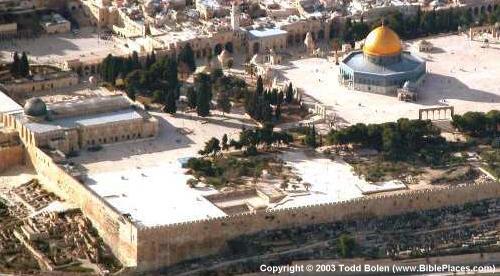
54Ariel view of the southern portion of the Temple Mount from the southeast showing the Dome of the Rock (golden dome, upper right) and the Al-Aqsa Mosque (gray-blue dome, center left) as of A.D. 2003. The edge of the Kidron Valley is in the immediate foreground. Copyright © 2003 www.BiblePlaces.com. This image appears by special permission and may not be duplicated for use in derivative works.
55“It is due to this uncompromising emphasis on God’s absolute unity that in Islam the greatest of all sins is the sin of shirk, or assigning partners to God.”—Norman L. Geisler and Abdul Saleeb, Answering Islam (Grand Rapids, MI: Baker Books. 1993), 18.
56“Kateregga writes. . .‘Islam teaches that the first phase of life on earth did not begin in sin and rebellion against Allah. Although Adam disobeyed Allah, he repented and was forgiven and even given guidance for mankind. Man is not born a sinner and the doctrine of the sinfulness of man has no basis in Islam.’. . . Faruqi, notes that ‘in the Islamic view, human beings are no more “fallen” than they are “saved.” Because they are not “fallen,” they have no need of a savior. But because they are not “saved” either, they need to do good works—and do them ethically—which alone will earn them the desired “salvation.” ’ ”—Ibid., 42-43.
57Both OT and NT were written hundreds of years prior to the Qur’an: an incontrovertible fact. For example, the Dead Sea Scrolls, dated prior to the birth of Christ, contain the detailed prediction of His death (Isaiah 53). Neither Judaism nor Islam can adequately deal with this reality for both deny the substitutionary atonement of the death of Messiah.
58Imad N. Shehadeh, “Do Muslims and Christians Believe in the Same God?,” in Bibliotheca Sacra, vol. 161 no. 641 (Dallas, TX: Dallas Theological Seminary. January-March 2004), 22-23, 26.
59Ice, Ready to Rebuild, 163-164.
60“He said: ‘I will go to my Lord! He will surely guide me! O my Lord! grant me a righteous (son)!’ So We gave him the good news of a boy ready to suffer and forbear. Then, when (the son) reached (the age of serious) work with him, He said: ‘O my son! I see in vision that I offer thee in sacrifice: now see what is thy view!’ (The son) said: ‘O my father! Do as thou art commanded: thou wilt find me, if Allah so wills one practising patience and constancy!’ So when they had both submitted their wills (to Allah), and he had laid him prostrate on his forehead (for sacrifice), We called out to him, ‘O Abraham! Thou hast already fulfilled the vision!’—thus indeed do we reward those who do right. For this was obviously a trial—and we ransomed him with a momentous sacrifice: and we left (this blessing) for him among generations (to come) in later times: ‘Peace and salutation to Abraham!’ Thus indeed do We reward those who do right for he was one of Our believing servants. And we gave him the good news of Isaac—a prophet—one of the righteous. We blessed him and Isaac: but of their progeny are (some) that do right and (some) that obviously do wrong, to their own souls. (Surah 37:99-113)” [emphasis added]—Abdullah Yusuf Ali, The Meaning of the Holy Qur’an (Beltsville, MD: Amana Publications. 2001), Surah 37:99-113.
61Price, The Coming Last Days Temple, 170.
62Ibid., 180.
63“The Farthest Mosque must refer to the site of the Temple of Solomon in Jerusalem on the hill of Moriah, at or near which stands the Dome of the Rock. This and the Mosque known as the Farthest Mosque (al Masjid al Aqsa) were completed by the Amir ’Abd al Malik in A.H. 68. Farthest, because it was the place of worship farthest west which was known to the Arabs in the time of the Holy Prophets: it was a sacred place to both Jews and Christians, but the Christians then had the upper hand, as it was included in the Byzantine (Roman) Empire, which maintained a Patriarch at Jerusalem.”—Ali, The Meaning of the Holy Qur’an, 673n2168.
64Ibid., Surah 17:1.
65Price, The Coming Last Days Temple, 173-174.
66 “June 7, 1967 - Israel, during the Six-Day War, liberates Temple Mount; hopes of rebuilding Temple revive, and Rabbi Goren suggests blowing up mosques on the Temple Mount, but later Defense Minister Moshe Dayan orders Israeli flag removed from atop the Dome of the Rock. . . . June 17, 1967 - Moshe Dayan meets with leaders of Supreme Muslim Council in Al-Aqsa Mosque and returns Temple Mount, especially site of the Temple, to sovereign control of the Muslim Wakf as a gesture of peace; agrees that Jews can have access to Mount, but cannot conduct prayers or religious activities.”—Ibid., 602, 603.
67Ibid., 104-105.
68“ ‘This site is one of the oldest in the world. Its sanctity dates from the earliest times. Its identity with the site of Solomon’s Temple is beyond dispute.’—Guidebook issued by the Supreme Muslim Council of Jerusalem in 1930”—Randall Price, Unholy War (Eugene, OR: Harvest House Publishers. 2001), 259.
69Yet even the Qur’an indicates that the Promised Land was given to Moses and the Jews: “Remember Moses said to his people: ‘O my People! Call in remembrance the favour Of Allah unto you, when He produced prophets among you, made you kings, and gave You what He had not given to any other among the peoples. O my people! enter the holy land which Allah hath assigned unto you, and turn not back ignominiously, for then will ye be overthrown, to your own ruin.’ (Surah 5:20-21)”—Ali, The Meaning of the Holy Qur’an, Surah 5:20-21.
70TEMPLE MOUNT CLOSED EARLY; WHAT DOES JEWISH LAW SAY?, Arutz Sheva News Service, Monday, August 25, 2003 / Av 27, 5763. [www.IsraelNationalNews.com].
71YESHA RABBIS: A ‘MITZVAH’ TO VISIT TEMPLE MOUNT, Arutz Sheva News Service, Friday, September 5, 2003. [www.IsraelNationalNews.com].
72Ergun Mehmet Caner and Emir Fethi Caner, Unveiling Islam (Grand Rapids, MI: Kregel Publications. 2002).
73Geisler, Answering Islam.
74Price, Unholy War.
75We have only included passages which are definite references to the Tribulation Temple. Other passages may be related to the Tribulation Temple, but such reference is less certain (e.g., Rev. 13:6‣, 14‣). Some see a passage in Isaiah as denoting an unaccepted Temple at the time of the end: “Isaiah [Isa. 66:1-6] speaks of a house or temple being built for God which He does not sanction. It cannot refer to Solomon’s Temple or the Temple built by Zerubbabel, because God did sanction both of them. Nor can it refer to the Millennial Temple. That one will be built by Messiah, and God will certainly sanction it. Therefore, the only temple that this could refer to is the Tribulation Temple. . . . What God wants Israel to do at this time is to return to Him in faith, not merely to build Him a house.”—Fruchtenbaum, The Footsteps of Messiah, 138. Although this may be possible, the passage may simply denote God’s dislike of insincere worship offered within the existing temple.
76The city of Babylon in Revelation 18‣ is taken to be Jerusalem. God’s defense of the city of Jerusalem recorded in Zechariah 12, 14 is taken to describe its destruction by Rome. For an excellent summary comparison of the destruction of Jerusalem in A.D. 70 with Zechariah, see [Thomas Ice, “The Olivet Discourse,” in Tim LaHaye and Thomas Ice, eds., The End Times Controversy (Eugene, OR: Harvest House Publishers. 2003), 182].
77Thomas Ice, “Has Bible Prophecy Already Been Fulfilled?,” in The Conservative Theological Journal, vol. 4 no. 13 (Fort Worth, TX: Tyndale Theological Seminary. December 2000), 309.
78Thomas Ice and Timothy J. Demy, When the Trumpet Sounds (Eugene, OR: Harvest House Publishers. 1995), 113.
79Alexander Roberts, James Donaldson, and A. Cleveland Coxe, eds., Ante-Nicene Fathers Vol. I (Buffalo, NY: Christian Literature Company. 1885), s.v. “ECF 1.1.7.1.5.31.”
80Price, The Coming Last Days Temple, 501.
81Paul Lee Tan, The Interpretation of Prophecy (Dallas, TX: Bible Communications, Inc. 1993), 318-319.
82Fruchtenbaum, The Footsteps of Messiah, 461.
83 New Electronic Translation : NET Bible, electronic edition (Dallas, TX: Biblical Studies Press. 1998), Zec. 6:12 n10.
84Ice, Ready to Rebuild, 173.
85Charles H. Ray, “A Study of Daniel 9:24-17, Part II,” in The Conservative Theological Journal, vol. 5 no. 16 (Fort Worth, TX: Tyndale Theological Seminary. December 2001), 309.
86Price, The Coming Last Days Temple, 249.
87Walter Scott, Exposition of The Revelation (London, England: Pickering & Inglis. n.d.), 219.
88“It must not be forgotten that Ezekiel is not alone in this affirmation of a revival of a temple ritual in the coming Kingdom. As Reeve says, ‘The great prophets all speak of a sacrificial system in full vogue in the Messianic Age.’ [J. J. Reeve, ‘Sacrifice,’ I.S.B.E., op cit., Vol. IV, p. 2651.].”—McClain, The Greatness Of The Kingdom, 251.
89Jerry M. Hullinger, “The Problem of Animal sacrifices in Ezekiel 40-48,” in Bibliotheca Sacra, vol. 152 no. 607 (Dallas, TX: Dallas Theological Seminary. July-Sep 1995), 279.
90McClain, The Greatness Of The Kingdom, 250.
91John L. Mitchell, “The Problem of Millennial Sacrifices, Part 2,” in Bibliotheca Sacra, vol. 110 no. 440 (Dallas, TX: Dallas Theological Seminary. Oct-Dec 1953), 360.
92Hullinger, The Problem of Animal sacrifices in Ezekiel 40-48, 280.
93Ibid., 285.
94Ibid., 281.
95Ibid., 288.
96Indeed, this is precisely the situation of the Roman Catholic who may have a mortal sin laid to his account which has the potential to send him to hell in the next moment if he should die before confession and absolution.
97The population who entered the kingdom in their natural unresurrected bodies and who will eventually die.
98A. R. Fausset, “The Revelation of St. John the Divine,” in Robert Jamieson, A. R. Fausset, and David Brown, A Commentary, Critical and Explanatory, on the Old and New Testaments (Oak Harbor, WA: Logos Research Systems, Inc. 1997, 1877), Rev. 3:12.